

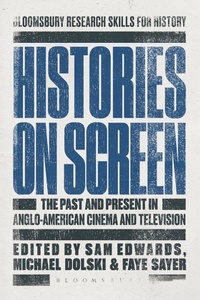
Histories on Screen
The Past and Present in Anglo-American Cinema and Television
1st Edition
Published on 8. February 2018
352 pages
978-1-4742-1705-7 (ISBN)
Description

How, as historians, should we 'read' a film? Histories on Screen answers this and other questions in a crucial volume for any history student keen to master source use.
The book begins with a theoretical 'Thinking about Film' section that explores the ways in which films can be analyzed and interrogated as either primary sources, secondary sources or indeed as both. The much larger 'Using Film' segment of the book then offers engaging case studies which put this theory into practice. Topics including gender, class, race, war, propaganda, national identity and memory all receive good coverage in what is an eclectic multi-contributor volume. Documentaries, films and television from Britain and the United States are examined and there is a jargon-free emphasis on the skills and methods needed to analyze films in historical study featuring prominently throughout the text.
Histories on Screen is a vital resource for all history students as it enables them to understand film as a source and empowers them with the analytical tools needed to use that knowledge in their own work.
The book begins with a theoretical 'Thinking about Film' section that explores the ways in which films can be analyzed and interrogated as either primary sources, secondary sources or indeed as both. The much larger 'Using Film' segment of the book then offers engaging case studies which put this theory into practice. Topics including gender, class, race, war, propaganda, national identity and memory all receive good coverage in what is an eclectic multi-contributor volume. Documentaries, films and television from Britain and the United States are examined and there is a jargon-free emphasis on the skills and methods needed to analyze films in historical study featuring prominently throughout the text.
Histories on Screen is a vital resource for all history students as it enables them to understand film as a source and empowers them with the analytical tools needed to use that knowledge in their own work.
More details
Series
Edition
1. Auflage
Language
English
Place of publication
London
United Kingdom
Publishing group
Bloomsbury Publishing PLC
Target group
Professional and scholarly
Illustrations
25 bw illus
ISBN-13
978-1-4742-1705-7 (9781474217057)
Copyright in bibliographic data and cover images is held by Nielsen Book Services Limited or by the publishers or by their respective licensors: all rights reserved.
Schweitzer Classification
Other editions
Additional editions
Sam Edwards | Faye Sayer | Michael Dolski
Histories on Screen
The Past and Present in Anglo-American Cinema and Television
Book
02/2018
Bloomsbury Academic
€37.50
Shipment within 15-20 days
Persons
Sam Edwards is Senior Lecturer in American History at Manchester Metropolitan University, UK. He has published widely on the cultural history of twentieth century conflict. He is the author of Allies in Memory: World War II and the Politics of Transatlantic Commemoration, c.1941-2001 (2015), which was shortlisted for the Royal Historical Society's Gladstone Prize.
Michael Dolski is a historian with the Joint Prisoner of War-Missing in Action Accounting Command's Central Identification Laboratory in the USA. Together with Sam Edwards and John Buckley, he is editor of D-Day in History and Memory: The Normandy Landings in International Remembrance and Commemoration (2014), and he is the author of D-Day Remembered: The Normandy Landings in American Collective Memory (2016).
Faye Sayer is Senior Lecturer in Public History and Community Archaeology at Manchester Metropolitan University, UK. She has published extensively on the value of public history and community archaeology, and she is the author of Public History: A Practical Guide (Bloomsbury Academic, 2015).
Michael Dolski is a historian with the Joint Prisoner of War-Missing in Action Accounting Command's Central Identification Laboratory in the USA. Together with Sam Edwards and John Buckley, he is editor of D-Day in History and Memory: The Normandy Landings in International Remembrance and Commemoration (2014), and he is the author of D-Day Remembered: The Normandy Landings in American Collective Memory (2016).
Faye Sayer is Senior Lecturer in Public History and Community Archaeology at Manchester Metropolitan University, UK. She has published extensively on the value of public history and community archaeology, and she is the author of Public History: A Practical Guide (Bloomsbury Academic, 2015).
Content
List of Illustrations
List of Contributors
Acknowledgements
Introduction
Part I: Thinking about Film and Television
1. The Moving Image as Primary Source: Author, Text and Context, Michael Dolski (Defense POW/MIA Accounting Command, USA)
2. The Moving Image as a Secondary Source: Truth, Authenticity and Narrative, Faye Sayer (Manchester Metropolitan University, UK)
3. The Moving Image as Memory: Past and Present on Screen, Sam Edwards (Manchester Metropolitan University, UK)
Part II: Using Film and Television: Case Studies
The Lens of History: Race, Class and Gender on Screen
4. CASE STUDY: 'The Way We Are': Class and Britishness on Film, Marcus Morris (Manchester Metropolitan University, UK)
5. CASE STUDY: Were Fires Started? Exploring Gender in British Cinema of the Second World War, Corinna Penniston-Bird (Lancaster University, UK)
6. CASE STUDY: Screening Multicultural Britain: Blair, Britishness and Bend it Like Beckham, Sarah Ilot (Teeside University, UK)
7. CASE STUDY: Mammy, Mandingo, Django and Solomon: A Century of American Slavery in Cinema from Uncle Tom's Cabin to Twelve Years a Slave, Lydia Plath (Canterbury Christ Church University, UK)
Reel Life and Real Life: Documenting and Narrating the Past
8. CASE STUDY: The Empire at the Movies: India in Newsreels, c. 1911 to 1947, Tilman Frasch (Manchester Metropolitan University, UK)
9. CASE STUDY: 'Truth' and 'Interiority': Screening and Interpreting the Early Modern Era, Jonathan Spangler (Manchester Metropolitan University, UK)
10. CASE STUDY: Hollywood Musicals Make History, Nicholas Gebhardt (Birmingham City University, UK)
11. CASE STUDY: 'Moving' Images: Educational Uses of D-Day Imagery, Michael Dolski (Defense POW/MIA Accounting Command, USA)
Part III: Making Memory and Identity: The Politics and Purpose of Film and TV
12. CASE STUDY: Superhero Films and American National Identity, Michael Goodrum (University of Essex, UK)
13. CASE STUDY: 'We Will Remember Them?': Film, Television and the First World War in British Memor, Sam Edwards (Manchester Metropolitan University, UK)
14. CASE STUDY: Presenting the Past: New Directions in Television History, Nicola Bishop (Manchester Metropolitan University, UK)
Filmography
Bibliography
Index
List of Contributors
Acknowledgements
Introduction
Part I: Thinking about Film and Television
1. The Moving Image as Primary Source: Author, Text and Context, Michael Dolski (Defense POW/MIA Accounting Command, USA)
2. The Moving Image as a Secondary Source: Truth, Authenticity and Narrative, Faye Sayer (Manchester Metropolitan University, UK)
3. The Moving Image as Memory: Past and Present on Screen, Sam Edwards (Manchester Metropolitan University, UK)
Part II: Using Film and Television: Case Studies
The Lens of History: Race, Class and Gender on Screen
4. CASE STUDY: 'The Way We Are': Class and Britishness on Film, Marcus Morris (Manchester Metropolitan University, UK)
5. CASE STUDY: Were Fires Started? Exploring Gender in British Cinema of the Second World War, Corinna Penniston-Bird (Lancaster University, UK)
6. CASE STUDY: Screening Multicultural Britain: Blair, Britishness and Bend it Like Beckham, Sarah Ilot (Teeside University, UK)
7. CASE STUDY: Mammy, Mandingo, Django and Solomon: A Century of American Slavery in Cinema from Uncle Tom's Cabin to Twelve Years a Slave, Lydia Plath (Canterbury Christ Church University, UK)
Reel Life and Real Life: Documenting and Narrating the Past
8. CASE STUDY: The Empire at the Movies: India in Newsreels, c. 1911 to 1947, Tilman Frasch (Manchester Metropolitan University, UK)
9. CASE STUDY: 'Truth' and 'Interiority': Screening and Interpreting the Early Modern Era, Jonathan Spangler (Manchester Metropolitan University, UK)
10. CASE STUDY: Hollywood Musicals Make History, Nicholas Gebhardt (Birmingham City University, UK)
11. CASE STUDY: 'Moving' Images: Educational Uses of D-Day Imagery, Michael Dolski (Defense POW/MIA Accounting Command, USA)
Part III: Making Memory and Identity: The Politics and Purpose of Film and TV
12. CASE STUDY: Superhero Films and American National Identity, Michael Goodrum (University of Essex, UK)
13. CASE STUDY: 'We Will Remember Them?': Film, Television and the First World War in British Memor, Sam Edwards (Manchester Metropolitan University, UK)
14. CASE STUDY: Presenting the Past: New Directions in Television History, Nicola Bishop (Manchester Metropolitan University, UK)
Filmography
Bibliography
Index
