

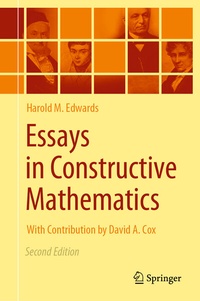
Essays in Constructive Mathematics
Description

This collection of essays aims to promote constructive mathematics, not by defining it or formalizing it, but by practicing it. All definitions and proofs are based on finite algorithms, which pave illuminating paths to nontrivial results, primarily in algebra, number theory, and the theory of algebraic curves. The second edition adds a new set of essays that reflect and expand upon the first.
The topics covered derive from classic works of nineteenth-century mathematics, among them Galois's theory of algebraic equations, Gauss's theory of binary quadratic forms, and Abel's theorems about integrals of rational differentials on algebraic curves. Other topics include Newton's diagram, the fundamental theorem of algebra, factorization of polynomials over constructive fields, and the spectral theorem for symmetric matrices, all treated using constructive methods in the spirit of Kronecker.
In this second edition, the essays of the first edition are augmented with newessays that give deeper and more complete accounts of Galois's theory, points on an algebraic curve, and Abel's theorem. Readers will experience the full power of Galois's approach to solvability by radicals, learn how to construct points on an algebraic curve using Newton's diagram, and appreciate the amazing ideas introduced by Abel in his 1826 Paris memoir on transcendental functions.Mathematical maturity is required of the reader, and some prior knowledge of Galois theory is helpful. But experience with constructive mathematics is not necessary; readers should simply be willing to set aside abstract notions of infinity and explore deep mathematics via explicit constructions.
Reviews / Votes
"A book of this kind with significantly worked-out algorithmic calculations, including many examples, is a rare valuable product." (Wim Ruitenburg, Mathematical Reviews, April, 2024)
"This is the second edition of Harold Edwards' Essays in Constructive Mathematics ... . The essays contained in this volume are serious works of mathematics done from a constructivist perspective. ... I think that most mathematicians already familiar with these topics will find Edwards' constructivist approach to the topics covered to be fascinating." (Benjamin Linowitz, MAA Reviews, December 31, 2023)
More details
Other editions
Additional editions
Persons
Harold M. Edwards [1936-2020] was Professor Emeritus of Mathematics at New York University. His research interests lay in number theory, algebra, and the history and philosophy of mathematics. He authored numerous books, including Riemann's Zeta Function (1974, 2001) and Fermat's Last Theorem (1977), for which he received the Leroy P. Steele Prize for mathematical exposition in 1980.
David A. Cox (Contributing Author) is Professor Emeritus of Mathematics in the Department of Mathematics and Statistics of Amherst College. He received the Leroy P. Steele Prize for mathematical exposition in 2016 for his book Ideals, Varieties, and Algorithms , with John Little and Donal O'Shea.
