

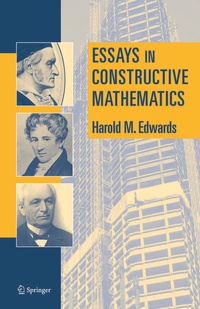
Essays in Constructive Mathematics
Description

Reviews / Votes
From the reviews:
"Harold Edwards is well known for his books with a constructivist slant, and his latest book aims to spread his message further. . The major part of the book consists of essays . telling a connected story, showing what can be achieved with such a constructive restriction imposed. The achievement is impressive . . " (John Baylis, The Mathematical Gazette, Vol. 90 (5l9), 2006)
"It is not a book about the history/philosophy of mathematics but rather a very serious book of mathematics. . the mathematics is accessible to those with advanced undergraduate or graduate level courses in algebra . . Without a doubt the mathematics in this book is rigorous . . One of the nice features of this book is the bibliography which notes the sections where each reference appears. It should appeal to mathematicians and historians of mathematics alike." (Bonnie Shulman, MathDL, January, 2005)
"The author of this volume points out immediately that it is not about the history or philosophy of mathematics, but rather a book about mathematics. It soon becomes clear, though, that historical and philosophical issues strongly influenced the topics discussed. . The general point of view is that all definitions, theorems, constructs, and proofs should involve only algorithms that terminate in a finite number of steps. . The book contains a wealth of interesting mathematics well worth reading." (Larry C. Grove, SIAM Review, Vol. 47 (4), 2005)
"The book under review presents several important topics in mathematics from a constructivist point of view. . This book is a delight to read. . Moreover, the required background is kept to a minimum, so the book can be read by anyone with a good understanding of basic algebra. . The style of the book itself is sufficient reason for reading it. . One would wish that more mathematicians read the masters in search of inspiration, instead of merely following the most recent fads." (S.C. Coutinho, SIGACT News, Vol. 41 (2), 2010)More details
Other editions
Additional editions
Person
Harold M. Edwards is Emeritus Professor of Mathematics at New York University. His previous books are Advanced Calculus (1969, 1980, 1993), Riemann's Zeta Function (1974, 2001), Fermat's Last Theorem (1977), Galois Theory (1984), Divisor Theory (1990) and Linear Algebra (1995). Readers of his Advanced Calculus will know that his preference for constructive mathematics is not new. In 1980 he was awarded the Steele Prize for mathematical exposition for the Riemann and Fermat books.
