

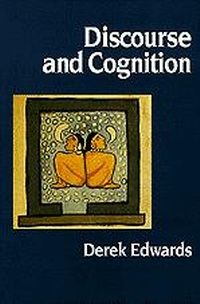
Discourse and Cognition
1st Edition
Published on 13. December 1996
368 pages
978-0-85702-290-5 (ISBN)
Description

`For those already familiar with discursive work it will be a joy - Edwards writes with enormous clarity and insight. For psychologists whose work involves an understanding of the relations between language and cognition this book will be essential reading.... This is a demanding book that will repay close attention. It can also be dipped into as a resource for the brilliant reworkings of traditional psychological topic areas, such as emotion, language, cognition, categories, AI, narrative, scripts and developmental psychology. If you want a glimpse into the future of psychology, get this book - the end of cognitivism starts here' - History and Philosophy of Psychology
The central project of this multidisciplinary volume is a wholesale reappraisal of psychological concepts of human action, mental states, language and social interactions. Derek Edwards reviews a wide range of thought and research to demonstrate how the dominant cognitive approach to psychology has failed. He makes a compelling case for language to be best understood as a kind of activity, as discourse.
The argument draws upon ethnomethodology, conversation analysis, linguistic philosophy and social studies of science. These influences underpin a fascinating intellectual survey ranging across cognitivism, discursive psychology, shared knowledge, categories and metaphor, emotion and narrative. The emphasis throughout is on the value of close empirical study of text and talk, through which the topics of mind, world and `who we are' are seen as `ways of talking'.
The central project of this multidisciplinary volume is a wholesale reappraisal of psychological concepts of human action, mental states, language and social interactions. Derek Edwards reviews a wide range of thought and research to demonstrate how the dominant cognitive approach to psychology has failed. He makes a compelling case for language to be best understood as a kind of activity, as discourse.
The argument draws upon ethnomethodology, conversation analysis, linguistic philosophy and social studies of science. These influences underpin a fascinating intellectual survey ranging across cognitivism, discursive psychology, shared knowledge, categories and metaphor, emotion and narrative. The emphasis throughout is on the value of close empirical study of text and talk, through which the topics of mind, world and `who we are' are seen as `ways of talking'.
Reviews / Votes
`For those already familiar with discursive work it will be a joy - Edwards writes with enormous clarity and insight. For psychologists whose work involves an understanding of the relations between language and cognition this book will be essential reading.... This is a demanding book that will repay close attention. It can also be dipped into as a resource for the brilliant reworkings of traditional psychological topic areas, such as emotion, language, cognition, categories, AI, narrative, scripts and developmental psychology. If you want a glimpse into the future of psychology, get this book - the end of cognitivism starts here' - History and Philosophy of Psychology`This volume has the rare potential to capture the interest of theoretical psychologists, researchers, practitioners, and students alike. Those with passing interest will be captivated by intrguing argument, and experts will be drawn into a rigorous debate around previously commonly held understandings. At issue are relationships between reality, cognition, and language.... Edwards combines scholarship, expertise, and originality, with a tangible enthusiasm for his topic.... a valuable addition to the library of readers committed to exploring new ideas and investigating alternative research and practice approaches.... The value of this volume rests in the writer's ability to respect the traditional and the contemporary while simultaneously demonstrating the greater contribution that may be made by both in the light of suggested new understandings about discourse and cognition. Minimally, the invitation is a tantalizing one; maximally, Edward's discursive psychology may prove an exciting idea that is worth embracing' - Contemporary Psychology
` This is a fascinating book which courses effortlessly along the boundaries of what were once condsidered to be distinct academic disciplines, but which, at least since the issue of "blurred genres" was raised by Geertz (1983), have become the most fertile of zones.... In summary, much that is in this book (as well as Potter's equally impressive Representing Reality...) alerts me to the ambitious scale of the discursive endeavour: with their work the "discursive turn" has found its most ardent spokesmen. And as with writers like Geertz and Clifford in cultural anthropology, their work is so reflexively constructed as to be lit by its own candle, that is, this is scholarship that makes everything seem interesting, including (perhaps especially) the light with which we regard it' - Journal of Sociolinguistics
More details
Language
English
Place of publication
London
United Kingdom
Target group
College/higher education
Professional and scholarly
ISBN-13
978-0-85702-290-5 (9780857022905)
Copyright in bibliographic data and cover images is held by Nielsen Book Services Limited or by the publishers or by their respective licensors: all rights reserved.
Schweitzer Classification
Other editions
Additional editions
Derek Edwards
Discourse and Cognition
Book
12/1996
1st Edition
SAGE Publications Inc
€243.90
Shipment within 15-20 days
Derek Edwards
Discourse and Cognition
Book
12/1996
1st Edition
SAGE Publications Inc
€127.90
Shipment within 15-20 days
Person
Derek Edwards is Reader in Discursive Psychology in the Department of Social Sciences, Loughborough University. He is co-author (with Neil Mercer) of Common Knowledge, (with Jonathan Potter) of Discursive Psychology and (with others) of Ideological Dilemmas.
Content
An Informal Introduction
Cognitivism and Cognition
Discourse and Reality
Talk as Action
Shared Knowledge
Scripts and Dispositions
Emotion
Categories I
Language and Perception
Categories II
Bodily Experience and Folk Psychology
Narrative
Stories and Rememberings
Membership
Children, Animals and Machines
Cognitivism and Cognition
Discourse and Reality
Talk as Action
Shared Knowledge
Scripts and Dispositions
Emotion
Categories I
Language and Perception
Categories II
Bodily Experience and Folk Psychology
Narrative
Stories and Rememberings
Membership
Children, Animals and Machines
