


Disability and the Making of Place
Will be published approx. on 14. September 2026
282 pages
E-Book
978-1-040-68386-6 (ISBN)
Description

This edited collection advances critical scholarship about the complex interrelationships between disability and place. Developing theorising around place-making as a relational, everyday practice, it draws on disabled people's lived experiences to explore the myriad ways in which they encounter, negotiate, and (re)make place.
Offering novel insights drawn from research in eight countries, and refracted through diverse experiences of impairment, disability and embodiment, the text draws attention to everyday place-making as a series of performances, feelings, narratives and tactics through which disabled people navigate, occupy and proactively take place. Using a diverse array of methodological approaches, chapters shed light on the embodied experiences and meanings of disability as they are worked out in place. At its heart, this collection argues for a fundamental rethinking of place to foster a radical openness to difference, where disabled people can build meaningful lives, valued social identities and a sense of belonging.
Disability and the Making of Place will be of interest to scholars and students within disability studies, human geography, sociology, urban studies, and the social sciences more broadly.
Offering novel insights drawn from research in eight countries, and refracted through diverse experiences of impairment, disability and embodiment, the text draws attention to everyday place-making as a series of performances, feelings, narratives and tactics through which disabled people navigate, occupy and proactively take place. Using a diverse array of methodological approaches, chapters shed light on the embodied experiences and meanings of disability as they are worked out in place. At its heart, this collection argues for a fundamental rethinking of place to foster a radical openness to difference, where disabled people can build meaningful lives, valued social identities and a sense of belonging.
Disability and the Making of Place will be of interest to scholars and students within disability studies, human geography, sociology, urban studies, and the social sciences more broadly.
Reviews / Votes
"This timely book calls for a greater engagement with place in disability scholarship. Within its pages, international authors navigate fragmented and unequal landscapes, shaped by ableism and austerity, crucially, to advocate for disability justice in, with and about place."Katherine Runswick-Cole, University of Sheffield, UK
"A major, critically important, timely and original intervention, foregrounding the political power of geography to disability studies and the experience of disability. This has never been more critical as disabled people continue to be at the sharp end of a range of geographical-political processes, from climate change to government disinvestment, with the rise of AI and far right politics as emerging contexts. Essential reading for geographers and disability researchers alike."
Louise Holt, Professor of Human Geography, Loughborough University, UK
More details
Series
Language
English
Place of publication
London
United Kingdom
Publishing group
Taylor & Francis Ltd
Target group
College/higher education
Product notice
Reflowable
Illustrations
27 Halftones, black and white; 27 Illustrations, black and white
ISBN-13
978-1-040-68386-6 (9781040683866)
Copyright in bibliographic data is held by Nielsen Book Services Limited or its licensors: all rights reserved.
Schweitzer Classification
Other editions
Additional editions
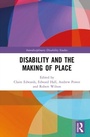
Claire Edwards | Edward Hall | Andrew Power
Disability and the Making of Place
Book
approx. 09/2026
1st Edition
Routledge
€191.50
Not yet published
Persons
Claire Edwards is a Senior Lecturer in the School of Applied Social Studies at University College Cork in Ireland. Her research is concerned with exploring the everyday dynamics of socio-spatial disablism in disabled people's lives, and with challenging 'taken-for-granted' assumptions about disability which underpin law and social policy.
Edward Hall is a Reader in Human Geography in the Faculty of Arts and Social Sciences at the University of Dundee, Scotland. His research is concerned with the social geographies of people with learning disabilities, with particular attention to social inclusion and belonging, the changing landscape of social care and support, and experiences of hate crime.
Andrew Power is Professor of Human Geography at the University of Southampton in the UK. His research interests concern social care and disability, with a particular focus on the forms of support for disabled people, across the community and in care settings. He also has an allied interest in the relational geographies of the voluntary sector and family care.
Robert Wilton is a Professor in the School of Earth, Environment & Society at McMaster University in Hamilton in Canada. His research is broadly concerned with disabled people's experiences of, and struggles over, social inclusion/exclusion. He has focused particular attention on access to paid work in both 'mainstream' and social economies.
Edward Hall is a Reader in Human Geography in the Faculty of Arts and Social Sciences at the University of Dundee, Scotland. His research is concerned with the social geographies of people with learning disabilities, with particular attention to social inclusion and belonging, the changing landscape of social care and support, and experiences of hate crime.
Andrew Power is Professor of Human Geography at the University of Southampton in the UK. His research interests concern social care and disability, with a particular focus on the forms of support for disabled people, across the community and in care settings. He also has an allied interest in the relational geographies of the voluntary sector and family care.
Robert Wilton is a Professor in the School of Earth, Environment & Society at McMaster University in Hamilton in Canada. His research is broadly concerned with disabled people's experiences of, and struggles over, social inclusion/exclusion. He has focused particular attention on access to paid work in both 'mainstream' and social economies.
Content
1.Introduction: disability and the making of place 2.Belonging, inclusion and resistance: people with intellectual disabilities' experiences in public libraries 3.Building everyday learning places in an online world: young disabled people's embodied negotiation of vocational learning and training 4.The assemblage of the accessible parking space and psycho-emotional disablism 5.Making space in an ableist world: disability geographies in post-apartheid South Africa 6.Close enough for comfort: socio-material (dis)comforts of young people with an ostomy in everyday space 7.Building lives together: the collective hustle of disabled people within the personalisation of care and support 8.In their own voices: disability, space, and power dynamics in Ghana 9.Placing disability in times of climate and ecological breakdown 10.The gentle art of making autistic islands 11.Giving disability a place in the home: visual impairment, guide dogs, and multi-species transitions 12.'You're not a man; you're a man on a scooter': negotiating chronic illness and masculinity in place 13.Afterword: futurity and the spatialities of disability
