

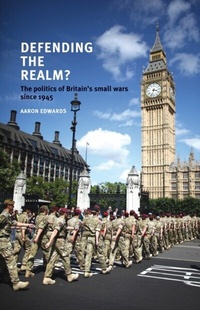
Defending the Realm?
The Politics of Britain's Small Wars Since 1945
1st Edition
Published on 28. February 2018
336 pages
978-1-5261-2995-6 (ISBN)
Description

Britain is often revered for its extensive experience of waging 'small wars'. Its long imperial history is littered with high profile counter-insurgency campaigns, thus marking it out as the world's most seasoned practitioner of this type of warfare. This is the first book to detail the tactical and operational dynamics of Britain's small wars, arguing that the military's use of force was more heavily constrained by wider strategic and political considerations than previously admitted. Outlining the civil-military strategy followed by the British in Palestine, Malaya, Kenya, Cyprus, Aden, Northern Ireland, Iraq and Afghanistan, Defending the realm? argues that Britain's small wars since 1945 were fought against the backdrop of an irrevocable decline in British power. Written from a theoretically-informed perspective, grounded in rich archival sources, oral testimonies and a revisionist reading of the literature on counter-insurgency and counter-terrorism, this is the definitive account of the politics of Britain's small wars. -- .
Reviews / Votes
Counterinsurgency campaigns are too often analysed in the context of competing tactical approaches. Aaron Edwards focuses on the strategy and civil-military relations of post-World War II British counterinsurgency, making Defending the realm? an important and timely contribution to current debates on the challenges and costs of counterinsurgency.Douglas Porch, Distinguished Professor of National Security Affairs at the Naval Postgraduate School, Monterey, California
A tour de force of modern British counterinsurgency, spanning over eight major campaigns since 1945 - Dr Aaron Edwards deserves congratulation for such meticulous research into each of these politically unique episodes. He has drawn on much material previously unpublished in his analysis of Britain's imperial decline and his focus on the political dimension rather than the military actualities of each campaign is refreshing. In all, Dr Edwards has provided an invaluable account of the differences between each and every British counterinsurgency campaign since 1945, explaining why they differed rather than attempting to develop yet another paradigm in counterinsurgency.
Col. David Benest, Former CO, 2 Para and former counter-insurgency advisor to the British Ambassador in Afghanistan
Aaron Edwards subjects Britain's experience of warfare against irregular enemies in 'small wars' since 1945 to the thorough strategic examination that it needs. While Defending the realm? tells the stories of eight 'small wars' in convincing detail, it does so very much with appropriate help from the guiding light provided by a firm grasp of the theory of strategy. Edwards' work is outstanding in its achievement of a successful marriage between history and strategic studies. He uses Clausewitz pervasively, though not intrusively or slavishly, as he insists on analysing the British strategic experience in its full political context. This is an exceptional book that must register as a major contribution to our understanding.
Professor Colin S. Gray, Department of Politics and International Relations, University of Reading
Edwards provides an invaluable account of the differences between each British counter-insurgency campaign since 1945, explaining why they differed rather than attempting to develop yet another paradigm of counter-insurgency.
A concise, readable text that should be of interest to students and scholars of British foreign policy, international relations, and security studies.
Edwards offers rich historical descriptions of important case-studies.
"In each of these case studies Edwards draws on a strong variety of appropriate sources. A selection of documents from different archives, autobiographies, newspapers, secondary literature and, in some cases, interviews have been used to good effect in these different studies. As Edwards explains, this volume covers a lot of historical material but does not aim to provide in-depth analysis of each study, although it does point the reader to other useful works. This approach is perhaps best demonstrated with the chapter on the British in Aden. This well-written and highly developed section is a promising insight into Edwards' future work on this topic."
(Philip R. Gannon, Political Studies Review Volume 12, Issue 3, September 2014) -- .
All prices
More details
Language
English
Place of publication
Manchester
United Kingdom
Target group
College/higher education
ISBN-13
978-1-5261-2995-6 (9781526129956)
Copyright in bibliographic data and cover images is held by Nielsen Book Services Limited or by the publishers or by their respective licensors: all rights reserved.
Schweitzer Classification
Other editions
Additional editions
Book
12/2014
Manchester University Press
€33.70
Shipment within 15-20 days
Book
12/2012
Manchester University Press
€131.50
Shipment within 15-20 days
Person
Aaron Edwards is Senior Lecturer in Defence and International Affairs at the Royal Military Academy, Sandhurst -- .
Content
Abbreviations
Preface and Acknowledgements
Introduction
Drawing Lines in the Sand: Withdrawal from Palestine
Winning 'Hearts and Minds': From Imperialism to Independence in Malaya
Quelling Rebellion: Countering the Mau Mau in Kenya
Securing the Base: Fighting Terrorists in Cyprus
Holding the Thin Red Line: Retreat from Aden
Soldiering the Peace: Combating Terrorism in Northern Ireland
Return to Mesopotamia: The Politics of Britain's Military Intervention in Iraq
Building Peace amidst Conflict: Britain's Changing Strategy in Afghanistan since 2001
Conclusion
Select Bibliography
Index -- .
Preface and Acknowledgements
Introduction
Drawing Lines in the Sand: Withdrawal from Palestine
Winning 'Hearts and Minds': From Imperialism to Independence in Malaya
Quelling Rebellion: Countering the Mau Mau in Kenya
Securing the Base: Fighting Terrorists in Cyprus
Holding the Thin Red Line: Retreat from Aden
Soldiering the Peace: Combating Terrorism in Northern Ireland
Return to Mesopotamia: The Politics of Britain's Military Intervention in Iraq
Building Peace amidst Conflict: Britain's Changing Strategy in Afghanistan since 2001
Conclusion
Select Bibliography
Index -- .
