

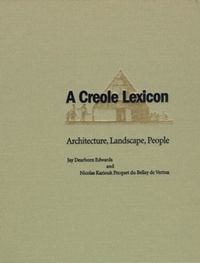
A Creole Lexicon
Description

Throughout Louisiana's colonial and postcolonial periods, there evolved a highly specialized vocabulary for describing the region's buildings, people, and cultural landscapes. This creolized language -- a unique combination of localisms and words borrowed from French, Spanish, English, Indian, and Caribbean sources -- developed to suit the multiethnic needs of settlers, planters, explorers, builders, surveyors, and government officials. Today, this historic vernacular is often opaque to historians, architects, attorneys, geographers, scholars, and the general public who need to understand its meanings. With A Creole Lexicon, Jay Edwards and Nicolas Kariouk provide a highly organized resource for its recovery. Here are definitions for thousands of previously lost or misapplied terms, including watercraft and land vehicles, furniture, housetypes unique to Louisiana, people, and social categories.
Drawn directly from travelers' accounts, historic maps, and legal documents, the volume's copious entries document what would actually have been heard and seen by the peoples of the Louisiana territory. Newly produced diagrams and drawings as well as reproductions of original eighteenth- and nineteenth-century documents and Historic American Buildings Surveys enhance understanding. Sixteen subject indexes list equivalent English words for easy access to appropriate Creole translations. A Creole Lexicon is an invaluable resource for exploring and preserving Louisiana's cultural heritage.
All prices
More details
Other editions
Additional editions
Persons
Jay Dearborn Edwards is a professor of anthropology at Louisiana State University, where he has taught courses in anthropology, folklore, and vernacular architecture for more than thirty years. A lifelong student of the historic vernacular and Creole architecture of Louisiana, the Gulf South, and the West Indies, Edwards is the author, coauthor, or editor of four previous books:Cajun Country; Historic Louisiana Nails: Aids to the Dating of Old Buildings; and Louisiana's Remarkable French Vernacular Architecture; and Plantations by the River: Watercolor Paintings from St. Charles Parish, Louisiana, by Father Joseph M. Paret, 1859, winner of the Louisiana Endowment for the Humanities Book of the Year Award.
Born in Paris, Nicolas Kariouk Pecquet du Bellay de Verton, grew up surrounded by various cultures and fluent in several languages. He received a bachelor of science degree in mechanical engineering from Columbia University in 1961. In 1995, he retired from his career in the nuclear-related sciences and subsequently earned a master's degree in anthropology from Louisiana State University. He lives in Baton Rouge.
The coauthors' collaboration was sparked by a fortuitous encounter which brought together Jay Edwards's profound interest in vernacular architecture and Nicolas Kariouk's lifelong love for etymology.
