

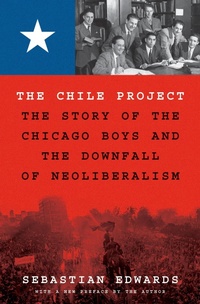
The Chile Project
The Story of the Chicago Boys and the Downfall of Neoliberalism
1st Edition
Published on 11. March 2025
384 pages
978-0-691-27078-4 (ISBN)
Description

How Chile became home to the world's most radical free-market experiment-and what its downfall suggests about the fate of neoliberalism around the globe
In The Chile Project, Sebastian Edwards tells the remarkable story of how the neoliberal economic model-installed in Chile during the Pinochet dictatorship and deepened during three decades of left-of-center governments-came to an end in 2021, when Gabriel Boric, a young former student activist, was elected president, vowing that "If Chile was the cradle of neoliberalism, it will also be its grave." More than a story about one Latin American country, The Chile Project is a behind-the-scenes history of the spread and consequences of the free-market thinking that dominated economic policymaking around the world in the second half of the twentieth century-but is now on the retreat.
In 1955, the U.S. State Department launched the "Chile Project" to train Chilean economists at the University of Chicago, home of the libertarian Milton Friedman. After General Augusto Pinochet overthrew socialist president Salvador Allende in 1973, Chile's "Chicago Boys" implemented the purest neoliberal model in the world for the next seventeen years, undertaking a sweeping package of privatization and deregulation, creating a modern capitalist economy, and sparking talk of a "Chilean miracle." But under the veneer of success, a profound dissatisfaction with the vast inequalities caused by neoliberalism was growing. In 2019, protests erupted throughout the country, and in 2022 Boric began his presidency with a clear mandate: to end neoliberalismo.
In telling the fascinating story of the Chicago Boys and Chile's free-market revolution, The Chile Project provides an important new perspective on the history of neoliberalism and its global decline today.
In The Chile Project, Sebastian Edwards tells the remarkable story of how the neoliberal economic model-installed in Chile during the Pinochet dictatorship and deepened during three decades of left-of-center governments-came to an end in 2021, when Gabriel Boric, a young former student activist, was elected president, vowing that "If Chile was the cradle of neoliberalism, it will also be its grave." More than a story about one Latin American country, The Chile Project is a behind-the-scenes history of the spread and consequences of the free-market thinking that dominated economic policymaking around the world in the second half of the twentieth century-but is now on the retreat.
In 1955, the U.S. State Department launched the "Chile Project" to train Chilean economists at the University of Chicago, home of the libertarian Milton Friedman. After General Augusto Pinochet overthrew socialist president Salvador Allende in 1973, Chile's "Chicago Boys" implemented the purest neoliberal model in the world for the next seventeen years, undertaking a sweeping package of privatization and deregulation, creating a modern capitalist economy, and sparking talk of a "Chilean miracle." But under the veneer of success, a profound dissatisfaction with the vast inequalities caused by neoliberalism was growing. In 2019, protests erupted throughout the country, and in 2022 Boric began his presidency with a clear mandate: to end neoliberalismo.
In telling the fascinating story of the Chicago Boys and Chile's free-market revolution, The Chile Project provides an important new perspective on the history of neoliberalism and its global decline today.
More details
Other editions
Additional editions
Book
05/2025
Princeton University Press
€21.00
Shipment within 10-20 days
Person
Sebastian Edwards is the Henry Ford II Distinguished Professor of International Economics at the University of California, Los Angeles, and a former chief economist for Latin America and the Caribbean at the World Bank. His many books include American Default: The Untold Story of FDR, the Supreme Court, and the Battle over Gold (Princeton) and Crisis and Reform in Latin America: From Despair to Hope.
