

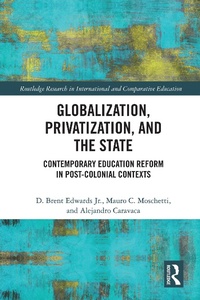
Globalization, Privatization, and the State
Contemporary Education Reform in Post-Colonial Contexts
1st Edition
Published on 16. August 2022
218 pages
978-1-000-62207-2 (ISBN)
Description

This text explores how the dynamics of globalization and privatization have influenced State policy and impacted education reform in Honduras. It makes the argument that understanding education reform in post-colonial contexts requires that scholars go beyond a surface-level description of such trends as privatization to consider, in addition, the ways that the logics, practices, and relationships that characterized colonialism continue to be embedded in the apparatus of modern States. The first part of the volume documents historical trends and the evolution of privatisation in Honduras, while the second part explicitly engages in an extended discussion of State theory, before shifting to present a framework for depicting how these logics are the foundational layer upon which states and global governance have been constructed. The framework draws upon scholarship from political economy, world systems, and post-colonialism to depict the "ethos of privatization" at the core of post-colonial States, wherein what drives the system is private benefit, in the interest of individuals and their networks, but not in the interest of those outside the State. Applying this unique framework to the case of Honduras and offering empirical analysis of the Honduran education sector, the changing role and priorities of the State, and the increasing involvement of international organizations, NGOs, and private actors in the provision of education, the text increases understanding of how State theory interacts with broader global dynamics to impact education. This text will benefit researchers, academics, and educators with a focus on international and comparative education, policy analysis, globalization, and international development.
Reviews / Votes
"This book bursts open the taken-for-granted concepts of the state that circulate in studies of globalisation and education. Putting a critical reading of state theories into conversation with the specificities of educational privatization in Honduras, the authors illuminate the urgent need for a sustained and robust understanding of the interlocking forces of colonialism and capitalism in the field of education."- Arathi Sriprakash, Professor of Education, University of Bristol, UK
"This book offers and applies a much-needed framework for the study of the links between education reform and globalization in post-colonial settings. In doing so, it illuminates and accurately critiques the lack of deeper engagement with the (post-colonial) State in comparative and international education. The result is an impressive account of the ways that education reforms in Honduras have been--and continue to be--informed by logics, practices, and relationships that have their origins in colonialism. Most importantly, the book's framework and insights are broadly relevant and are sure to serve as key referents for work at the intersection of education, the State, and privatization."
- Xavier Bonal, Professor, Autonomous University of Barcelona, Spain
"Edwards, Moschetti and Caravaca's Globalization, Privatization, and the State: Education Reform in Post-colonial Contexts is a landmark in that it places the case study Honduras at the nexus of the ethos of privatization in education, the legacy of the post-colonial state and the exogenous and endogenous forces that shape the modalities of the modern state. This book goes beyond a surface-level description and analysis of global trends such as privatization and globalization and offers a timely and captivating perspective on the state's role in education. In recentering the role of the post-colonial state, Edwards, Moschetti and Caravaca engage and challenge readers to comprehend the colonial logic of the state and to explore alternatives to state functioning. In today's changing global governance architecture, this book is a must-read for anyone who wants to comprehend the state's reemerging role and its efficacy in education."
- Tavis Jules, Associate Professor, Loyola University Chicago, USA
"An extremely instructive and easy to read book describing and critiquing key theories of the state, with an emphasis on contemporary understandings of global policies in education. A productive application of post-colonial theories to Honduras, a country handicapped by low cohesion, limited organizational complexity, and a severely dependent economy, the book provides a test for examining the extent and autonomy of state power in enacting and implementing educational reform. Offering vital insights, this work will serve as a much-needed referent to those seeking to broaden their knowledge of how states function under similar conditions.
- Nelly P. Stromquist, Emerita Professor, University of Maryland, USA
"This is an important and timely book. Through advancing a model of the post-colonial state in education and critically applying it to the case of the privatisation of education in Honduras, the authors invite us to critically reconsider the nature of the relationship between education policy, colonialism and globalization. The book is a must read for scholars interested in both the genealogy of state theory in international and comparative education and the political economy of privatisation of education in Latin America"
- Leon Tikly, Professor & Global Chair in Education, University of Bristol, UK
"By integrating the insights from multiple power-conscious perspectives on the state, the authors offer an intriguing case study of the privatization of education in Honduras. However, they also offer an innovative framework for engaging with the many complex social, political, and economic dimensions that shape the globalization of educational policy in various contexts characterized by enduring colonial legacies in their many formations."
- Sharon Stein, Assistant Professor, University of British Columbia, Canada
"Este libro es indispensable para comprender las reformas educativas mas alla de los esquemas analiticos de politica internacional, indagando en la naturaleza del propio Estado y en la forma en que los estados perifericos, como Honduras, se ven afectados por el colonialismo. Los autores de esta obra argumentan que la comprension de las reformas educativas en contextos postcoloniales, requiere que los academicos trasciendan la descripcion o el analisis superficial de tendencias como la privatizacion para considerar las formas en que las tensiones, practicas y relaciones que caracterizan el colonialismo se insertan en el aparato de los estados modernos. Esta obra se ilustra desde el campo empirico y aporta a la comunidad cientifica, conocimiento sobre un pais desconocido, cargado de contradicciones sociales y politicas, derivadas de su singular condicion geopolitica. En la literatura, el caso de Honduras ya ha sido analizado desde la perspectiva de estado moderno versus estado pre-moderno, en el cual el autoritarismo y la administracion clientelar son factores claves, pero es en esta obra donde por primera vez se aborda desde las logicas coloniales. Los argumentos clave, desarrollados aqui son un aporte potencial para pensar una agenda de alternativas."
- Ricardo Morales-Ulloa, Professor, Universidad Pedagogica Nacional Francisco Morazan, Honduras
"El libro aborda una tematica de indudable relevancia y aporta nuevas perspectivas para el estudio de los procesos de privatizacion educativa a nivel global. Tomando como base el caso de Honduras, se propone una lectura critica del lugar del Estado en el desarrollo de estos procesos. Resulta particularmente interesante como el libro muestra las limitaciones de las lineas de estudio desarrolladas actualmente para abordar el fenomeno de la privatizacion educativa, a la vez que sugiere la necesidad de integrar lecturas de mas larga duracion que muestren como las practicas y los modos de relacion coloniales subsisten en los modos de organizacion de los Estados modernos. El cierre del libro, en su capitulo 9 titulado "Within and Beyond the State: Post-Colonial Perspectives and Decolonial Directions", propone la necesidad de trascender miradas poscoloniales e integrar enfoques decoloniales. El libro en su conjunto supone un aporte de indudable trascendencia para una renovacion de las lineas de estudio acerca de la privatizacion educativa y constituye un aporte de muy necesario para quienes investigamos sobre estas tematicas desde diversos contextos y realidades nacionales."
- Pablo Martinis, Professor, Universidad de la Republica, Uruguay
More details
Series
Edition
1. Auflage
Language
English
Place of publication
London
United Kingdom
Publishing group
Taylor & Francis Ltd
Target group
College/higher education
Product notice
Reflowable
Illustrations
4 Tables, black and white; 8 Line drawings, black and white; 8 Illustrations, black and white
ISBN-13
978-1-000-62207-2 (9781000622072)
Copyright in bibliographic data and cover images is held by Nielsen Book Services Limited or by the publishers or by their respective licensors: all rights reserved.
Schweitzer Classification
Other editions
Additional editions
D. Brent Edwards Jr. | Mauro C. Moschetti | Alejandro Caravaca
Globalization, Privatization, and the State
Contemporary Education Reform in Post-Colonial Contexts
Book
05/2024
1st Edition
Routledge
€63.10
Shipment within 10-20 days
D. Brent Edwards Jr. | Mauro C. Moschetti | Alejandro Caravaca
Globalization, Privatization, and the State
Contemporary Education Reform in Post-Colonial Contexts
Book
08/2022
1st Edition
Routledge
€205.40
Shipment within 15-20 days
Persons
D. Brent Edwards Jr. is Associate Professor of Theory and Methodology in the Study of Education at the University of Hawaii, USA.
Mauro C. Moschetti is Serra-Hunter Lecturer (Assistant Professor) in the Faculty of Education at the Autonomous University of Barcelona, Spain.
Alejandro Caravaca is Research Assistant at the Autonomous University of Barcelona, Spain.
Mauro C. Moschetti is Serra-Hunter Lecturer (Assistant Professor) in the Faculty of Education at the Autonomous University of Barcelona, Spain.
Alejandro Caravaca is Research Assistant at the Autonomous University of Barcelona, Spain.
Content
1. The Intersection of Globalization, Privatization, and the State 2. Default Privatization in a Weak State: Manifestations of Privatization in Education Provision 3. Contemporary Education Reform Dynamics in Honduras: Privatization Through Policymaking 4. Privatization and the Modern State: Tracing Clientelism and Private Interests in Education 5. The State in Macro-Sociological Scholarship and Global Education Policy Studies: A Critical Appraisal 6. Critical Perspectives on the State: Political Economy, World Systems, and Post-Colonial Insights 7. Connecting State Theories and Extending the Post-Colonial Perspective 8. Explaining the Post-Colonial State: A Framework and Its Application 9. Within and Beyond the State: Post-Colonial Perspectives and Decolonial Directions
