

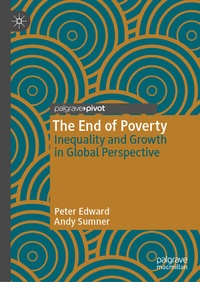
The End of Poverty
Description

In this book Edward and Sumner argue that to better understand the impact of global growth on poverty it is necessary to consider what happens across a wide range of poverty lines. Starting with the same datasets used to produce official estimates of global poverty, they create a model of global consumption that spans the entire world's population. They go on to demonstrate how their model can be utilised to understand how different poverty lines imply very different visions of how the global economy needs to work in order for poverty to be eradicated.
More details
Other editions
Additional editions
Persons
Peter Edward is Director of the MBA programme and Lecturer in International Business Management at Newcastle University Business School, UK. His research focuses on business ethics and corporate social responsibility, the changing role of business in society and the impact of global economic growth on major societal challenges, particularly on poverty and inequality.
Andy Sumner is Reader in International Development at King's College London, UK. His research focuses on global poverty and the distributional and welfare dynamics of late economic development in developing countries.
Content
Chapter 1: Introduction.- Chapter 2: Growth and Distribution since the Cold War.- Chapter 3: A Model of Global Consumption, Output and Distribution.- Chapter 4: Global Poverty by Different Poverty Lines since the Cold War.- Chapter 5: The End of Global Poverty.- Chapter 6: Conclusion.
