

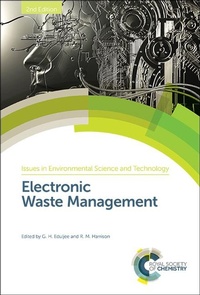
Electronic Waste Management
2nd Edition
Published on 6. September 2019
352 pages
978-1-78801-878-4 (ISBN)
Description

Electronic waste, which includes everything from refrigerators to smartphones, is one of the world's fastest growing waste streams. Often these items are simply discarded as new technology becomes available. A huge amount of electronic waste is generated globally and currently only around 20% of it is recycled. The complex mixture of materials and components within electronic waste makes it difficult to manage and many of these components can pose hazards to human health or the environment if not disposed of carefully.
There have been significant changes in the global approach to electronic waste management and the legislation around it since the publication of the first edition of Electronic Waste Management. This new edition provides an updated overview across the world as well as presenting new chapters on current issues in recycling and management of this waste.
This is an essential reference not only for those working in recycling and waste management, but also for those working in manufacturing and product development who wish to consider the full lifecycle of their products. It also provides valuable insights for policymakers developing more environmentally sound and sustainable systems and strategies for the management of electronic waste.
There have been significant changes in the global approach to electronic waste management and the legislation around it since the publication of the first edition of Electronic Waste Management. This new edition provides an updated overview across the world as well as presenting new chapters on current issues in recycling and management of this waste.
This is an essential reference not only for those working in recycling and waste management, but also for those working in manufacturing and product development who wish to consider the full lifecycle of their products. It also provides valuable insights for policymakers developing more environmentally sound and sustainable systems and strategies for the management of electronic waste.
Reviews / Votes
Overall, this is an excellent and easily read text book on current state-of-the-art WEEE management. It is well written and is generally data-driven, using a myriad of contemporary references. The book should be an essential source of current information for all policy makers and anyone involved in the industry. * https://doi.org/10.1080/00202967.2020.1723255 *More details
Series
Edition
2nd edition
Language
English
Place of publication
Cambridge
United Kingdom
Target group
Professional and scholarly
File size
4,06 MB
ISBN-13
978-1-78801-878-4 (9781788018784)
DOI
10.1039/9781788018784
Copyright in bibliographic data and cover images is held by Nielsen Book Services Limited or by the publishers or by their respective licensors: all rights reserved.
Schweitzer Classification
Other editions
Additional editions
Gev Eduljee | R. M. Harrison
Electronic Waste Management
Book
09/2019
2nd Edition
Royal Society of Chemistry
€88.50
Shipment within 3-4 weeks
Gev Eduljee | R. M. Harrison
Electronic Waste Management
E-Book
09/2019
2nd Edition
Royal Society of Chemistry
€92.99
Available for download
Previous edition
Gev Eduljee | R. M. Harrison
Electronic Waste Management
Book
09/2019
2nd Edition
Royal Society of Chemistry
€88.50
Shipment within 3-4 weeks
Persons
Dr Gev Eduljee is a non-executive director at resource management consultancy Resource Futures. Previously he was Director of External Affairs at SUEZ recycling & recovery UK. He worked in hazardous waste treatment before spending 15 years in environmental consulting. He has published widely on waste management, risk assessment and public health issues. He was a member of Defra's Advisory Committee on Packaging and of the Advisory Committee on Hazardous Substances.
Professor Roy Harrison OBE is listed by ISI Thomson Scientific (on ISI Web of Knowledge) as a Highly Cited Researcher in the Environmental Science/Ecology category. He has an h-index of 84 (i.e. 84 of his papers have received 84 or more citations in the literature). In 2004 he was appointed OBE for services to environmental science in the New Year Honours List and in 2017 was elected a Fellow of the Royal Society. He was profiled by the Journal of Environmental Monitoring (Vol 5, pp 39N-41N, 2003). Professor Harrison's research interests lie in the field of environment and human health. His main specialism is in air pollution, from emissions through atmospheric chemical and physical transformations to exposure and effects on human health. Much of this work is designed to inform the development of policy.
Professor Roy Harrison OBE is listed by ISI Thomson Scientific (on ISI Web of Knowledge) as a Highly Cited Researcher in the Environmental Science/Ecology category. He has an h-index of 84 (i.e. 84 of his papers have received 84 or more citations in the literature). In 2004 he was appointed OBE for services to environmental science in the New Year Honours List and in 2017 was elected a Fellow of the Royal Society. He was profiled by the Journal of Environmental Monitoring (Vol 5, pp 39N-41N, 2003). Professor Harrison's research interests lie in the field of environment and human health. His main specialism is in air pollution, from emissions through atmospheric chemical and physical transformations to exposure and effects on human health. Much of this work is designed to inform the development of policy.
Content
Introduction and Overview;
Materials Used in Manufacturing Electrical and Electronic Products;
A Circular Economy for Consumer Electronics;
An Overview of Electronic Waste Management in the UK;
Management of Electronic Waste in Africa;
Electronic Waste Management in the Asia Pacific Region;
Traceability of Electronic Waste Using Blockchain Technology;
Electronics: A Broken Story about Production and Consumption;
The Recycling of Lithium-ion Batteries: Current and Potential Approaches;
Environmentally Sustainable Solvent-based Process Chemistry for Metals in Printed Circuit Boards;
Plastics in Electronic Waste: Results from the PolyCE Project
Materials Used in Manufacturing Electrical and Electronic Products;
A Circular Economy for Consumer Electronics;
An Overview of Electronic Waste Management in the UK;
Management of Electronic Waste in Africa;
Electronic Waste Management in the Asia Pacific Region;
Traceability of Electronic Waste Using Blockchain Technology;
Electronics: A Broken Story about Production and Consumption;
The Recycling of Lithium-ion Batteries: Current and Potential Approaches;
Environmentally Sustainable Solvent-based Process Chemistry for Metals in Printed Circuit Boards;
Plastics in Electronic Waste: Results from the PolyCE Project
