

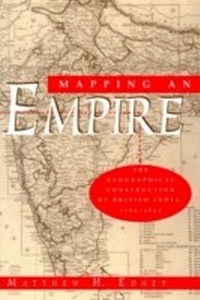
Mapping an Empire
The Geographical Construction of British India, 1765-1843
1st Edition
Published on 31. May 2024
482 pages
978-0-226-18486-9 (ISBN)
Description

In this fascinating history of the British surveys of India, Matthew H. Edney relates how imperial Britain used modern survey techniques to not only create and define the spatial image of its Empire, but also to legitimate its colonialist activities.
"There is much to be praised in this book. It is an excellent history of how India came to be painted red in the nineteenth century. But more importantly, Mapping an Empire sets a new standard for books that examine a fundamental problem in the history of European imperialism."-D. Graham Burnett, Times Literary Supplement
" Mapping an Empire is undoubtedly a major contribution to the rapidly growing literature on science and empire, and a work which deserves to stimulate a great deal of fresh thinking and informed research."-David Arnold, Journal of Imperial and Commonwealth History
"This case study offers broadly applicable insights into the relationship between ideology, technology and politics. . . . Carefully read, this is a tale of irony about wishful thinking and the limits of knowledge."- Publishers Weekly
"There is much to be praised in this book. It is an excellent history of how India came to be painted red in the nineteenth century. But more importantly, Mapping an Empire sets a new standard for books that examine a fundamental problem in the history of European imperialism."-D. Graham Burnett, Times Literary Supplement
" Mapping an Empire is undoubtedly a major contribution to the rapidly growing literature on science and empire, and a work which deserves to stimulate a great deal of fresh thinking and informed research."-David Arnold, Journal of Imperial and Commonwealth History
"This case study offers broadly applicable insights into the relationship between ideology, technology and politics. . . . Carefully read, this is a tale of irony about wishful thinking and the limits of knowledge."- Publishers Weekly
All prices
More details
Other editions
Additional editions
Book
05/1999
University of Chicago Press
€40.85
Shipment within 10-20 days
Book
09/1997
University of Chicago Press
€36.53
Article exhausted; check different version
Person
Please fill in author biography
Content
- Intro
- Contents
- List of Illustrations and Maps
- List of Tables
- Preface
- Note on East India Company Coinage
- Places Mentioned in the Text: Southern India and Northern India
- Chronology of Events and the Expansion of the East India Company
- Chapter One. The Ideologies and Practices of Mapping and Imperialism
- Part One: The Enlightenment Construction of Geographical Knowledge
- Chapter Two. Observation and Representation
- Chapter Three. Surveying and Mapmaking
- Part Two: Institutional Structures Andcartographic Anarchy
- Chapter Four. Structural Constraints of the East India Company's Administration
- Chapter Five. Cartographic Anarchy and System in Madras, 1790-1810
- Part Three: The Great Trigonometrical Survey and Cartographic System
- Chapter Six. Institutions for Mapping All of British India, 1814-23
- Chapter Seven. Triangulation, the Cartographic Panacea, 1825-32
- Chapter Eight. The Final Compromise: Triangulation and Archive, 1831-43
- Part Four: Cartography, Science, and there Representation of Empire
- Chapter Nine. Scientific Practice: Incorporating the Rationality of Empire
- Chapter Ten. Cartographic Practice: Inscribing an Imperial Space
- Biographical Notes
- Notes
- Archival Sources and Bibliography
- Unpublished Primary Sources, by Archive
- Published Primary Sources
- Secondary Sources Relating to the British Surveys in India
- Principal Secondary Sources
- Index

