

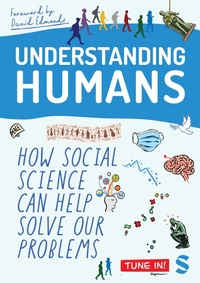
Understanding Humans
How Social Science Can Help Solve Our Problems
1st Edition
Published on 14. September 2023
144 pages
978-1-5296-8066-9 (ISBN)
Description

Compiling the best episodes of SAGE's 'Social Science Bites' podcast since its beginning in 2012, this pocket-sized volume is sure to inspire and provoke. With a foreword by David Edmonds, host of the podcast, this book will show you how social science can help to solve problems in today's society. It is structured into sections on identity, learning, human behaviour, social change, and the unexpected, with each chapter offering the perspective of one of the most dynamic thinkers in the social sciences.
Taking a multidisciplinary approach, Edmonds' selection of interviews includes topics such as racial inequality, moral psychology, the pandemic, and the prison system. Interviewees include Sam Friedman, Professor of Sociology at LSE, Gurminder K. Bhambra, Professor of Postcolonial and Decolonial Studies at the University of Sussex, and Jennifer Richeson, Professor of Psychology at Yale University. This book will show you the range of voices in the social sciences today, and how this diversity is what is needed to grapple with the complexity of the issues we face.
Taking a multidisciplinary approach, Edmonds' selection of interviews includes topics such as racial inequality, moral psychology, the pandemic, and the prison system. Interviewees include Sam Friedman, Professor of Sociology at LSE, Gurminder K. Bhambra, Professor of Postcolonial and Decolonial Studies at the University of Sussex, and Jennifer Richeson, Professor of Psychology at Yale University. This book will show you the range of voices in the social sciences today, and how this diversity is what is needed to grapple with the complexity of the issues we face.
Reviews / Votes
The eclectic chapters in 'Understanding Humans: How Social Science Can Solve Our Problems' illuminate the profound role of social sciences in exploring and addressing social issues. This book serves as a valuable resource for a broad audience, being accessible and engaging for readers without prior knowledge or expertise in the fields drawn upon by the researchers. It provides readers with a compelling overview of exceptional research studies on how we think and act as individuals, and the social, economic, educational and political structures that we operate within. -- Ulviyya Khalilova * LSE Review of Books *More details
Edition
1. Auflage
Language
English
Place of publication
London
United Kingdom
Publishing group
Sage Publications Ltd (Digital)
Target group
College/higher education
Professional and scholarly
Product notice
Reflowable
File size
4,23 MB
ISBN-13
978-1-5296-8066-9 (9781529680669)
Copyright in bibliographic data and cover images is held by Nielsen Book Services Limited or by the publishers or by their respective licensors: all rights reserved.
Schweitzer Classification
Other editions
Additional editions
Book
10/2023
1st Edition
SAGE Publications Ltd
€39.70
Shipment within 3-4 weeks
Person
David Edmonds is a Distinguished Research Fellow at the Uehiro Centre for Practical Ethics at Oxford University and a former BBC radio journalist. He is the author or editor of many philosophy books (and one on chess) which together have been translated into over two dozen languages. These include (with John Eidinow), Wittgenstein's Poker and, most recently, a biography, Parfit: A Philosopher and his Mission to Save Morality. As well as Social Science Bites, David also hosts a couple of philosophy podcasts. Philosophy Bites, which he makes with Nigel Warburton, has had over 47 million downloads.
Content
PART 1: IDENTITY
Chapter 1: Sam Friedman on Class
Chapter 2: Janet Carsten on the Kinship of Anthropology
PART 2: HOW WE THINK AND LEARN
Chapter 3: Daniel Kahneman on Bias
Chapter 4: Mahzarin Banaji on Implicit Bias
Chapter 5: Gurminder K. Bhambra on Postcolonial Social Science
Chapter 6: Jonathan Haidt on Moral Psychology
Chapter 7: Jo Boaler on Fear of Mathematics
Chapter 8: Saskia Sassen on Before Method
PART 3: HUMAN BEHAVIOUR
Chapter 9: Stephen Reicher on Crowd Psychology
Chapter 10: Robert Shiller on Behavioral Economics
Chapter 11: David Halpern on Nudging
Chapter 12: Valerie Curtis on the Sources of Disgust
PART 4: MAKING SOCIAL CHANGE
Chapter 13: Jennifer Richeson on Perceptions of Racial Inequality
Chapter 14: Erica Chenoweth on Nonviolent Resistance
Chapter 15: Alison Liebling on Successful Prisons
Chapter 16: Lawrence Sherman on Experimental Criminology
PART 5: EXPLAINING THE PRESENT AND THE UNEXPECTED
Chapter 17: Hetan Shah on Social Science and the Pandemic
Chapter 18: Bruce Hood on the Supernatural
Chapter 1: Sam Friedman on Class
Chapter 2: Janet Carsten on the Kinship of Anthropology
PART 2: HOW WE THINK AND LEARN
Chapter 3: Daniel Kahneman on Bias
Chapter 4: Mahzarin Banaji on Implicit Bias
Chapter 5: Gurminder K. Bhambra on Postcolonial Social Science
Chapter 6: Jonathan Haidt on Moral Psychology
Chapter 7: Jo Boaler on Fear of Mathematics
Chapter 8: Saskia Sassen on Before Method
PART 3: HUMAN BEHAVIOUR
Chapter 9: Stephen Reicher on Crowd Psychology
Chapter 10: Robert Shiller on Behavioral Economics
Chapter 11: David Halpern on Nudging
Chapter 12: Valerie Curtis on the Sources of Disgust
PART 4: MAKING SOCIAL CHANGE
Chapter 13: Jennifer Richeson on Perceptions of Racial Inequality
Chapter 14: Erica Chenoweth on Nonviolent Resistance
Chapter 15: Alison Liebling on Successful Prisons
Chapter 16: Lawrence Sherman on Experimental Criminology
PART 5: EXPLAINING THE PRESENT AND THE UNEXPECTED
Chapter 17: Hetan Shah on Social Science and the Pandemic
Chapter 18: Bruce Hood on the Supernatural
