

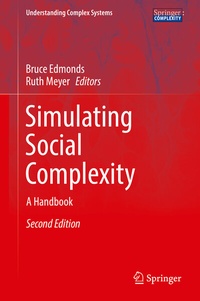
Simulating Social Complexity
Description

Ruth Meyer is also a former Springer book editor. She's a Research Associate at the Center of Policy Modeling at Manchester Metropolitan University. Among others, her research interests lie in agent-based simulation and discrete-event simulation.
More details
Other editions
Additional editions
Persons
Content
Part1. Introduction.- Chapter1. Introduction.- Chapter2. Historical Introduction.- Chapter3. Types of Simulation.- Chapter4. Different Modelling Purposes.- Part2. Methodology.- Chapter5. Informal Approaches to Developing Simulations.- Chapter6. Applying software engineering methods to simulation development.- Chapter6. Checking Simulations.- Chapter7. Verifying and Validating simulations.- Chapter8. Understanding Simulation Results.- Chapter9. How many runs should one do .- Chapter10. Participatory Approaches.- Chapter11. Combining Analytic and Simulation Approaches.- Chapter12. Interpreting and Understanding Simulations.- Chapter13. Documenting Social Simulation Models: The ODD Protocol as a Standard.- Part3. Mechanisms.- Chapter14. Utility, Games, and Narratives.- Chapter15. Social Constraint.- Chapter16. Reputation.- Chapter17. Social Networks and Spatial Distribution.- Chapter18. Learning.- Chapter19. Evolutionary Mechanisms.- Part4. Applications.- Chapter20.
Agent-based Modelling and Simulation Applied to Environmental Management.- Chapter21. Distributed Computer Systems.- Chapter22. Simulating Complexity of Animal Social Behaviour.- Chapter23. Agent-based Simulation as a Useful Tool for the Study of Markets.- Chapter24. Movement of People and Goods.- Chapter25. Modeling Power and Authority: An Emergentist View from Afghanistan.- Chapter26. Human Societies - Understanding Observed Social Phenomena.- Chapter27. Some pitfalls to beware when applying models to issues of policy relevance.