

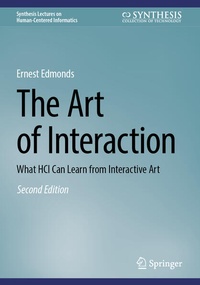
The Art of Interaction
Description

This book continues to explore the question of how Human-Computer Interaction (HCI) can learn from art. It considers how the HCI research agenda can be advanced by looking at art research and how HCI practitioners can improve creativity support and the amplification of that important human capability within their work. This book answers these questions from the perspective that interactive art has become a common part of life as a result of the many ways in which the computer and the Internet have facilitated it. HCI is as important to interactive art as color mixing is fundamental to painting. The book reviews recent work that looks at these issues through art research. In interactive digital art, the artist is concerned with how the artwork behaves, how the audience interacts with it, and, ultimately, how participants experience and engage with art. The values of art are deeply human and increasingly relevant to HCI as its focus moves from product design toward social benefits and the support of human creativity. The book examines these issues through a series of case studies and also brings together a collection of research results from art practice that illuminate this significant new and expanding area. In particular, this book points readers toward a much-needed critical language that they can use to describe, compare, and frame research in HCI support for creativity. This second edition updates the material where appropriate and adds a new case study.
More details
Other editions
Additional editions
Previous edition
Person
Ernest Edmonds is a pioneer computer artist and HCI innovator for whom combing creative arts practice with creative technologies has been a life-long pursuit. In 2017, he won both the ACM SIGCHI Lifetime Achievement Award for Practice in Human-Computer Interaction and the ACM SIGGRAPH Distinguished Artist Award for Lifetime Achievement in Digital Art. He is a chairman of the Board of ISEA International, whose main activity is the annual International Symposium on Electronic Art that began in 1988. Ernest was born in London in 1942 and, having started at Leicester Polytechnic (now De Montfort University-DMU), he then worked at Loughborough University and the University of Technology, Sydney, before returning to DMU as a professor of Computational Art and Director of the Institute of Creative Technologies. He is now Emeritus Professor at DMU.
