

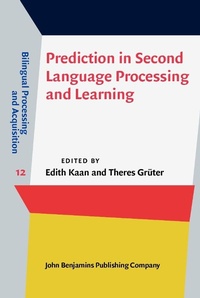
Prediction in Second Language Processing and Learning
1st Edition
Published on 22. September 2021
248 pages
978-90-272-5894-6 (ISBN)
Description

There is ample evidence that language users, including second-language (L2) users, can predict upcoming information during listening and reading. Yet it is still unclear when, how, and why language users engage in prediction, and what the relation is between prediction and learning. This volume presents a collection of current research, insights, and directions regarding the role of prediction in L2 processing and learning. The contributions in this volume specifically address how different (L1-based) theoretical models of prediction apply to or may be expanded to account for L2 processing, report new insights on factors (linguistic, cognitive, social) that modulate L2 users' engagement in prediction, and discuss the functions that prediction may or may not serve in L2 processing and learning. Taken together, this volume illustrates various fruitful approaches to investigating and accounting for differences in predictive processing within and across individuals, as well as across populations.
More details
Other editions
Additional editions
Edith Kaan | Theres Grueter
Prediction in Second Language Processing and Learning
Book
09/2021
John Benjamins Publishing Co
€119.04
Shipment within 10-15 days
Content
- Intro
- Prediction in Second Language Processing and Learning
- Editorial page
- Title page
- Copyright page
- Table of contents
- Acknowledgments
- List of contributors
- Chapter 1. Prediction in second language processing and learning: Advances and directions
- Introduction
- What is prediction and what is it good for in L2 learning and processing?
- What is prediction?
- What is prediction good for?
- A brief history of prediction in language processing research
- Research on prediction in L1 sentence processing
- Research on prediction in L2 sentence processing
- Prediction in L1 and L2 processing: The role of utility
- Cue reliability and utility in L1 predictive processing
- Cue reliability and utility in L2 predictive processing
- A note about proficiency
- Prediction and learning
- Insights from L1 speakers
- Insights from L2 speakers
- Again: Utility
- Concluding remarks, synopses of chapters, and future directions
- Acknowledgments
- Funding
- References
- Chapter 2. Automaticity and prediction in non-native language comprehension
- Introduction
- Graded view of automaticity
- A production-based model of prediction
- Automaticity of prediction in L1
- Automaticity of prediction in L2
- Conclusion
- References
- Chapter 3. Second language prediction ability across different linguistic domains: Evidence from German
- Introduction
- Semantic prediction
- Morphosyntactic prediction
- The current study
- Method
- Results
- Discussion
- Acknowledgments
- Funding
- References
- Chapter 4. Influence of syntactic complexity on second language prediction
- Introduction
- Prediction in comprehension
- Prediction in L2 comprehension
- Variation in prediction and mediating factors
- The current study
- Method
- Participants
- Materials
- Procedure
- Results
- Behavioral task accuracy
- Eye-tracking data analysis
- Discussion
- References
- Chapter 5. Language prediction in second language: Does language similarity matter?
- Introduction
- Cross-linguistic influence and language processing in L2
- Cross-linguistic influence and prediction in L2
- Do cross-linguistic differences in features and rules affect L2 prediction?
- Can L2 speakers use features that do not exist in their L1 as prediction cues?
- Is the use of the sentence context in L2 prediction affected by CLI?
- Is the use of the discourse context in L2 prediction affected by CLI?: First steps
- Cross-linguistic influence and models of language prediction
- Cross-linguistic influence and error-based implicit learning
- Cross-linguistic influence and prediction-by-production
- Conclusions and directions for future research
- References
- Chapter 6. Prediction in bilingual children: The missing piece of the puzzle
- What is prediction?
- How are prediction and proficiency related?
- What do we know about prediction skills in monolingual children?
- What do we know about prediction skills in adult L2 speakers?
- What do we (not) know about bilingual children?
- How can research with bilingual children inform L2 predictive processing accounts?
- What's next?
- Acknowledgements
- References
- Chapter 7. Code-switching: A processing burden, or a valuable resource for prediction?
- Introduction
- Illustrative Study 1: Can code-switching signal less expected upcoming lexical information?
- Illustrative Study 2: Can code-switching ease the processing of taboo or negative information?
- General discussion
- Potential mechanisms underlying the CS effect
- Factors modulating how CS affects prediction
- Conclusions
- Acknowledgments
- Funding
- References
- Chapter 8. Prediction and grammatical learning in second language sentence processing
- Introduction
- Grammatical learning and prediction
- Learning and prediction in L2 acquisition
- Learning to predict in an L2
- Learning to predict due to exposure and structural priming
- Predicting to learn in an L2
- Syntactic adaptation and the consequences of prediction error
- Conclusions and outlook
- References
- Chapter 9. The role of prediction in second language vocabulary learning
- Overview
- Prediction and L1 vocabulary acquisition in children
- Prediction and vocabulary learning in adults
- Prediction and motivation in L2 vocabulary learning
- Summary and open questions
- Acknowledgments
- Funding
- References
- Chapter 10. Forcing prediction increases priming and adaptation in second language production
- Introduction
- Structural priming and learning from prediction error
- Prediction in L2 processing and structural priming
- The role of L2 proficiency in predictive processing and structural priming
- This study
- Methods
- Participants
- Materials
- Procedure
- Guessing game (GG) condition
- Control condition (CC)
- Data annotation and analysis
- Results
- Production of predicted primes in the GG group
- Proficiency
- Exit interview
- Discussion
- Acknowledgments
- References
- Index
