

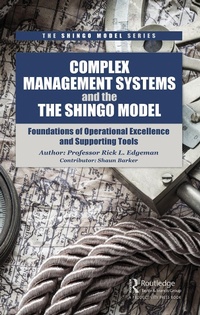
Complex Management Systems and the Shingo Model
Foundations of Operational Excellence and Supporting Tools
1st Edition
Published on 21. February 2019
290 pages
978-1-351-85965-3 (ISBN)
Description

The Shingo Enterprise Excellence Prize Model (SEEM) has exerted global influence over the ways that exceptional organizations formulate/deploy strategy with its focus on processes, Lean thinking, continuous improvement, innovation, workforce development, and supplier strategies. This book details the SEEM, which lies at the heart of the Shingo Prize. It will link the theoretical underpinnings of the SEEM and their implications for practice. Case studies illustrate important points. Selected tools that support practical implementation of the model are discussed and their use illustrated. This book will deepen understanding of why the model works and how implementation can be accomplished.
More details
Series
Edition
1. Auflage
Language
English
Place of publication
London
United Kingdom
Publishing group
Taylor & Francis Ltd
Target group
Professional and scholarly
Illustrations
15 Illustrations, black and white
File size
24,18 MB
ISBN-13
978-1-351-85965-3 (9781351859653)
Copyright in bibliographic data and cover images is held by Nielsen Book Services Limited or by the publishers or by their respective licensors: all rights reserved.
Schweitzer Classification
Other editions
Additional editions
Rick Edgeman
Complex Management Systems and the Shingo Model
Foundations of Operational Excellence and Supporting Tools
Book
02/2019
1st Edition
CRC Press
€68.30
Shipment within 10-20 days
Person
Rick Edgeman is Professor and Chair of the Management Department in the Robbins College of Business & Entrepreneurship at Fort Hays State University (Kansas) and Research Fellow in the Shingo Institute at Utah State University, where he previously served as Research Director and Professor of Management Practice. He is also concurrently Professor of Sustainability & Enterprise Performance in the Business Development & Technology Department at Denmark's Aarhus University and Honorary Professor of Engineering Operations Management in the Department of Technology & Innovation at Denmark's Southern Denmark University.
Past or occasional service includes roles as Visiting Professor in the Executive MBA program at the University of Lugano, which serves as the University of Lugano (Switzerland); Professor of Quality Management in the Quality Sciences Division at Uppsala University (Sweden); Visiting Professor in the Faculty of Management and Economics at Tomas Bata University in the Czech Republic; Visiting Professor in the Quality and Environmental Management Division at Lulea University (Sweden; QUEST Professor & Executive Director of the QUEST Honors Fellows Program in the Robert H. Smith School of Business at the University of Maryland; Professor & Chair of the Statistical Science Department at the University of Idaho; and Professor & Director of the Center for Quality & Productivity Improvement at Colorado State University. He has provided numerous keynote addresses and other invited lectures, including ones at Oxford University, Cambridge University, the University of Versailles (France), Chalmers University (Sweden), and the Royal Melbourne Institute of Technology.
Rick has authored more than 250 publications on quality management, sustainability, six sigma, leadership, innovation, and statistics. He formerly co-edited the journal Measuring Business Excellence and is presently associate editor of Total Quality Management & Business Excellence. He has also edited special issues of several journals, and on the editorial review boards of numerous journals, including the Six Sigma Forum and Quality Engineering. He earned the Ph.D. in Statistics from the University of Wyoming and was cited by the American Society for Quality in 2000 as one of 21 Voices of Quality for the 21<+>st<+> Century-one of only six academics worldwide included among the 21.
Past or occasional service includes roles as Visiting Professor in the Executive MBA program at the University of Lugano, which serves as the University of Lugano (Switzerland); Professor of Quality Management in the Quality Sciences Division at Uppsala University (Sweden); Visiting Professor in the Faculty of Management and Economics at Tomas Bata University in the Czech Republic; Visiting Professor in the Quality and Environmental Management Division at Lulea University (Sweden; QUEST Professor & Executive Director of the QUEST Honors Fellows Program in the Robert H. Smith School of Business at the University of Maryland; Professor & Chair of the Statistical Science Department at the University of Idaho; and Professor & Director of the Center for Quality & Productivity Improvement at Colorado State University. He has provided numerous keynote addresses and other invited lectures, including ones at Oxford University, Cambridge University, the University of Versailles (France), Chalmers University (Sweden), and the Royal Melbourne Institute of Technology.
Rick has authored more than 250 publications on quality management, sustainability, six sigma, leadership, innovation, and statistics. He formerly co-edited the journal Measuring Business Excellence and is presently associate editor of Total Quality Management & Business Excellence. He has also edited special issues of several journals, and on the editorial review boards of numerous journals, including the Six Sigma Forum and Quality Engineering. He earned the Ph.D. in Statistics from the University of Wyoming and was cited by the American Society for Quality in 2000 as one of 21 Voices of Quality for the 21<+>st<+> Century-one of only six academics worldwide included among the 21.
Content
Chapter 1: Toward a Model -- The Enterprise as a Complex System.
Chapter 2: BEST Environmental Domains.
Chapter 3: Stakeholder Perspectives.
Chapter 4: Mediating Factors.
Chapter 5: Enterprise Alignment.
Chapter 6: Enterprise Processes.
Chapter 7: Modes of Enterprise Development.
Chapter 8: What We've Learned So Far -- A Complex Systems Management Model.
Chapter 9: Enterprise Excellence Models.
Chapter 10: Conversations -- Connecting Stakeholder and Process Voices.
Chapter 11: Underlying Principles and Insights of the Shingo Model.
Chapter 12: The Shingo Model -- A Complex Systems Enterprise Excellence Model.
Chapter 13: The Shingo Prize -- Winners and Characteristics of Excellent Enterprises.
Chapter 14: Enterprise Assessment Using the Shingo Enterprise Excellence Model.
Chapter 15: Presentation of Assessment Results.
Chapter 16: One Possible Future for the Shingo Enterprise Excellence Model.
Chapter 17: Summary and Conclusions.
References.
Appendix A: Selected Voice of the Customer Approaches.
Appendix B: Selected Kaizen (Continuous Improvement) Tools.
Appendix C: Selected Management and Planning Tools.
Appendix D: An Overview of Selected Lean and Advanced Tools.
Appendix E: Enterprise Assessment Aids.
Chapter 2: BEST Environmental Domains.
Chapter 3: Stakeholder Perspectives.
Chapter 4: Mediating Factors.
Chapter 5: Enterprise Alignment.
Chapter 6: Enterprise Processes.
Chapter 7: Modes of Enterprise Development.
Chapter 8: What We've Learned So Far -- A Complex Systems Management Model.
Chapter 9: Enterprise Excellence Models.
Chapter 10: Conversations -- Connecting Stakeholder and Process Voices.
Chapter 11: Underlying Principles and Insights of the Shingo Model.
Chapter 12: The Shingo Model -- A Complex Systems Enterprise Excellence Model.
Chapter 13: The Shingo Prize -- Winners and Characteristics of Excellent Enterprises.
Chapter 14: Enterprise Assessment Using the Shingo Enterprise Excellence Model.
Chapter 15: Presentation of Assessment Results.
Chapter 16: One Possible Future for the Shingo Enterprise Excellence Model.
Chapter 17: Summary and Conclusions.
References.
Appendix A: Selected Voice of the Customer Approaches.
Appendix B: Selected Kaizen (Continuous Improvement) Tools.
Appendix C: Selected Management and Planning Tools.
Appendix D: An Overview of Selected Lean and Advanced Tools.
Appendix E: Enterprise Assessment Aids.
