

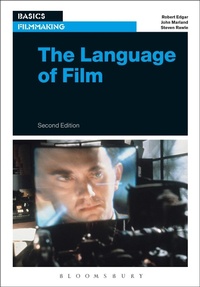
The Language of Film
2nd Edition
Published on 27. August 2015
216 pages
978-1-4725-7525-8 (ISBN)
Description

An effective filmmaker needs to have a good understanding of how film language works, and more importantly, how to actively influence an audience's thoughts and feelings and guide their gaze around the screen.
Packed with examples from classic and contemporary cinema, The Language of Film reveals the essential building blocks of film and explains how the screen communicates meaning to its audience. You will learn about fundamental theories and concepts, including film semiotics, narrative structures, ideology, and genre, as well as how elements such as shot size, camera movement, editing technique, and color come together to create the cinematic image.
With insightful case studies and discussion questions, dozens of practical tips and exercises, and a new chapter on film sound, this new edition of The Language of Film is a must-have guide for aspiring filmmakers.
Packed with examples from classic and contemporary cinema, The Language of Film reveals the essential building blocks of film and explains how the screen communicates meaning to its audience. You will learn about fundamental theories and concepts, including film semiotics, narrative structures, ideology, and genre, as well as how elements such as shot size, camera movement, editing technique, and color come together to create the cinematic image.
With insightful case studies and discussion questions, dozens of practical tips and exercises, and a new chapter on film sound, this new edition of The Language of Film is a must-have guide for aspiring filmmakers.
More details
Series
Edition
2nd edition
Language
English
Place of publication
London
United Kingdom
Publishing group
Bloomsbury Publishing PLC
Target group
College/higher education
Illustrations
75 colour illus
File size
6,50 MB
ISBN-13
978-1-4725-7525-8 (9781472575258)
Copyright in bibliographic data and cover images is held by Nielsen Book Services Limited or by the publishers or by their respective licensors: all rights reserved.
Schweitzer Classification
Other editions
Additional editions
Robert Edgar | John Marland | Steven Rawle
The Language of Film
Book
08/2018
Bloomsbury Academic USA
€42.50
Shipment within 15-20 days
Persons
Robert Edgar is a Senior Lecturer in Creative Writing and Film and Television Production at York St John University, UK. John Marland is a Senior Lecturer in Film and Television Production and English Literature at York St John University, UK. Steven Rawle is a Senior Lecturer in Film and Television Production at York St John University, UK.
Content
Introduction
Chapter 1: Semiotics: Images; The Visual Mind; Reading the Signs; Making Meaning; Codes and Filters; Case Study: Seven; Chapter Summary
Chapter 2: Narrative: Theories of Storytelling; Structuralism; Theories of Structure; Genette's Narrative; Discourse; Music; Short Film and Narrative; Case Study: The Secret Life of Walter Mitty; Chapter Summary
Chapter 3: Intertextuality: Text; Quotation; Allusion; Cult Film; Genre; Case Study: Citizen Kane; Chapter Summary
Chapter 4: Ideology: Ideological Analysis; Realism; Ideology and Genre; Case Study: Dead Man's Shoes; Chapter Summary
Chapter 5: Frames and Images: The Shot; Distance, Height and Framing; Shot Distances; Mise en Scène; The Mobile Camera Frame; Time and the Long Take; Case Study: Hero; Chapter Summary
Chapter 6: Sound: Film: An Audiovisual Medium; Sound Properties; Diegetic and Non-diegetic Sound; Offscreen Space and Audio; The Voice; Music; Case Study: Berberian Sound Studio; Chapter Summary
Chapter 7: Constructing Meaning: Continuity Editing; Discontinuity Editing; Montage; Pacing; Case Study: Psycho; Chapter Summary
Conclusion; Film Language Glossary; Index; Acknowledgements and Credits
Chapter 1: Semiotics: Images; The Visual Mind; Reading the Signs; Making Meaning; Codes and Filters; Case Study: Seven; Chapter Summary
Chapter 2: Narrative: Theories of Storytelling; Structuralism; Theories of Structure; Genette's Narrative; Discourse; Music; Short Film and Narrative; Case Study: The Secret Life of Walter Mitty; Chapter Summary
Chapter 3: Intertextuality: Text; Quotation; Allusion; Cult Film; Genre; Case Study: Citizen Kane; Chapter Summary
Chapter 4: Ideology: Ideological Analysis; Realism; Ideology and Genre; Case Study: Dead Man's Shoes; Chapter Summary
Chapter 5: Frames and Images: The Shot; Distance, Height and Framing; Shot Distances; Mise en Scène; The Mobile Camera Frame; Time and the Long Take; Case Study: Hero; Chapter Summary
Chapter 6: Sound: Film: An Audiovisual Medium; Sound Properties; Diegetic and Non-diegetic Sound; Offscreen Space and Audio; The Voice; Music; Case Study: Berberian Sound Studio; Chapter Summary
Chapter 7: Constructing Meaning: Continuity Editing; Discontinuity Editing; Montage; Pacing; Case Study: Psycho; Chapter Summary
Conclusion; Film Language Glossary; Index; Acknowledgements and Credits
