

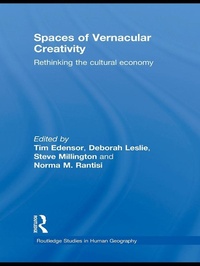
Spaces of Vernacular Creativity
Rethinking the Cultural Economy
Published on 29. October 2009
272 pages
978-1-134-01845-1 (ISBN)
Description

Creativity has become part of the language of regeneration experts, urban planners and government policy makers attempting to revive the economic and cultural life of cities in the 21st century. Concepts such as the creative class, the creative industries and bohemian cultural clusters have come to dominate thinking about how creativity can contribute to urban renewal. Spaces of Vernacular Creativity offers a critical perspective on the instrumental use of arts and creative practices for the purposes of urban regeneration or civic boosterism.
Several important contributions are brought into one volume to examine the geography of locally embedded forms of arts and creative practice. There has been an explosion of interest in both academic and policy circles in the notion of creativity, and its role in economic development and urban regeneration. This book argues for a rethinking of what constitutes creativity, foregrounding non-economic values and practices, and the often marginal and everyday spaces in which creativity takes shape. Drawing on a range of geographic contexts including the U.S., Europe, Canada and Australia, the book explores a diverse array of creative practices ranging from art, music, and design to community gardening and anticapitalist resistance. The book examines working class, ethnic and non-elite forms of creativity, and a variety of creative spaces, including rural areas, suburbs and abandoned areas of the city. The authors argue for a broader and more inclusive conception of what constitutes creative practice, advocating for an approach that foregrounds economies of generosity, conviviality and activism. The book also explores the complexities and nuances that connect the local and the global and finally, the book provides a space for valuing alternative, marginal and displaced knowledges.
Spaces of Vernacular Creativity provides an important contribution to the debates on the creative class and on the role of value of creative knowledge and skills. The book aims to contribute to contemporary academic debates regarding the development of post-industrial economies and the cognitive cultural economy. It will appeal to a wide range of disciplines including, geography, applied art, planning, cultural studies, sociology and urban studies, plus specialised programmes on creativity and cultural industries at Undergraduate and Postgraduate levels.
Several important contributions are brought into one volume to examine the geography of locally embedded forms of arts and creative practice. There has been an explosion of interest in both academic and policy circles in the notion of creativity, and its role in economic development and urban regeneration. This book argues for a rethinking of what constitutes creativity, foregrounding non-economic values and practices, and the often marginal and everyday spaces in which creativity takes shape. Drawing on a range of geographic contexts including the U.S., Europe, Canada and Australia, the book explores a diverse array of creative practices ranging from art, music, and design to community gardening and anticapitalist resistance. The book examines working class, ethnic and non-elite forms of creativity, and a variety of creative spaces, including rural areas, suburbs and abandoned areas of the city. The authors argue for a broader and more inclusive conception of what constitutes creative practice, advocating for an approach that foregrounds economies of generosity, conviviality and activism. The book also explores the complexities and nuances that connect the local and the global and finally, the book provides a space for valuing alternative, marginal and displaced knowledges.
Spaces of Vernacular Creativity provides an important contribution to the debates on the creative class and on the role of value of creative knowledge and skills. The book aims to contribute to contemporary academic debates regarding the development of post-industrial economies and the cognitive cultural economy. It will appeal to a wide range of disciplines including, geography, applied art, planning, cultural studies, sociology and urban studies, plus specialised programmes on creativity and cultural industries at Undergraduate and Postgraduate levels.
More details
Series
Language
English
Place of publication
London
United Kingdom
Publishing group
Taylor & Francis Ltd
Target group
College/higher education
Illustrations
13 s/w Abbildungen, 4 s/w Tabellen, 10 s/w Photographien bzw. Rasterbilder, 3 s/w Zeichnungen
4 Tables, black and white; 3 Line drawings, black and white; 10 Halftones, black and white; 13 Illustrations, black and white
File size
10,37 MB
ISBN-13
978-1-134-01845-1 (9781134018451)
Copyright in bibliographic data and cover images is held by Nielsen Book Services Limited or by the publishers or by their respective licensors: all rights reserved.
Schweitzer Classification
Other editions
Additional editions
Tim Edensor | Deborah Leslie | Steve Millington
Spaces of Vernacular Creativity
Rethinking the Cultural Economy
Book
11/2015
1st Edition
Routledge
€73.60
Shipment within 10-20 days
Tim Edensor | Deborah Leslie | Steve Millington
Spaces of Vernacular Creativity
Rethinking the Cultural Economy
Book
10/2009
1st Edition
Routledge
€231.90
Shipment within 15-20 days
Persons
Tim Edensor teaches Cultural Geography at MMU. He is author of Tourists at the Taj (1998), National Identity, Popular Culture and Everyday Life (2002) and Industrial Ruins: Space, Aesthetics and Materiality (2005). He is currently researching landscapes of illumination, geographies of rhythm and urban materiality.
Deborah Leslie is an Associate Professor of Geography at the University of Toronto. She is interested in the role of cultural industries in urban economic development, and has done research on a range of industries including design, fashion, art, furniture, advertising and more recently the circus. She has related research interests in the creative city initiatives and urban governance, and in the geography of commodity chains. She is author of a number of publications relating to these topics.
Steve Millington is a Senior Lecturer in Human Geography at Manchester Metropolitan University. His research interests include landscapes of illumination, vernacular creativity and geographies of play. He is co-author of Cosmopolitan Urbanism (2006) and has recently published journal articles in Global Networks and Sociology.
Norma M. Rantisi is an Associate Professor in the Department of Geography, Planning & Environment at Concordia University (Canada). She is author and co-author of numerous articles on the themes of fashion design, the cultural economy and policies governing design in urban settings. She has co-edited two special journal issues: one for Environment and Planning A on the creative economy and one for The Journal of Economic Geography on relational economic geography.
Deborah Leslie is an Associate Professor of Geography at the University of Toronto. She is interested in the role of cultural industries in urban economic development, and has done research on a range of industries including design, fashion, art, furniture, advertising and more recently the circus. She has related research interests in the creative city initiatives and urban governance, and in the geography of commodity chains. She is author of a number of publications relating to these topics.
Steve Millington is a Senior Lecturer in Human Geography at Manchester Metropolitan University. His research interests include landscapes of illumination, vernacular creativity and geographies of play. He is co-author of Cosmopolitan Urbanism (2006) and has recently published journal articles in Global Networks and Sociology.
Norma M. Rantisi is an Associate Professor in the Department of Geography, Planning & Environment at Concordia University (Canada). She is author and co-author of numerous articles on the themes of fashion design, the cultural economy and policies governing design in urban settings. She has co-edited two special journal issues: one for Environment and Planning A on the creative economy and one for The Journal of Economic Geography on relational economic geography.
Content
1. Introduction: Rethinking Creativity: Critiquing the Creative Class Thesis (Tim Edensor, Deborah Leslie, Steve Millington and Norma M. Rantisi) Part 1: Governing and Practising Creativity 2. Creative Spaces and the Art of Urban Living (Graeme Evans) 3. Creativity by Design? The Role of Informal Spaces in Creative Production (Rantisi and Leslie) 4. Art goes AWOL (Malcolm Miles) Part 2: Decentering Creativity 5. Creative Suburbs: Cultural 'Popcorn' Pioneering in Multi-purpose Spaces (Alison Bain) 6. Beyond Bohemia: Geographies of Everyday Creativity for Musicians in Toronto (Brian J. Hracs) 7. Mapping Vernacular Creativity: the Extent and Diversity of Rural Festivals in Australia (Chris Gibson, Chris Brennan-Horley and Jim Walmsley) 8. Imagining the Spatialities of Music Production: The Co-constitution of Creative Clusters and Networks (Bas Van Heur) 9. Remediating Vernacular Creativity: Photography and Cultural Citizenship in the Flickr Photosharing Network (Jean Burgess) Part 3: Everyday Spaces of Creativity 10. Creativity, Space and Performance: Community Gardening (David Crouch) 11. Growing Places: Community Gardening, Ordinary Creativities and Place-based Regeneration in a Northern English City (Paul Milbourne) 12. Creative Destruction and Critical Creativity: Recent Episodes in the Social Life of Gnomes (Tracey J. Potts) 13. Christmas Lights Displays and the Creative Production of Spaces of Generosity (Edensor and Millington) Part 4: Alternative Creativities 14. Challenge, Change, and Space in Vernacular Cultural Practice (Ann Markusen) 15. The Politics of Creative Performance in Public Space: Towards a Critical Geography of Toronto Case Studies (Heather E. McLean) 16. Creativity Unbound: Cultivating the Generative Power of Non-economic Neighbourhood Spaces (Ava Bromberg)
