

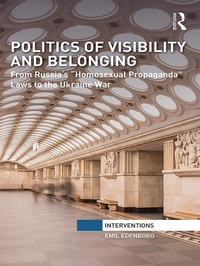
Politics of Visibility and Belonging
From Russia?s "Homosexual Propaganda" Laws to the Ukraine War
Published on 14. July 2017
218 pages
978-1-351-71293-4 (ISBN)
Description

In this book, Edenborg studies contemporary conflicts of community as enacted in Russian media, from the 'homosexual propaganda' laws to the Sochi Olympics and the Ukraine war, and explores the role of visibility in the production and contestation of belonging to a political community.
The book examines what it is that determines which subjects and narratives become visible and which are occluded in public spheres; how they are seen and made intelligible; and how those processes are involved in the imagination of communities. Investigating the differentiated consequences of visibility, Edenborg discusses what forms of visibility make belonging possible and what forms of visibility may be related to exclusion or violence. The book maps and analyses the practices and mechanisms whereby a state seeks to produce and shape belonging through controlling what becomes visible in public, and how that which becomes visible is seen and understood. In addition, it examines what forms contestation can take and what its effects may be.
Advancing theoretical understanding and offering a useful way to analytically conceptualize the role of visibility in the production and contestation of political communities, this work will be of interest to students and scholars of gender and sexuality politics, borders, citizenship, nationalism, migration and ethnic relations.
The book examines what it is that determines which subjects and narratives become visible and which are occluded in public spheres; how they are seen and made intelligible; and how those processes are involved in the imagination of communities. Investigating the differentiated consequences of visibility, Edenborg discusses what forms of visibility make belonging possible and what forms of visibility may be related to exclusion or violence. The book maps and analyses the practices and mechanisms whereby a state seeks to produce and shape belonging through controlling what becomes visible in public, and how that which becomes visible is seen and understood. In addition, it examines what forms contestation can take and what its effects may be.
Advancing theoretical understanding and offering a useful way to analytically conceptualize the role of visibility in the production and contestation of political communities, this work will be of interest to students and scholars of gender and sexuality politics, borders, citizenship, nationalism, migration and ethnic relations.
Reviews / Votes
This is an important book in which the role of visibility in general and the media as its facilitator in particular is added to the theorization of political projects of belonging. It focuses on fascinating contesting case studies from the Russian media but is of generic theoretical and political importance as well.- Professor Nira Yuval-Davis, Director of the research centre on Migration, Refugees and Belonging, University of East London
This book offers an interesting account of why and how the Kremlin tolerates disparate voices and alternative media, while retaining the commanding heights of media capacity. It shows how a populist-authoritarian regime exploits contradictory and illogical media narratives to frame particular emotional responses. It suggests how and why opponents of the Kremlin struggle to achieve effective traction in the public sphere.
- Dan Healey, University of Oxford, Salvic Review
This book is a monumental research effort. The attention to Russian sources of various kinds and technical knowledge (regarding pathogens, life sciences, military applications, and the Russian bureaucratic process) is remarkable.
- Lisa A. Balionee, Saint Joseph's University
More details
Series
Language
English
Place of publication
London
United Kingdom
Publishing group
Taylor & Francis Ltd
Target group
College/higher education
Product notice
Reflowable
Illustrations
16 s/w Photographien bzw. Rasterbilder, 16 s/w Abbildungen
16 Halftones, black and white; 16 Illustrations, black and white
File size
3,25 MB
ISBN-13
978-1-351-71293-4 (9781351712934)
Copyright in bibliographic data and cover images is held by Nielsen Book Services Limited or by the publishers or by their respective licensors: all rights reserved.
Schweitzer Classification
Other editions
Additional editions
Emil Edenborg
Politics of Visibility and Belonging
From Russia?s "Homosexual Propaganda" Laws to the Ukraine War
Book
09/2021
1st Edition
Routledge
€65.10
Shipment within 10-20 days
Emil Edenborg
Politics of Visibility and Belonging
From Russia?s "Homosexual Propaganda" Laws to the Ukraine War
Book
07/2017
1st Edition
Routledge
€215.77
Shipment within 10-20 days
Person
Emil Edenborg is Postdoctoral Researcher at Soedertoern University, Sweden.
Content
Introduction
Tverskaya Ulitsa, Moscow, May 2006
Projects of belonging in contemporary Russia
1: Politics of belonging: from speech to visibility
Politics of belonging: the issues at stake
Politics of belonging as speech: (counter)narratives and (counter)publics
Politics of belonging as visibility contestations
2: Russian media as a space of appearance
A historical overview of media in Russia
Containing, amplifying and contesting visibility in Russia
Revisiting the audience(s)
Conclusion
3: "Homosexual propaganda": regulating queer visibility
Queer visibility, belonging and geopolitics
Regulating queerness in Russian history
The dominant interpretation of the propaganda law
Tensions in the narrative
Conclusion
4: Sochi: the nation on display
Politics of belonging and the spectacular
Contexts and controversies around the Sochi Games
Sochi-2014 as a project of belonging
Contesting the Sochi spectacle
Conclusion
5: Ukraine: spectacles and specters of war
War, (in)visibility and belonging
Part one: satire and violent cartographies
Part two: spectacular and spectral homecomings
Conclusion
Conclusion: nothing more to see?
The limits of speech
Arrangements of visibility and the production of belonging
Visibility, invisibility and resistance
Russian politics, belonging and visibility
Seeing ahead
Tverskaya Ulitsa, Moscow, May 2006
Projects of belonging in contemporary Russia
1: Politics of belonging: from speech to visibility
Politics of belonging: the issues at stake
Politics of belonging as speech: (counter)narratives and (counter)publics
Politics of belonging as visibility contestations
2: Russian media as a space of appearance
A historical overview of media in Russia
Containing, amplifying and contesting visibility in Russia
Revisiting the audience(s)
Conclusion
3: "Homosexual propaganda": regulating queer visibility
Queer visibility, belonging and geopolitics
Regulating queerness in Russian history
The dominant interpretation of the propaganda law
Tensions in the narrative
Conclusion
4: Sochi: the nation on display
Politics of belonging and the spectacular
Contexts and controversies around the Sochi Games
Sochi-2014 as a project of belonging
Contesting the Sochi spectacle
Conclusion
5: Ukraine: spectacles and specters of war
War, (in)visibility and belonging
Part one: satire and violent cartographies
Part two: spectacular and spectral homecomings
Conclusion
Conclusion: nothing more to see?
The limits of speech
Arrangements of visibility and the production of belonging
Visibility, invisibility and resistance
Russian politics, belonging and visibility
Seeing ahead
