

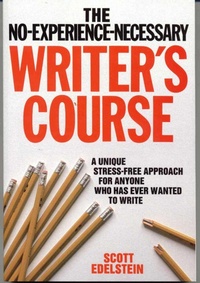
No Experience Necessary Writer's Course
1st Edition
Published on 2. January 1994
299 pages
978-1-4616-6044-6 (ISBN)
Description

A unique stress-free approach for anyone who has ever wanted to write.
More details
Other editions
Additional editions
Scott Edelstein
No Experience Necessary Writer's Course
Book
03/1994
Scarborough House
€15.80
Article not available for order

Scott Edelstein | Scott Eldelstein
No Experience Necessary Writer's Course
Book
01/1990
Madison Books, Inc
€38.54
Article exhausted; check different version
Person
By Scott Edelstein
Content
- Cover
- Title
- Copyright
- Contents
- Introduction Why This Book Is Special
- 1 Becoming a Writer in Thirty Seconds
- 2 The Ten Biggest Fears About Writing-and How to Get Over Them
- 3 The Ten Biggest Myths About Writing
- 4 The Secret to Writing Well
- 5 Getting Started
- Exercise #1
- 6 Why Would Anyone Want to Read What I Write?
- 7 The Fine Arts of Watching and Listening
- 8 Finding Your Ideal Places, Times, and Circumstances for Writing
- 9 Why Do People Write, and Which Reasons are Good Ones?
- Exercise #2
- 10 The Universal vs. the Personal
- 11 What Do I Write About?
- 12 Self as Subject, Others as Subjects
- 13 Locating Material for Your Writing
- 14 Should I Keep a Journal?
- 15 Forgetting What You Learned in School
- Exercise #3
- 16 Where and How Do I Start a Piece of Writing?
- 17 Who Am I Writing For?
- 18 The Censor, the Pessimist, the Nitpicker, and the Obsessive Planner Inside You
- Exercise #4
- 19 The Pros and Cons of Procrastination and Ritual
- 20 Writers' Rhythms
- 21 Writing What You Know and Faking What You Don't
- 22 The Importance of Failure to Good Writing
- Exercise #5
- 23 The Uses and Limits of Catharsis
- 24 Letting Your Writing Find Its Own Way
- 25 The Mysteries of Creativity
- 26 A Short Course in Temporary Insanity
- Exercise #6
- 27 Do I Have to Finish?
- 28 How Important Is Reading to Writing?
- 29 Fifty-Seven Terms You've Always Wanted Defined
- Exercise #7
- 30 Can I Work on More Than One Piece at a Time?
- 31 Reading Your Work Aloud
- 32 Saving Everything You Write
- 33 What Does It Mean to Be Meaningful?
- Exercise #8
- 34 The Proper Use of Salt
- 35 Looking Back on What You've Done
- 36 A Few Unkind but Well-Deserved Words About Literature
- 37 The Importance of Conciseness and Simplicity
- 38 The Importance of Clarity
- 39 Getting Your Readers to Use Their Senses
- 40 Showing vs. Telling
- Exercise #9
- 41 What Does It Mean to Understand a Piece of Writing?
- 42 You Can Pick Your Friends, But You Don't Have to Pick a Style
- 43 Other Things You Don't Have to Pick
- 44 Metaphor and Symbolism
- 45 "Shep Shall Bark No More"
- Exercise #10
- 46 Art vs. Entertainment: Some Useful Words on an Old Debate
- 47 Dreams as Inspiration
- 48 Fantasy and Daydreams as Inspiration
- Exercise #11
- 49 The Seven Major Forms of Creative Writing
- 50 Other Forms of Creative Writing
- 51 How to Say What You Want to Say
- Exercise #12
- 52 Creative Lying
- 53 Active and Passive Language
- 54 Three Tenses and Three Persons
- Exercise #13
- 55 Stream of Consciousness vs. Automatic Writing
- 56 Bisociation
- Exercise #14
- 57 Finding Your Ideal Critic
- 58 How to Spot and Ignore Bad Advice
- 59 Outlining, Netlining, and No Lining at All
- Exercise #15
- 60 What Is a Draft?
- 61 Revising
- 62 The Art of Cutting
- Exercise #16
- 63 Getting Unstuck
- 64 One or More Good Turns
- Exercise #17
- 65 Creative Waiting
- 66 Stereotypes and Anti-Stereotypes
- Exercise #18
- 67 Pace
- 68 Series Pieces
- Exercise #19
- 69 Openings
- 70 Endings
- 71 Titles and Names
- Exercise #20
- 72 Transitions
- Exercise #21
- 73 Composite People, Settings, and Plots
- 74 The Karma Principle
- 75 Word Choice
- 76 How Much or Often Can I Break the Rules?
- 77 When Is a Piece of Writing Finished?
- 78 How Do I Judge My Own Work?
- Exercise #22
- 79 Looking Back Once Again
- 80 The Classic Short Story and Its Variations
- 81 Talking with Your Characters
- 82 Anyone Can Understand Good Poetry
- 83 Daffodils, Gibberish, and Nestor: The Most Common Mistakes in Poetry
- 84 Rhymed vs. Unrhymed Poetry
- 85 Poetic Terms and Techniques
- 86 Tips for Writing Poetry
- 87 Forms of Poetry
- Exercise #23
- 88 A Writer's Library
- 89 "I Can Write Better Than That": Why So Much Trash Gets Published
- 90 The Publishing Establishments
- 91 Writer's Block
- 92 Writing for Children
- 93 Finding a Second Critic
- Exercise #24
- 94 A Do-It-Yourself Writers' Workshop
- 95 Submitting Your Work to Editors
- 96 Writing as a Career
- 97 Vanity Publishing and Other Schemes
- Exercise #25
- 98 Where Do I Go From Here?
- Additional Writing Exercises
