

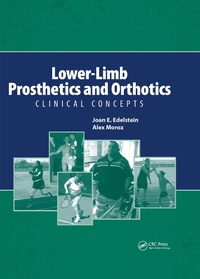
Lower-Limb Prosthetics and Orthotics
Clinical Concepts
1st Edition
Published on 1. June 2024
224 pages
978-1-040-14069-7 (ISBN)
Description

Lower-Limb Prosthetics and Orthotics: Clinical Conceptsis a comprehensive overview of lower-limb prosthetics and orthotics, covering normal and pathological gait, lower-limb biomechanics, clinical applications, as well as prosthetic and orthotic designs and components.
Joan Edelstein and Alex Moroz have writtenLower-Limb Prosthetics and Orthotics with the clinician's perspective in mind. Clinical management is incorporated throughout the text, including basic surgical concepts, postoperative management, preprosthetic care, and training in the use of devices. Additionally, this text incorporates unique features relevant to physicians such as prescription writing and prosthetic and orthotic construction and modification, as well as, the latest research regarding energy consumption and long-term utilization of prostheses.
Chapters Include:
Orthotics in neuromuscular diseases
Orthotics in pediatrics
Functional expectations
Gait and activities training
Transtibial and transfemoral prostheses and components
Transtibial and transfemoral biomechanics, evaluation, and gait analysis
Disarticulations and Bilateral Amputations
With over 150 line drawings and photographs to supplement the text, Lower-Limb Prosthetics and Orthotics: Clinical Concepts is ideal for clinicians in the fields of physical medicine and rehabilitation, orthopedics, vascular surgery, physical therapy and occupational therapy.
Joan Edelstein and Alex Moroz have writtenLower-Limb Prosthetics and Orthotics with the clinician's perspective in mind. Clinical management is incorporated throughout the text, including basic surgical concepts, postoperative management, preprosthetic care, and training in the use of devices. Additionally, this text incorporates unique features relevant to physicians such as prescription writing and prosthetic and orthotic construction and modification, as well as, the latest research regarding energy consumption and long-term utilization of prostheses.
Chapters Include:
Orthotics in neuromuscular diseases
Orthotics in pediatrics
Functional expectations
Gait and activities training
Transtibial and transfemoral prostheses and components
Transtibial and transfemoral biomechanics, evaluation, and gait analysis
Disarticulations and Bilateral Amputations
With over 150 line drawings and photographs to supplement the text, Lower-Limb Prosthetics and Orthotics: Clinical Concepts is ideal for clinicians in the fields of physical medicine and rehabilitation, orthopedics, vascular surgery, physical therapy and occupational therapy.
Reviews / Votes
"The strength of this text lies in its truly comprehensible coverage of lower-limb considerations in P&O, with a focus on breadth rather than depth. The authors' ability to condense this material into a text less than 200 pages long is admirable. Further, the text of the book is well supported by clear and current photographs and illustrations."- Phil Stevens, Med, CPO, FAAOP, American Academy of Orthotists & Prosthetists
"This is an excellent resource for clinicians in training. I would definitely have enjoyed using it during my residency training. It is also a good reference for practicing clinicians."
- Leslie K. Rydberg, MD, Rehabilitation Institute of Chicago, Doody Enterprises, Inc.
"In summary the book includes many important factors in the rehabilitation of lower limb amputees and would be a useful addition to libraries."
- Louise Johnson, Physiotherapy
More details
Edition
1. Auflage
Language
English
Place of publication
London
United Kingdom
Publishing group
Taylor & Francis Ltd
Target group
Professional and scholarly
ISBN-13
978-1-040-14069-7 (9781040140697)
Copyright in bibliographic data and cover images is held by Nielsen Book Services Limited or by the publishers or by their respective licensors: all rights reserved.
Schweitzer Classification
Other editions
Additional editions
Book
12/2010
1st Edition
SLACK Incorporated
€107.70
Shipment within 3-4 weeks
Persons
Joan E. Edelstein, MA, PT, FISPO, CPed is a world-renowned authority in prosthetics and orthotics. Beginning clinical practice in the Children's Division of the Institute of Physical Medicine and Rehabilitation, subsequently named the Rusk Institute of Rehabilitation Medicine at New York University, she then joined the faculty of the University of Wisconsin. Returning to New York, she became senior research scientist in New York University's Prosthetics and Orthotics Program, originally part of the College of Engineering, later under the joint aegis of the Department of Orthopedic Surgery in the School of Medicine and the Department of Prosthetics and Orthotics in the School of Education. The program awarded the world's first baccalaureate in prosthetics and orthotics. She conducted research on prostheses and orthoses for the upper and lower limbs, as well as trunk orthoses. Following the closing of the department, she became Associate Professor of Clinical Physical Therapy at the College of Physicians and Surgeons, Columbia University and served as the Director of the Program in Physical Therapy there. Highly regarded for her spirited instruction, she is a special lecturer at Columbia University and adjunct faculty member at New York University, Husson University, Touro College, and Eneslow Pedorthic Institute. Professor Edelstein presents postgraduate and continuing education courses throughout North America, Europe, Africa, Asia, and the Middle East. Her numerous publications include journal articles, book chapters, monographs, and books, particularly Orthotics: A Comprehensive Clinical Approach and Prosthetics and Patient Management: A Comprehensive Clinical Approach, both published by SLACK Incorporated. A certified pedorthist, Professor Edelstein is a Fellow of the International Society for Prosthetics and Orthotics.
Alex Moroz, MD, FACP, is an experienced educator in the field of disability and medical rehabilitation. Dr. Moroz graduated from Brooklyn College and New York University's School of Medicine, then trained in rehabilitation medicine at the world-renowned Rusk Institute of Rehabilitation Medicine, where he was invited to join its faculty in 2000, and is a full-time Assistant Professor of Rehabilitation Medicine at the School of Medicine, New York University. Prior to focusing on medical education, Dr. Moroz worked at Bellevue Hospital Prosthetic and Orthotic Clinics for several years. He has directed over 30 educational courses for physicians at New York University over the last decade, including 22 courses in prosthetics and orthotics where more than 1700 rehabilitation and orthopedic physicians have benefited from his educational leadership. He has also developed a Lower Extremity Prosthetics and Orthotics course for orthopedic surgery residents. An editor of the textbook Medical Aspects of Disability, he is also a contributing editor of Rehab in Review. Dr. Moroz has authored numerous peer-reviewed studies published in Archives of Physical Medicine and Rehabilitation, American Journal of Physical Medicine and Rehabilitation, International Journal of Rehabilitation Research, Topics in Geriatric Rehabilitation, and Journal of the American Geriatric Society, among other periodicals.
Alex Moroz, MD, FACP, is an experienced educator in the field of disability and medical rehabilitation. Dr. Moroz graduated from Brooklyn College and New York University's School of Medicine, then trained in rehabilitation medicine at the world-renowned Rusk Institute of Rehabilitation Medicine, where he was invited to join its faculty in 2000, and is a full-time Assistant Professor of Rehabilitation Medicine at the School of Medicine, New York University. Prior to focusing on medical education, Dr. Moroz worked at Bellevue Hospital Prosthetic and Orthotic Clinics for several years. He has directed over 30 educational courses for physicians at New York University over the last decade, including 22 courses in prosthetics and orthotics where more than 1700 rehabilitation and orthopedic physicians have benefited from his educational leadership. He has also developed a Lower Extremity Prosthetics and Orthotics course for orthopedic surgery residents. An editor of the textbook Medical Aspects of Disability, he is also a contributing editor of Rehab in Review. Dr. Moroz has authored numerous peer-reviewed studies published in Archives of Physical Medicine and Rehabilitation, American Journal of Physical Medicine and Rehabilitation, International Journal of Rehabilitation Research, Topics in Geriatric Rehabilitation, and Journal of the American Geriatric Society, among other periodicals.
Content
Dedication Acknowledgments About the Authors Contributing Authors Preface Chapter 1 Normal Gait Chapter 2 Early Management Richard A. Frieden, MD Chapter 3 Transtibial Prostheses Chapter 4 Transtibial Biomechanics Chapter 5 Transtibial Static Evaluation Chapter 6 Transtibial Gait Analysis Chapter 7 Transfemoral Prostheses Chapter 8 Transfemoral Biomechanics Chapter 9 Transfemoral Static Evaluation Chapter 10 Transfemoral Gait Analysis Chapter 11 Partial Foot Amputations and Prostheses Chapter 12 Knee and Hip Disarticulations and Prostheses Chapter 13 Bilateral Amputations and Prostheses Chapter 14 Prosthetic Gait and Activities Training Chapter 15 Lifelong Management of Older Patients Richard A. Frieden, MD Chapter 16 Prosthetic Functional Outcomes Chapter 17 Orthotic Principles Chapter 18 Shoes and Foot Orthoses Chapter 19 Ankle-Foot Orthoses Chapter 20 Knee-Ankle-Foot Orthoses Chapter 21 Hip-Knee-Ankle-Foot and Higher Orthoses Chapter 22 Orthotic Static Evaluation Chapter 23 Pathological Gait Analysis Chapter 24 Orthotic Functional Outcomes Chapter 25 Orthotics in Management of Musculoskeletal and Neuromuscular Disorders Chapter 26 Pediatric Prosthetics and Orthotics Joan T. Gold, MD and Joan E. Edelstein, MA, PT, FISPO, CPed Financial Disclosures Index
