

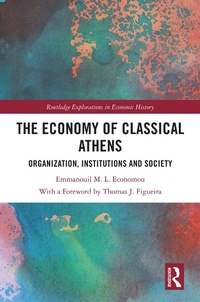
The Economy of Classical Athens
Organization, Institutions and Society
1st Edition
Published on 6. October 2023
362 pages
978-1-000-98403-3 (ISBN)
Description

In parallel to the development of democracy, the Athenians of the Classical period established a series of sophisticated economic institutions for the time through which they developed a maritime and commercially oriented economy. This book provides a thorough analysis of this transformation and the functioning of the Athenian economy during the Classical period. Through the approach of New Institutional Economics (NIE), the book explores the establishment of key institutions including property rights protection, the legal protection of commercial contracts, prices determined by the forces of supply and demand, institutions against profiteering, banking services, the provision of loans through interest rates, consumer credit, insurance companies and a (primitive) version of joint-stock companies. Furthermore, the book focuses on the structure of the public sector, on how the state budget was determined and on how decisions on public revenues and expenditures were made. It also provides an integrated and detailed analysis of the social welfare policies that were implemented through the provision of a variety of public goods in Classical Athens. Moreover, it focuses on a series of socio-economic aspects such as the social status of women, slaves and foreigners and the viewpoints of prominent Athenian philosophers regarding economic organization. Finally, the book investigates whether an Athenian economic-political model of governance, based on a combination of advanced economic institutions (of free market type logic, even if in a primordial form) and direct democracy principles, can provide any lessons for modern societies. The book will be of great interest to readers of the economy, history and society of Ancient Greece as well as economic historians, ancient historians and policymakers more broadly.
Reviews / Votes
"In the last 50 years, intensive research by numerous devoted scholars has established that the economy in classical Athens functioned much like a money and credit-based market economy by drawing on the incentives of private property over the means of production in a framework of consistent and well-defined state institutions and regulations. If there are any doubts in the minds of those who side with the view that the ancient Athenian economy was 'primitive' and 'backward', they are soundly dispelled by the powerful arguments submitted in this well-written boo? by Emmanouil M. L. Economou." George C. Bitros, Emeritus Professor of Economics, Athens University of Economics and Business"Like Aristotle (??????? ?????), Dr Economou has a nomen that is also an omen. He is a leading expert on ancient Greek, and especially Classical Athenian, economy in all its aspects and ramifications. In his thoroughly researched and powerfully argued 'Economics in Classical Athens: Organization, Institutions and Society' he demonstrates that the Athenians in their democratic period of c. 500 to 320 BCE developed a high level of consent-building which played an essential role in founding their historical paradigm's great success. The Classical Athenian democracy was indeed, in its economic aspect, a model of a social organism adaptive to change. All students of Athenian democracy, including comparative economic historians, will profit from a careful reading of this major new work." - Paul Cartledge, A.G. Leventis Professor of Greek Culture Emeritus, University of Cambridge, Faculty of Classics
"In economics, it has become exceedingly clear that the most important factors for development are the institutions in a society, both the formal rules (laws, regulations, etc.), and the informal rules (such as social norms). Ancient Greece witnessed the introduction of many institutions that would prove to be conducive to market behaviour (secure property rights, trade-friendly policies etc.). And the ancient Athenian society of the classical period is remarkable in many ways. Economou's book is a very welcome addition to the literature on ancient Greece. Economou's presentation of the Athenian institutional structure is comprehensive and meticulous. Some of the institutional features he describes are well-known in the social science literature while others will be news to this audience and will provide very interesting reading. Economou deals a lot both with the Athenian welfare policies and public sector generally. Similarly, he devotes a substantial part of the book to the financial sector in Athens and to the role of money. Economou incorporates a substantial number of quotes from the literature in his writing, both from the ancient literature and from contemporary scholars. This is helpful, and it also makes for a more interesting reading experience. If you are interested in the mechanisms of institutional change, ancient Athens is a very useful place to begin your study, and if you are interested in ancient Athens, this book by Emmanouil M.L. Economou is a very good place to start." - Carl Hampus Lyttkens, Professor ?meritus of Economics, Department of Economics, Lund University, Author of Economic analysis of institutional change in ancient Greece, Routledge 2013.
More details
Series
Edition
1. Auflage
Language
English
Place of publication
London
United Kingdom
Publishing group
Taylor & Francis Ltd
Target group
College/higher education
Illustrations
30 Tables, black and white; 11 Line drawings, black and white; 26 Halftones, black and white; 37 Illustrations, black and white
ISBN-13
978-1-000-98403-3 (9781000984033)
Copyright in bibliographic data and cover images is held by Nielsen Book Services Limited or by the publishers or by their respective licensors: all rights reserved.
Schweitzer Classification
Other editions
Additional editions
Book
05/2025
1st Edition
Routledge
€68.20
Shipment within 10-20 days
Book
10/2023
1st Edition
Routledge
€206.40
Shipment within 10-20 days
Person
Emmanouil M.L. Economou is an Assistant Professor of History of Economic Institutions at the Department of Economics, University of Thessaly (Greece). He is a member of the Laboratory of Economic Policy and Strategic Planning (L.E.P.S.PLAN) in the same department. He is also a member of the Laboratory of Intelligence and Cyber-Security, Department of International and European Studies, University of Piraeus (Greece).
His research focuses on Economic History, Institutional Economics, International Political Economy and Defense Economics. He is the author of nine books (five in English and four in Greek) with acclaimed publishing houses such as Routledge, Springer and Cambridge Scholars Publishing.
He has contributed to the international academic bibliography with 65 papers in distinguished peer review journals, and in English and Greek collective volumes (scientific books). Contributions in peer review journals include, among others, the Journal of Institutional Economics (3), Defence and Peace Economics (2), Sustainability, European Journal of Law and Economics, Peace Economics, Peace Science and Public Policy (2), Economics of Governance, Evolutionary and Institutional Economics Review, Homo Oeconomicus, Journal of Financial Economic Policy and Journal of Risk and Financial Management (4).
He is also a reviewer in the following highly distinguished journals: American Political Science Review, Journal of Institutional Economics, Cliometrica, Public Choice, Peace Economics, Peace Science and Public Policy, Investigaciones de Historia Economica - Economic History Research (EHR) and Journal of Risk and Financial Management.
Furthermore, he has 79 publications of discussion papers (64 in English, in the IDEAS RePec - Munich International Library and 15 as "?????" discussion papers published by the L.E.P.S.PLAN Laboratory). He has participated in 43 international and Greek conferences. He often writes in Greek press on economic, historical and defense issues.
His research focuses on Economic History, Institutional Economics, International Political Economy and Defense Economics. He is the author of nine books (five in English and four in Greek) with acclaimed publishing houses such as Routledge, Springer and Cambridge Scholars Publishing.
He has contributed to the international academic bibliography with 65 papers in distinguished peer review journals, and in English and Greek collective volumes (scientific books). Contributions in peer review journals include, among others, the Journal of Institutional Economics (3), Defence and Peace Economics (2), Sustainability, European Journal of Law and Economics, Peace Economics, Peace Science and Public Policy (2), Economics of Governance, Evolutionary and Institutional Economics Review, Homo Oeconomicus, Journal of Financial Economic Policy and Journal of Risk and Financial Management (4).
He is also a reviewer in the following highly distinguished journals: American Political Science Review, Journal of Institutional Economics, Cliometrica, Public Choice, Peace Economics, Peace Science and Public Policy, Investigaciones de Historia Economica - Economic History Research (EHR) and Journal of Risk and Financial Management.
Furthermore, he has 79 publications of discussion papers (64 in English, in the IDEAS RePec - Munich International Library and 15 as "?????" discussion papers published by the L.E.P.S.PLAN Laboratory). He has participated in 43 international and Greek conferences. He often writes in Greek press on economic, historical and defense issues.
Content
Chapter 1: Introduction. Chapter 2: The ancient economy: Some further introductory issues. Chapter 3: Adopting a 'turn to the sea' strategy and the transformation of the Athenian economy. Chapter 4: The protection of private property and the rule of law. Chapter 5: The Athenian market. Chapter 6: The financial institutions of the Athenian economy. Chapter 7: The role of money in the economy. Chapter 8: The Athenian Public Sector and State Budget. Chapter 9: Economic growth policies in Classical Athens. Chapter 10: Social Welfare policies through the provision of public goods. Chapter 11: Epilogue: The Athenian city-state culture. Economy, freedom, democracy and the rule of law.
