

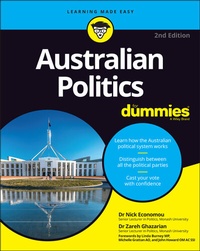
Australian Politics For Dummies
Description

Australian Politics For Dummies gives you a helping hand as you get to grips with the good, the bad and the ugly of Australian politics. Seasoned political punters and voting novices alike will find fascinating facts and top thrills in in this essential guide. Master the ins and outs of elections, parties and policies. In no time, you'll be discussing and debating the biggest issues with ease. Down under, we all have to vote. It's one of the many beautiful things about this land of ours, and this book will help you learn why (and how) to cast that ballot.
This updated edition gives you everything you need to cast your vote with confidence. You'll identify what makes the Australian political system tick, distinguish between the different political parties and understand the influence of the media in Australian politics.
* Decipher political terminology, make sense of the houses of parliament and understand why we have minor parties
* Learn how Australia's political system evolved and grasp today's voting systems
* Make sense of coalition politics and figure out the differences between the Labor and Liberal parties
* Find out why Australia's system of government is described as 'Washminster,' and discover the Whips and the Usher of the Black Rod
You want to know more about Australian politics, but, if we're being realistic, it's very complicated. Australian Politics For Dummies clears it all up.
More details
Other editions
Additional editions
Persons
Dr Zareh Ghazarian is a Senior Lecturer in Politics and International Relations in the School of Social Sciences at Monash University.
Content
- Intro
- Title Page
- Copyright Page
- Table of Contents
- Foreword
- Introduction
- About This Book
- Foolish Assumptions
- Icons Used in This Book
- Where to Go from Here
- Part 1 Politics: You're in It
- Chapter 1 Australian Politics: The Basics
- What Is Politics?
- Compulsory Voting
- A Lot of Government
- Governing the nation
- Governing the states
- Administering the territories
- Roads, rates and rubbish: Local government
- From Government to Politics
- Political parties
- A two-party system?
- Interest Groups: Fighting for Causes and Advancing Interests
- Promotional interest groups
- Sectional interest groups
- Umbrellas and peaks
- Understanding Politicians
- Who becomes a politician?
- A 'boys' club'?
- Heavy hitters: Interest group politicians
- Politics: You Can't Escape It
- Chapter 2 Hot Topics in Australia: The Political Debate
- Apathetic or Engaged?
- Awareness of issues
- The 'isms' in politics
- Things We Never Tire of Talking About
- Tariffs
- The role of the unions
- Immigration
- Reconciliation
- Women in politics
- Great and powerful friends
- New Things We're Talking About
- COVID-19 and the pandemic
- The environment and climate change
- Climate change and water
- The republic
- Globalisation
- Nation building
- Complex Issues, Simple Choices
- Part 2 The Australian System of Government
- Chapter 3 One Country, Many Rulebooks
- Australia Is a Federation
- The Constitution and power-sharing
- The constitutions as rulebooks
- The Path to Federation
- The constitutional conventions
- The states came first
- The need for a national government
- Big States and Small States
- A house for the states: The Senate
- You get at least five lower house seats if . . .
- Changing the Constitution
- The Australian System of Constitutional Government
- The governors and the governor-general
- The Executive in Council
- Ministers of the Crown
- The parliament
- The electors
- The courts
- Australian Constitutionalism: More than the Written Word
- Chapter 4 Westminster: Much More than Big Ben
- A Constitution without a (Written) Constitution
- What do conventions cover?
- The Crown
- The parliament
- The executive
- Responsible Government
- Forming a Responsible Government
- Resign! Resign!
- Collective Responsibility
- Ministerial Responsibility
- Westminster as Adversarial Politics
- The alternative prime minister
- The shadow ministry
- Westminster and Party Politics
- Tyranny of the executive?
- Winner takes all?
- Westminster and Australia
- Chapter 5 Washminster: The Australian Hybrid
- British or American?
- American federalism: A model for Australia
- A Senate, a court and a written constitution: The American legacy
- Limits to Americanisation: Responsible Government
- Responsible Government the Australian Way
- Executive in Council or Cabinet?
- The governor-general or the prime minister?
- What about the states?
- House of Representatives or the Senate?
- Deadlocks
- The joint sitting
- Clash of the Houses: The 1975 Constitutional Crisis
- The politics of the crisis
- The crisis: The deferral of supply
- The governor-general: The reserve powers exercised
- The governor-general's actions: The controversies
- The meaning of the 1975 crisis
- Kerr's argument: Parliamentary Responsibility
- After the crisis
- Chapter 6 Parliament: The House on the Hill
- Housing the Houses of Parliament
- The new house
- The old house
- Westminster parliaments: An overview
- Never the twain shall meet?
- Who's Who? Putting People in Their Place
- The Speaker
- The President
- Frontbenchers and backbenchers
- The crossbenchers
- In the Senate?
- The Whips
- Question Time
- Pairing
- Voting in the Parliament
- Ring the bells! The division
- Crossing the floor
- Conscience voting
- Government rules, OK?
- Making Laws in the Parliament
- Amended bills
- Legislating: The Representatives versus the Senate
- The People's Forum or a Rubber Stamp?
- Adjournments and grievances
- The rise of standing committees
- What about Hung Parliaments?
- How common are hung parliaments?
- Who governs while the crossbenchers are making up their minds?
- The role of the governor
- Minority or coalition?
- Stable or volatile?
- Chapter 7 Governing the Great Southern Land
- The Constitution and the Division of the Powers of Government
- Section 51
- Federal-State Relations
- Adopting (and challenging) the Uniform Tax system
- Controlling the purse strings
- Cooperative Federalism
- From COAG to National Cabinet
- Ministerial councils
- Intergovernmental agreements
- Uncooperative Federalism
- The High Court of Australia
- The Federal Court
- Policy-making Australian Style
- Public policy
- Cabinet government the Australian way
- Creating policy
- Ministerial advisers
- Statutory authorities
- Big Government or Small Government?
- Part 3 Party time!
- Chapter 8 Parties, Parliament and Politics
- What Is a Party?
- Majors and Minors
- Oddities of the Australian majors
- Issues for the Australian minors
- Minor parties in the parliament
- Beyond the Parliament: Party Organisation
- Mass membership, mass parties
- Raising money
- Raising candidates
- Preselection
- Factions
- Alternatives or Wellsprings: Interest Groups and Social Movements
- Promotional interest groups
- Social movements
- Chapter 9 The Australian Labor Party
- The Unions Create a Party
- The strikes of 1891
- The union movement's delegates?
- Root and branch representation
- The Party Organisation
- The supreme organ: Conference
- State and National Executive
- From 36 faceless men to 400 delegates
- A youth wing: Young Labor
- The Labor Organisation: Internal Politics
- The importance of factions
- Left versus right
- Labor and Policy: What Labor Stands For
- The Socialist Objective
- Ben Chifley and bank nationalisation
- The Splits
- Labor and conscription: 1916
- Labor and the Great Depression: 1931
- Lead-up to the 1955 split: The Industrial Groupers
- Many tensions, one big split
- Modernising Labor: From Whitlam to Rudd and Gillard
- The Whitlam policy legacy
- Hayden: Farewell the Socialist Objective
- The Hawke government
- Keating: From treasurer to prime minister
- The rise of Rudd
- The Gillard years
- Pragmatism in Action: Labor in the States
- Labor in the Future
- Chapter 10 The Liberal Party
- Early Origins: Free Traders, Protectionists and Fusionists
- A new anti-Labor party: The Nationalists
- Anti-Labor Uniting (Sort Of)
- United they stand: Creating the United Australia Party
- United they fall: The collapse of the UAP
- From the UAP Ashes: The Liberal Party
- The Liberal Party Organisation
- Getting together: State and Federal Council
- Follow the leader!
- The Party Room
- By Menzies, of Menzies, for Menzies
- A structure for government or opposition?
- The branch membership strikes back!
- The Young Liberals
- Liberal women
- Liberal Factionalism
- Liberals versus conservatives
- Moderates versus Hardliners
- Wets and Dries
- State-based alliances
- Leadership alliances
- The Liberal Party in Government
- Pragmatism or programs?
- Liberals and the unions
- Menzies in government
- Malcolm Fraser's government
- The Howard government
- Post-Howard: The Abbott, Turnbull and Morrison governments
- The Liberal Party in the States
- The Liberal Party and the Future
- Chapter 11 The National Party
- The Origins of Rural Party Politics: The Country Party
- A farmer's party
- Soldier settlements
- A shared constituency
- The Country Party consolidates
- Coalition Politics
- The coalition agreement
- Limits to coalition
- The National Party Organisation
- A small parliamentary party
- Queensland: A National Party heartland
- Factionalism in the National Party
- The National Party in Government
- The early coalitionists
- John (Black Jack) McEwen: A Country Party giant
- Doug Anthony: A moderniser
- Tim Fischer: Back to basics
- From Barnaby Joyce to Michael McCormack and back to Joyce
- Future Challenges
- Chapter 12 The Minor Parties and Independents
- Minor Parties: People's Tribune or a Waste of Time?
- The importance of the electoral system
- Preference wheeling and dealing
- Measuring minor party success
- Senate-based minor parties
- Here today, gone tomorrow?
- Out on Their Own: Independents
- Independent success
- Once were party people
- The Who's Who of Minor Parties
- The Democratic Labor Party
- The Australian Democrats
- The Nuclear Disarmament Party
- The West Australian Greens
- The Australian Greens (the Greens)
- Pauline Hanson's One Nation
- Family First
- Clive Palmer United Party
- Liberal Democrats
- Minor Parties of the Future
- Part 4 Citizen Power!
- Chapter 13 Elections: A Festival of Democracy
- Democratic Origins
- Federal and State Elections
- Australian elections: Compulsory democracy
- Conducting elections
- Different electoral systems
- Many elections
- Double-dissolution elections
- Calling elections: Who has the power?
- The role of the prime minister
- Fixed-term parliaments?
- The Importance of Electoral Systems
- Up the majority! Preferential voting
- Lowering the electoral bar: Proportional representation
- The Senate ballot paper: It's a whopper!
- Who Wins and How?
- Recounts and disputed returns
- Exaggerated majorities
- Paradoxical outcomes
- Ransom-holding minorities
- After the election is over
- In between elections: By-elections
- Chapter 14 Let the Campaign Begin!
- The Rules of the Game
- Elections: It's Party Time!
- Show me the money
- Preselections and nominations
- Directing preferences
- The Campaign
- Raising money and conducting campaigns
- Battle of the leaders?
- The television campaign: The Great Debates
- Launching the campaign
- At the Press Club
- The Big Day! Sausage Sizzles and More
- Counting the vote: Saturday night fever!
- Who Votes How and Why?
- Electing oppositions in or voting governments out?
- Seats: Safe, marginal and swinging
- Predicting election outcomes: The pendulum
- Focusing on the marginals
- A Guide to Voter Types
- The rusted-ons
- The swingers
- The donkey vote
- Informal voters
- Battlers
- Working families
- Doctors' wives
- Post-materialists
- Chapter 15 The Fourth Estate: The Media
- The Role of 'the Press' in Politics
- Press corps and press galleries
- The Australian press gallery
- The Media
- Newspapers
- Television
- Radio
- The internet and social media
- King and Queen Makers? Journalists and Commentators
- Journalists
- Opinion writers
- Political cartoonists
- Opinion pollsters
- Government Broadcasting? The ABC
- Balanced or left-wing bias?
- Covering elections
- The Power of the Media?
- Agenda setting
- Spin doctors
- Opinion polling
- Part 5 Part of Tens
- Chapter 16 Ten Politicians Who Made an Impact
- John Christian Watson (1867-1941)
- John Curtin (1885-1945)
- Robert Menzies (1894-1978)
- Gough Whitlam (1916-2014)
- Malcolm Fraser (1930-2015)
- Bob Hawke (1929-2019)
- John Howard (b. 1939)
- Don Chipp (1925-2006)
- Bob Brown (b. 1944)
- Pauline Hanson (b. 1954)
- Chapter 17 Ten (Plus One!) Speeches Worth Listening to Again
- Sir Henry Parkes: The Crimson Thread of Kinship, 1890
- John Curtin: We Are Fighting Mad, 1942
- Robert Menzies: Forgotten People, 1942
- Ben Chifley: Light on the Hill, 1949
- Neville Bonner: Aboriginal Rights, 1971
- Gough Whitlam: It's Time, 1972
- Paul Keating: The Redfern Speech, 1992
- Pauline Hanson: Inaugural Speech to Parliament, 1996
- John Howard: Bali Terrorist Attack, 2002
- Kevin Rudd: Apology to the Stolen Generations, 2008
- Julia Gillard: 'Misogyny Speech', 2012
- Chapter 18 Ten Acts of Political Bastardry in Australia
- The Hopetoun Blunder
- Aspiring to Conscription
- Fleeing a Sinking Ship?
- Spoilsport!
- Over a Barrel
- The Dismissal
- The Drover's Dog
- Bringing out the Knives
- Kiss and Tell?
- A Parade of Bastardry
- Chapter 19 Ten (Plus One!) Women who made History in Australian Politics
- Dame Enid Lyons (1897-1981)
- Dame Dorothy Tangney (1907-1985)
- Dame Margaret Guilfoyle (1926-2020)
- Susan Ryan (1942-2020)
- Joan Child (1921-2013)
- Janine Haines (1945-2004)
- Margaret Reid (b. 1935)
- Rosemary Follett (b. 1948)
- Quentin Bryce (b. 1942)
- Julia Gillard (b. 1961)
- Linda Burney (b. 1957)
- Glossary
- Index
- EULA
Chapter 1
Australian Politics: The Basics
IN THIS CHAPTER
Exploring the difference between politics and government
Coming to grips with Australia's voting system
Understanding the three levels of government in Australia
Getting to know the key players in Australian politics
Checking out interest groups
Looking at what makes a politician
Realising you can't ever be outside politics
Politics is everywhere. Throughout history, humans have grappled with understanding politics. In fact, it's one of the oldest concepts studied. Politics moulded the most ancient civilisations and plays a crucial role in the running of modern society. The world would be a very different place without it.
In this chapter, you get a quick tour of the basics in Australian politics and tackle the time-honoured question, 'What is politics?' You also get to kick around the reputation of those who seek to become politicians. (In fact, you get to see how becoming involved in politics is a very noble pastime, despite the way politicians' reputations tend to be besmirched by commentators.)
Also in this chapter, you find some of the key features of the Australian system, all of which we cover in greater detail later in the book. Included in this chapter are quick introductions to some of the major organisations through which citizens try to engage with the political system, including political parties, interest groups and protest movements.
What Is Politics?
Elections! Leaders! Policy! Government! To most Australians, politics can be any one or all of these things. But, technically, the study of politics is the study of power. Political scientists tend to assume that the struggle that occurs between people and between associations to win power constitutes politics.
Power is a difficult thing to define, but, in a country such as Australia, the idea that someone has power is often equated with the idea of government. A powerful person may be the prime minister, given that he or she is the person who heads a government. A government minister may be thought of as powerful by having the right to make decisions on policy and having a department of public servants to carry out that policy.
The elusive nature of power is often revealed when ex-ministers and even former prime ministers talk about their time in office, lamenting that they wanted to achieve so much more than they did. Often, the blame for thwarted ambition is laid at the feet of politics.
AREN'T POLITICS AND GOVERNMENT THE SAME?
Many people think politics and government are the same thing, but they're actually quite different.
Government refers to the way a community administers its own affairs. It is also a reference to the institutions and structures used by members of the community (in a modern democracy, the body of elected representatives) to make decisions on matters of policy and have those decisions carried out. So, government involves parliaments as the places where decisions are debated and made, and public service departments that convert political decisions into actual administration.
Politics, on the other hand, is the product of the struggle that occurs between individuals, organisations and even governing institutions for influence over decisions that are made.
The ancient Greeks understood politics to be the product of democracy - the idea that citizens should be able to govern themselves. The interaction of ideas and arguments as part of decision-making was seen as being the stuff of politics. The ancient Greeks also had a word for a person not interested in public affairs - idiot.
Compulsory Voting
For most Australian citizens, politics is also equated with democracy. In this case, democracy is actually electoral democracy - that is, the will of the people expressed by way of an election. In this process, voters elect representatives to the legislature, the generic word for parliament, where governments are formed.
The Australian national parliament is made up of two chambers - the House of Representatives (or lower house) and the Senate (or states' house or, indeed, the upper house).
As a political writer once pointed out, participating in elections is the closest most people come to politics in their lives. This is a bit distinct from government, however, because government affects everyone's life every day through the provision of services as a result of government policy. In this way, politics does have an impact on everyone's life every day, whether they think about it or not.
In any modern electoral democracy, voting is seen as an important human right. Australia has an interesting take on voting. In addition to being a right, voting is actually a duty of citizenship. Australia has compulsory voting. You get to explore the intricacies of compulsory voting in Chapter 13.
Compulsory voting means all Australian citizens must take an interest in politics. Opting out isn't an option - not turning up to an election is against the law!
A Lot of Government
As the saying goes, 'the more the merrier', especially if you like elections. Australia has many elections because it has a lot of government. For a nation of just over 25 million people, Australia has an abundance of politicians hard at work in their national and state parliaments, and their local town halls and civic centres.
Australia has three levels of government:
- Federal government (that's the government going on in the national capital of Canberra)
- State government (based in the capital city of each state but overseeing the whole state)
- Local government (in cities and shires across each state)
Each level of government has its own rules that determine how much time elapses between elections. Some states have fixed four-year terms; others have variable four-year terms. The federal government is elected for a three-year term, but early elections can and do happen. Each state's local government election system varies, with some states having compulsory local elections.
In short, Australians are constantly involved in elections. The variety of elections is matched by the variety of electoral systems, with permutations and outcomes that could give Pythagoras a headache (more on that in Chapter 13). The reason Australia has this array of government is because it is a federation.
Federations involve dividing the power to govern between national and state governments. Each level of government has the legal authority to make policy and enact laws in particular areas, thanks to the existence of constitutions. Constitutions are legal documents that establish the legal authority of government and the powers that government can exercise.
In Australia, the state governments came first. The national government - often referred to as the federal government - came along later. Indeed, the federal government was created by the states (originally called colonies), which gave the new national system of government specific powers, while retaining some powers themselves. We cover the division of powers between the federal and state governments in Chapter 3.
Governing the nation
National governance is the concern of the federal government, which has its parliament in Canberra, in the Australian Capital Territory (the ACT). The Australian Constitution, the document that outlines the way Australia is run, was drawn up by the federating colonies in the 1890s, and ratified by the British parliament in 1900. The first meeting of the federal parliament occurred on 1 January 1901 in the Royal Exhibition Building in Melbourne.
The federal government can only exercise power in those areas of responsibility outlined in the Constitution. This includes powers over defence, quarantine, immigration, currency, external affairs, marriage, foreign corporations, foreign policy, and importing and exporting (especially of strategic minerals).
The federal government also has substantial power over finances, including the payment of money to the states. During World War II, the federal government legislated to establish a monopoly over the levying of income and company tax. This makes the federal government the dominant level of government in federal-state financial relations. When you pay your income tax, your money goes to the Australian Taxation Office, which acts on behalf of the federal government.
The head of parliamentary government in federal politics is the prime minister. The Queen's representative is called the governor-general. Chapter 3 covers the roles involved in Australia's system of constitutional government in detail.
Governing the states
After 1 January 1901 - the date of Federation - the six Australian colonies became six states: Victoria, New South Wales, Queensland, South Australia, Western Australia and Tasmania. These are known as the original states and are guaranteed a minimum of five seats in the federal parliament's House of Representatives, and an equal number of senators in the Senate (today, 12 senators each).
Each state has its own constitution, parliament, legal system, governor and head of parliamentary...
