

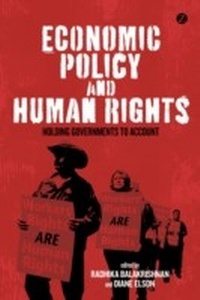
Economic Policy and Human Rights
Holding Governments to Account
Zed Books Ltd (Publisher)
1st Edition
Published on 10. November 2011
274 pages
978-1-84813-876-6 (ISBN)
Description

Economic Policy and Human Rights presents a powerful critique of three decades of neoliberal economic policies, assessed from the perspective of human rights norms. In doing so, it brings together two areas of thought and action that have hitherto been separate: progressive economics concerned with promoting economic justice and human development; and human rights analysis and advocacy.
Focussing on in-depth comparative case studies of the USA and Mexico and looking at issues such as public expenditure, taxation and international trade, the book shows that heterodox economic analysis benefits greatly from a deeper understanding of a human rights framework. This is something progressive economists have often been skeptical of, regarding it as too deeply entrenched in 'Western' norms, discourses and agendas. Such a categorical rejection is unwarranted. Instead, human rights norms can provide an invaluable ethical and accountability framework, challenging a narrow focus on efficiency and growth.
A vital book for anyone interested in human rights and harnessing economics to create a better world.
Focussing on in-depth comparative case studies of the USA and Mexico and looking at issues such as public expenditure, taxation and international trade, the book shows that heterodox economic analysis benefits greatly from a deeper understanding of a human rights framework. This is something progressive economists have often been skeptical of, regarding it as too deeply entrenched in 'Western' norms, discourses and agendas. Such a categorical rejection is unwarranted. Instead, human rights norms can provide an invaluable ethical and accountability framework, challenging a narrow focus on efficiency and growth.
A vital book for anyone interested in human rights and harnessing economics to create a better world.
Reviews / Votes
An insightful exploration of the relationship between human rights and economic policies. This book asks how we should evaluate economic policies in the light of the human rights commitments that states have signed up to, and offers practical tools for assessing the justice of alternative economic policy choices. In the current economic climate, the messages and frameworks for analysis should be taken seriously by policy makers and their advisors. For activists and advocacy groups, it offers the language to counter economic policy choices that undermine progress towards the realization of rights. * Sarah Cook, Director, United Nations Research Institute for Social Development * Recommended reading for anyone committed to social and economic justice. * Ceasefire * Economists have long struggled to find frameworks for integrating concerns of justice with economic policy formation. This refreshingly novel approach to assessing the effectiveness of macroeconomic policy offers a timely alternative lens that identifies human well-being as the main guidepost. Its most striking achievement lies in clearly delineating the linkages between human rights and macroeconomic policies, providing a tool to hold governments accountable to their human rights commitments. * Stephanie Seguino, University of Vermont *More details
Edition
1. Auflage
Language
English
Place of publication
London
United Kingdom
Publishing group
Bloomsbury Publishing PLC
Target group
College/higher education
Professional and scholarly
ISBN-13
978-1-84813-876-6 (9781848138766)
Copyright in bibliographic data and cover images is held by Nielsen Book Services Limited or by the publishers or by their respective licensors: all rights reserved.
Schweitzer Classification
Other editions
Additional editions
Book
11/2011
Zed Books Ltd
€41.40
Shipment within 3-4 weeks
Book
11/2011
Zed Books Ltd
€118.20
Shipment within 3-4 weeks
Persons
Radhika Balakrishnan, Executive Director of the Center for Women's Global Leadership, and Professor, Women's and Gender Studies at Rutgers, the State University of New Jersey. Previously, she was Professor of Economics and International Studies at Marymount Manhattan College. She has worked at the Ford Foundation as a program officer in the Asia Regional Program. She is currently the Chair of the Board of the US Human Rights Network and on the Board of the Center for Constitutional Rights.
Diane Elson holds a Chair in Sociology at the University of Essex, UK and is a member of the Essex Human Rights Centre. She has acted as advisor to UNIFEM, UNDP, Oxfam, and other development agencies and is a past vice president of the International Association for Feminist Economics. She has published widely on gender and development. Her academic degrees include a B.A. in philosophy, politics, and economics from the University of Oxford; and a Ph.D. in economics from the University of Manchester.
Diane Elson holds a Chair in Sociology at the University of Essex, UK and is a member of the Essex Human Rights Centre. She has acted as advisor to UNIFEM, UNDP, Oxfam, and other development agencies and is a past vice president of the International Association for Feminist Economics. She has published widely on gender and development. Her academic degrees include a B.A. in philosophy, politics, and economics from the University of Oxford; and a Ph.D. in economics from the University of Manchester.
Content
Economic Policies and Human Rights Obligations: An Introduction - Radhika Balakrishnan & Diane Elson Essex
1. Fiscal and Monetary Policy and the Right to Work and to Just and Favourable Conditions of Work: Mexico -Sarah Gammage & Kristina Pirker
2. Human Rights Dimensions of Fiscal and Monetary Policies: United States - Radhika Balakrishnan & James Heintz
3. Human Rights and Public Expenditure in Mexico - Daniela Ramirez Camacho
4. Human Rights and Public Expenditure in USA - Nursel Aydiner-Avsar and Diane Elson
5. Taxation and Economic and Social Rights in Mexico - Lourdes Colinas & Roberto Constantino
6. Taxation and Economic and Social Rights in USA - Radhika Balakrishnan
7. Trade Policy and Human Rights: Mexico - Alberto-Serdan-Rosales and Carlos Salas
8. Trade Policy and Human Rights Obligations of the USA: the Case of the North American Free Trade Agreement (NAFTA) - Nursel Aydiner-Avsar and Diane Elson
9. Regulation: the Case of Pension Reform and Human Rights in Mexico - Gabriel Lara
10. Regulation: the Case of Pension Reform and Human Rights in USA - Radhika Balakrishnan
1. Fiscal and Monetary Policy and the Right to Work and to Just and Favourable Conditions of Work: Mexico -Sarah Gammage & Kristina Pirker
2. Human Rights Dimensions of Fiscal and Monetary Policies: United States - Radhika Balakrishnan & James Heintz
3. Human Rights and Public Expenditure in Mexico - Daniela Ramirez Camacho
4. Human Rights and Public Expenditure in USA - Nursel Aydiner-Avsar and Diane Elson
5. Taxation and Economic and Social Rights in Mexico - Lourdes Colinas & Roberto Constantino
6. Taxation and Economic and Social Rights in USA - Radhika Balakrishnan
7. Trade Policy and Human Rights: Mexico - Alberto-Serdan-Rosales and Carlos Salas
8. Trade Policy and Human Rights Obligations of the USA: the Case of the North American Free Trade Agreement (NAFTA) - Nursel Aydiner-Avsar and Diane Elson
9. Regulation: the Case of Pension Reform and Human Rights in Mexico - Gabriel Lara
10. Regulation: the Case of Pension Reform and Human Rights in USA - Radhika Balakrishnan
