

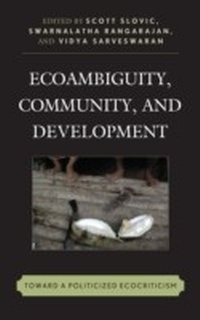
Ecoambiguity, Community, and Development
Toward a Politicized Ecocriticism
Lexington Books (Publisher)
1st Edition
Published on 19. February 2014
220 pages
978-0-7391-8909-2 (ISBN)
Description

Ecoambiguity, Community, and Development takes stock of cultural and environmental contexts in many different regions of the world by exploring literature and film. Artists and scholars working in the social ecology, environmental justice, and postcolonial arenas have long recognized that as soon as we tug on a thread of "ecodegradation," we generally find it linked to some form of cultural oppression. The reverse is also often true. In the spirit of postcolonial ecocriticism, the studies collected by Scott Slovic, R. Swarnalatha, and Vidya Sarveswaran emphasize the impossibility of disentangling environmental and cultural problems.
While not all the authors explicitly invoke Karen Thornber's term "ecoambiguity" or the concepts and terminology of postcolonial ecocriticism, their articles frequently bring to light various ironies. For example, the fact that Ukrainian environmental experience in the twenty-first century is defined by one of the world's most infamous industrial disasters, the Chernobyl nuclear accident of 1986, yet Ukrainian culture, like many throughout the world, actually cherishes a profound, even animistic, attachment to the wonders of nature. The repetition of this and other paradoxes in human cultural responses to the more-than-human world reinforces our sense of the congruities and idiosyncrasies of human culture. Every human culture, regardless of its condition of economic and industrial development, has produced its own version of "environmental literature and art"-but the nuances of this work reflect that culture's precise social and geophysical circumstances. In various ways, these stories of community and development from across the planet converge and diverge, as told and explained by distinguished scholars, many of whom come from the cultures represented in these articles.
While not all the authors explicitly invoke Karen Thornber's term "ecoambiguity" or the concepts and terminology of postcolonial ecocriticism, their articles frequently bring to light various ironies. For example, the fact that Ukrainian environmental experience in the twenty-first century is defined by one of the world's most infamous industrial disasters, the Chernobyl nuclear accident of 1986, yet Ukrainian culture, like many throughout the world, actually cherishes a profound, even animistic, attachment to the wonders of nature. The repetition of this and other paradoxes in human cultural responses to the more-than-human world reinforces our sense of the congruities and idiosyncrasies of human culture. Every human culture, regardless of its condition of economic and industrial development, has produced its own version of "environmental literature and art"-but the nuances of this work reflect that culture's precise social and geophysical circumstances. In various ways, these stories of community and development from across the planet converge and diverge, as told and explained by distinguished scholars, many of whom come from the cultures represented in these articles.
More details
Series
Edition
1. Auflage
Language
English
Place of publication
New York
United States
Publishing group
Bloomsbury Publishing Plc
Target group
Professional and scholarly
ISBN-13
978-0-7391-8909-2 (9780739189092)
Copyright in bibliographic data and cover images is held by Nielsen Book Services Limited or by the publishers or by their respective licensors: all rights reserved.
Schweitzer Classification
Other editions
Additional editions
Scott Slovic | Swarnalatha Rangarajan | Vidya Sarveswaran
Ecoambiguity, Community, and Development
Toward a Politicized Ecocriticism
Book
02/2014
Lexington Books
€116.50
Article exhausted; check different version
Persons
Vidya Sarveswaran is assistant professor of English in the Department of Humanities and Social Sciences at the Indian Institute of Technology Jodhpur. She has several journal articles to her credit, and has worked on several documentary films as a script writer.
Scott Slovic served as founding president of the Association for the Study of Literature and Environment and is editor of the journal ISLE: Interdisciplinary Studies in Literature and Environment. He is currently writing Fundamentals of Ecocriticism and Environmental Literature and editing The Cambridge Companion to American Literature and Environment.
Swarnalatha Rangarajan is associate professor of English at the Department of Humanities and Social Sciences at the Indian Institute of Technology Madras. She was the founding editor of the Indian Journal ofEcocriticism and has served as guest editor for two special issues on Indian ecosophy for The Trumpeter-the Canadian Journal of Deep Ecology.
Scott Slovic served as founding president of the Association for the Study of Literature and Environment and is editor of the journal ISLE: Interdisciplinary Studies in Literature and Environment. He is currently writing Fundamentals of Ecocriticism and Environmental Literature and editing The Cambridge Companion to American Literature and Environment.
Swarnalatha Rangarajan is associate professor of English at the Department of Humanities and Social Sciences at the Indian Institute of Technology Madras. She was the founding editor of the Indian Journal ofEcocriticism and has served as guest editor for two special issues on Indian ecosophy for The Trumpeter-the Canadian Journal of Deep Ecology.
Content
Table of Contents
Introduction
Scott Slovic, Swarnalatha Rangarajan, and Vidya Sarveswaran
Chapter 1: Plundering Borderlands North and South
Karen Thornber
Chapter 2: Tibet, a Topos in Ecopolitics of the Global South
Gang Yue
Chapter 3: Red China, Green Amnesia: Locating Environmental Justice in Contemporary Chinese Literature
Cheng Li and Yanjun Liu
Chapter 4: Minamata and the Symbolic Discourse of the South
Tsutomu Takahashi
Chapter 5: Indian Environmentalism and Its Fragments
Jyotirmaya Tripathy
Chapter 6: From Bhopal to Biometrics: Biological Citizenship in the Age of Globalization
Pamod Nayar
Chapter 7: Beyond the Eco-flaneur's Footsteps: Perambulatory Narration in Zakes Mda's Ways of Dying
Laura A. White
Chapter 8: Reconsidering the Eco-Imperatives of Ukrainian Consciousness: An Introduction to Ukrainian Environmental Literature
Inna Sukhenko
Chapter 9: Kissed by Lightning and Fourth Cinema's Natureculture Continuum
Salma Monani
Chapter 10: Under all the laws, natural, human, and divine: Reinterpreting La Leyenda Negra's Colonial Purpose
Dora Ramirez-Dhoore
Chapter 11: Mapmaking, Rubbertapping: Cartography and Social Ecology in Euclides da Cunha's The Amazon: Land Without History
Aarti Madan
Chapter 12: Down Under: New World Literatures and Ecocriticism
George B. Handley
Index
Contributors
Introduction
Scott Slovic, Swarnalatha Rangarajan, and Vidya Sarveswaran
Chapter 1: Plundering Borderlands North and South
Karen Thornber
Chapter 2: Tibet, a Topos in Ecopolitics of the Global South
Gang Yue
Chapter 3: Red China, Green Amnesia: Locating Environmental Justice in Contemporary Chinese Literature
Cheng Li and Yanjun Liu
Chapter 4: Minamata and the Symbolic Discourse of the South
Tsutomu Takahashi
Chapter 5: Indian Environmentalism and Its Fragments
Jyotirmaya Tripathy
Chapter 6: From Bhopal to Biometrics: Biological Citizenship in the Age of Globalization
Pamod Nayar
Chapter 7: Beyond the Eco-flaneur's Footsteps: Perambulatory Narration in Zakes Mda's Ways of Dying
Laura A. White
Chapter 8: Reconsidering the Eco-Imperatives of Ukrainian Consciousness: An Introduction to Ukrainian Environmental Literature
Inna Sukhenko
Chapter 9: Kissed by Lightning and Fourth Cinema's Natureculture Continuum
Salma Monani
Chapter 10: Under all the laws, natural, human, and divine: Reinterpreting La Leyenda Negra's Colonial Purpose
Dora Ramirez-Dhoore
Chapter 11: Mapmaking, Rubbertapping: Cartography and Social Ecology in Euclides da Cunha's The Amazon: Land Without History
Aarti Madan
Chapter 12: Down Under: New World Literatures and Ecocriticism
George B. Handley
Index
Contributors
