

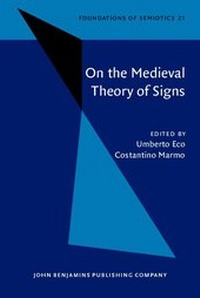
On the Medieval Theory of Signs
1st Edition
Published on 1. January 1989
IX, 224 pages
978-90-272-8604-8 (ISBN)
Description

In the course of the long debate on the nature and the classification of signs, from Boethius to Ockham, there are at least three lines of thought: the Stoic heritage, that influences Augustine, Abelard, Francis Bacon; the Aristotelian tradition, stemming from the commentaries on De Interpretatione; the discussion of the grammarians, from Priscian to the Modistae. Modern interpreters are frequently misled by the fact that the various authors regularly used the same terms. Such a homogeneous terminology, however, covers profound theoretical differences. The aim of these essays is to show that the medieval theory of signs does not represent a unique body of semiotic notions: there are diverse and frequently alternative semiotic theories. This book thus represents an attempt to encourage further research on the still unrecognized variety of the semiotic approaches offered by the medieval philosophies of language.
More details
Other editions
Additional editions
Book
01/1989
John Benjamins Publishing Co
€116.60
Shipment within 10-15 days
Persons
Content
- ON THE MEDIEVAL THEORY OF SIGNS
- Editorial page
- Title page
- Copyright page
- Table of contents
- Preface
- Section I
- On animal language in the medieval classification of signs*
- 1. The center and the marges: latratus canis
- 2. Signs and words
- 3. Aristotle
- 4. De Interpretatione 16a: from Boethius to Aquinas
- 5. Litterata and Articulata
- 6. Abelard: Institutio and Impositio
- 7. Augustine and the Stoic legacy
- 8. Roger Bacon
- 9. From intension to-extension
- Notes
- References
- Denotation
- Aristotle
- Boethius
- Anselm's 'appellatio'
- Abelard
- Aquinas
- The rising of the idea of supposition
- Bacon
- Duns Scotus and the Modistae
- Ockham
- After Ockham
- Conclusion
- Notes
- References
- Section II
- Thomas Aquinas: Natural semiotics and the epistemological process
- 1. Concerning the intellect
- 2. Sensation and Knowledge
- 3. Signs and the intellect
- 4. The reflexio and the intellect
- 5. A map of signs
- 6. The codes of reality
- Abbreviations
- References
- Sicut tabernarius vinum significat per circulum: Directions in contemporary interpretations of the Modistae
- 1. Modism as Worttheorie: Enders' hypothesis
- 2. Chomsky, Ockham and the Modistae
- 3. Young Heidegger, Husserl, and categorial grammars
- 4. Conclusion
- Notes
- References
- Ontology and semantics in the logic of Duns Scotus*
- 0. Introduction
- 1. Some remarks on Scotus' ontology
- 2. Scotus' semantics
- Conclusion
- Notes
- References
- Mental signs and the theory of representation in Ockham
- 1. Linguistic signs
- 2. The semiotic status of mental linguistic signs
- 3. Mental signs, knowledge, and the language of angels
- 4. The question of mental syncategoremata
- 5. Mental language and the theory of representation
- Notes
- References
- The series Foundations of Semiotics
