

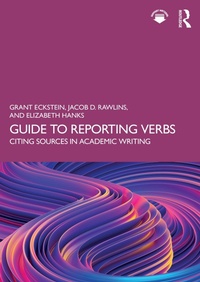
Guide to Reporting Verbs
Citing Sources in Academic Writing
1st Edition
Published on 8. August 2025
260 pages
978-1-040-36005-7 (ISBN)
Description

Guide to Reporting Verbs is an accessible guide to citing sources in academic writing across the disciplines. The way writers introduce previous literature is essential to authorial voice. Specifically, the effective use of reporting verbs can highlight important details about the cited work while allowing writers to present themselves as experts in their field. This reference guide lists the most common reporting verbs across various disciplines in the hard and soft sciences and provides important information about how they can be used in academic writing.
The book:
lists prevalent reporting verbs across six disciplines: applied linguistics, biology, history, philosophy, political science, and physics
provides information on authorial voice for each reporting verb
highlights effective use of each reporting verb through inclusion of a definition, the lemma along with a few members of the word family, stance act(s), common contextual environments, example sentences from academic sources, the verb's frequency in academic writing (based on two corpora, or databases), and the verb's relative frequencies across disciplines
offers practical tasks and exercises for students as online support material
Organized so that readers can use the guide as either a quick reference or a study aide, this resource will empower students to use appropriate, discipline-specific reporting verbs in their academic writing.
The book:
lists prevalent reporting verbs across six disciplines: applied linguistics, biology, history, philosophy, political science, and physics
provides information on authorial voice for each reporting verb
highlights effective use of each reporting verb through inclusion of a definition, the lemma along with a few members of the word family, stance act(s), common contextual environments, example sentences from academic sources, the verb's frequency in academic writing (based on two corpora, or databases), and the verb's relative frequencies across disciplines
offers practical tasks and exercises for students as online support material
Organized so that readers can use the guide as either a quick reference or a study aide, this resource will empower students to use appropriate, discipline-specific reporting verbs in their academic writing.
More details
Edition
1. Auflage
Language
English
Place of publication
London
United Kingdom
Publishing group
Taylor & Francis Ltd
Target group
College/higher education
Illustrations
159 Tables, black and white; 155 Line drawings, black and white; 155 Illustrations, black and white
File size
3,38 MB
ISBN-13
978-1-040-36005-7 (9781040360057)
Copyright in bibliographic data and cover images is held by Nielsen Book Services Limited or by the publishers or by their respective licensors: all rights reserved.
Schweitzer Classification
Other editions
Additional editions
Grant Eckstein | Jacob D. Rawlins | Elizabeth Hanks
Guide to Reporting Verbs
Citing Sources in Academic Writing
Book
08/2025
1st Edition
Routledge
€57.30
Shipment within 10-20 days
Grant Eckstein | Jacob D. Rawlins | Elizabeth Hanks
Guide to Reporting Verbs
Citing Sources in Academic Writing
Book
08/2025
1st Edition
Routledge
€205.70
Shipment within 10-20 days

Book
06/2025
Routledge
Unfortunately, price unknown
Available (delivery time upon request)
Persons
Grant Eckstein is Associate Professor of Linguistics at Brigham Young University, USA. He is the associate editor of the Journal of Response to Writing and co-author of Curriculum Development for Intensive English Programs (2022).
Jacob D. Rawlins is Associate Professor in the Linguistics department at Brigham Young University, USA. He is an associate editor of the International Journal of Business Communication. His books include Language Prescription: Values, Ideologies and Identity (2020).
Elizabeth Hanks is an Assistant Professor of Applied Linguistics at the University of South Florida. She uses corpus methods to address questions related to vocabulary, pragmatics, and register.
Jacob D. Rawlins is Associate Professor in the Linguistics department at Brigham Young University, USA. He is an associate editor of the International Journal of Business Communication. His books include Language Prescription: Values, Ideologies and Identity (2020).
Elizabeth Hanks is an Assistant Professor of Applied Linguistics at the University of South Florida. She uses corpus methods to address questions related to vocabulary, pragmatics, and register.
Content
Preface
Acknowledgments
Abbreviations
Introduction to Reporting Verbs
Methods
Instructions for Using this Guide
Frequent Reporting Verbs
Complete List of Reporting Verbs
Acknowledgments
Abbreviations
Introduction to Reporting Verbs
Methods
Instructions for Using this Guide
Frequent Reporting Verbs
Complete List of Reporting Verbs
