

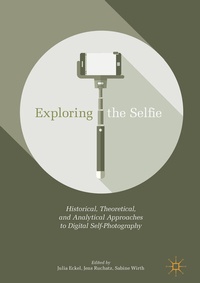
Exploring the Selfie
Historical, Theoretical, and Analytical Approaches to Digital Self-Photography
1st Edition
Published on 6. April 2018
XXI, 392 pages
978-3-319-57949-8 (ISBN)
Description

This volume explores the selfie not only as a specific photographic practice that is deeply rooted in digital culture, but also how it is understood in relation to other media of self-portrayal. Unlike the public debate about the dangers of 'selfie-narcissism', this anthology discusses what the practice of taking and sharing selfies can tell us about media culture today: can the selfie be critiqued as an image or rather as a social practice? What are the technological conditions of this form of vernacular photography? By gathering articles from the fields of media studies; art history; cultural studies; visual studies; philosophy; sociology and ethnography, this book provides a media archaeological perspective that highlights the relevance of the selfie as a stereotypical as well as creative practice of dealing with ourselves in relation to technology.
Reviews / Votes
"The chapters in this volume clearly point out that exploring selfies and selfie culture requires an interdisciplinary approach. The book therefore gathers contributions from the fields of Media Studies, Art History, Cultural Studies, Visual Studies, Philosophy, Sociology, and Ethnography, providing an overview of the different positions between the two main approaches of selfie research . and attempts to reconcile them." (Scriptable, rtreview.org, Issue 28, August, 2018)More details
Series
Language
English
Place of publication
Cham
Switzerland
Publishing group
Springer International Publishing
Product notice
Reflowable
Illustrations
XXI, 392 p. 44 illus., 40 illus. in color.
File size
10,53 MB
ISBN-13
978-3-319-57949-8 (9783319579498)
DOI
10.1007/978-3-319-57949-8
Schweitzer Classification
Other editions
Additional editions
Julia Eckel | Jens Ruchatz | Sabine Wirth
Exploring the Selfie
Historical, Theoretical, and Analytical Approaches to Digital Self-Photography
Book
04/2018
Palgrave Macmillan
€171.19
Shipment within 10-15 days
Persons
Julia Eckel is Research and Teaching Associate at the Institute of Media Studies at Philipps-University Marburg, Germany.
Jens Ruchatz is Professor of audiovisual transfer processes at the Institute of Media Studies at Philipps-University Marburg, Germany.
Sabine Wirth is Research and Teaching Associate at the Institute of Media Studies at Philipps-University Marburg, Germany.
Jens Ruchatz is Professor of audiovisual transfer processes at the Institute of Media Studies at Philipps-University Marburg, Germany.
Sabine Wirth is Research and Teaching Associate at the Institute of Media Studies at Philipps-University Marburg, Germany.
Content
1.The Selfie as Image (and) Practice - Approaching Digital Self-Photography.- 2. The Consecration of the Selfie. A Cultural History.- 3. Selfie-Reflexivity. Pictures of People Taking Photographs.- 4. Locating the 'Selfie' Within Photography's History - and Beyond.- 5. The Selfie as Feedback: Video, Narcissism, and the Closed-Circuit Video Installation.- 6. The Selfie and the Face.- 7. Selfies & Authorship - On the Displayed Authorship and the Author Function of the Selfie.- 8. Competitive Photography and the Presentation of the Self.- 9. Of Duckfaces and Cat-beards: Why Do Selfies Need Genres?.- 10. Interfacing the Self - Smartphone Snaps and the Temporality of the Selfie.- 11.The Video Selfie as Act and Artefact of Recording.- 12. Be a Hero - Self-Shoots at the Edge of the Abyss.- 13. Strike a Pose: Robot Selfies.- 14. Selfies and Purikura as Affective, Aesthetic Labour.- 15.The Kid Selfie as Self-Inscription: Re-Inventing an Emerging Media Practice.- 16."Machos" and "Top Girls": Photographic Self-Images of Berlin Hauptschüler.-
