

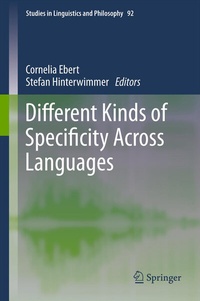
Different Kinds of Specificity Across Languages
Description

This anthology of papers analyzes a range of specificity markers found in natural languages. It reflects the fact that despite intensive research into these markers, the vast differences between the markers across languages and even within single languages have been less acknowledged. Commonly regarded specific indefinites are by no means a homogenous class, and so this volume fills a gap in our understanding of the semantics and pragmatics of indefinites.
The papers explore differences and similarities among these specificity markers, concentrating on the following issues: whether specificity is a purely semantic or also a pragmatic notion ; whether the contribution of specificity markers is located on the level of the at-issue content; whether some kind of speaker-listener asymmetry concerning the identification of the referent is involved; and the behavioral scope of these indefinites in the context of other quantifiers, negation, attitude verbs, and intensional/modal operators.
More details
Other editions
Additional editions
Content
Introduction by Cornelia Ebert and Stefan Hinterwimmer .- Specificity Markers and Nominal Exclamatives in French by Fabienne Martin .- The Interpretation of the German Specificity Markers bestimmt and gewiss by Christian Ebert, Cornelia Ebert and Stefan Hinterwimmer .- Pragmatic Variation among Specificity Markers by Tania Ionin .- Certain Presuppositions and some Intermediate Readings, and Vice Versa by Igor Yanovich .- Exceptional Scope: The Case of Spanish by Luis Alonso-Ovalle and Paula Menéndez-Benito .- The Distribution of two Indefinite Articles - The Case of Uzbek by Klaus von Heusinger and Udo Klein .- Scenarios of Equivalence - The Case of quelque by Jacques Jayez and Lucia M. Tovena .
