

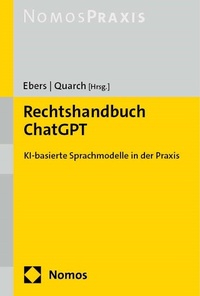
Rechtshandbuch ChatGPT
Description

Der Einsatz generativer künstlicher Intelligenz
hat mit OpenAI’s ChatGPT, Microsoft’s Copilot, Google’s Gemini und anderen großen Sprachmodellen die juristische Arbeit erreicht. Immer mehr Vorgänge in Unternehmen werden durch KI vorbereitet. Rechtsanwender:innen müssen die rechtlichen Probleme kennen und lösen.
Das neue Rechtshandbuch
zeigt, welche KI-Einsatzmöglichkeiten bei großen Sprachmodellen bestehen, was erlaubt ist und welchen Haftungsrisiken sich KI-Anwender:innen aussetzen.
Das Werk
• führt fachübergreifend in die Grundlagen der KI, Technologien, Fachtermini und Funktionsweisen der Systeme ein
• zeigt den aktuellen Rechtsrahmen des KI-Einsatzes auf (KI-VO und DSA bereits berücksichtigt) und
• gibt präzise juristische Antworten und Gestaltungshinweise auf und für praxisrelevante Fragestellungen beim Einsatz von ChatGPT & Co.
Besonders praxisnah
Die Darstellung in konkreten KI-Anwendungsfeldern:
• Arbeits-/Antidiskriminierungsrecht, Urheber-/Medienrecht, Datenschutz, Haftung/Product Compliance, Verbraucherrecht, Medizinrecht, Lauterkeitsrecht und Versicherungsrecht
• Rechtsdienstleistung nach RDG und BRAO
• Zivil- und Strafprozess, Steuerverwaltung und Notariat

More details
Other editions
Additional editions
Persons
Herausgegeben von
- Prof. Dr. Martin Ebers
- Dr. Benedikt M. Quarch, LL.B., M.A.
Bearbeitet von
RAin Patricia Batista, M.A. | Dr. Judit Bayer | RA Dr. Marc Bohlen, LL.M. (Stellenbosch) | RA Tom Braegelmann, LL.M. | Prof. Dr. Martin Ebers | RA u Mediator Philipp Eder, M.A. | RA u StB Oliver C. Ehrmann, FAStR | Prof. Dr. Jan Eichelberger, LL.M.oec. | Dr. Melanie Epe, LL.B., M.A. | RAin Lucia Franke, B.A. | Prof. Dr. Patrick Glauner | Dr. Jakob Horn, LL.M. (Harvard) | Prof. Dr. Sarah Legner | Jan-Laurin Müller | RA u Notar Dr. Pierre Plottek, FAErbR | Dr. Benedikt M. Quarch, LL.B., M.A. | Dr. Dr. Hans Steege | RAin Olga Stepanova, LL.M. (Berkeley) | Ass.Jur. Stella Thomas | Jun.-Prof. Dr. Johann Justus Vasel, LL.M. (NYU) | RA Bernhard Veeck, LL.M. | RA Tianyu Yuan
