

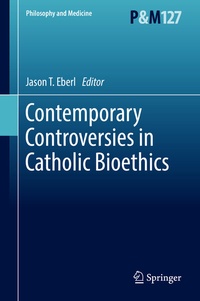
Contemporary Controversies in Catholic Bioethics
Description

This volume comprises various viewpoints representing a Catholic perspective on contemporary practices in medicine and biomedical research. The Roman Catholic Church has had a significant impact upon the formulation and application of moral values and principles to a wide range of controversial issues in bioethics. Catholic leaders, theologians, and bioethicists have elucidated and marshaled arguments to support the Church's definitive positions on several bioethical issues, such as abortion, euthanasia, and reproductive cloning. Not all bioethical issues, however, have been definitively addressed by Catholic authorities, and some Church teachings allow for differing applications in diverse circumstances. Moreover, as new biomedical technologies emerge, Church authorities rely on experts in science, medicine, philosophy, theology, law, and other disciplines to advise them. Such experts continue to debate issues related to reproduction, genetics, end-of-life care, and health care policy. This volume will be a valuable resource for scholars in bioethics or Catholic studies, who will benefit from the nuanced arguments offered based on the latest research. This volume is also instructive for students entering the field to become aware of the founding philosophical and theological principles informing the Catholic bioethical worldview.
Reviews / Votes
"The articles in this book make this a valuable resource for scholars in bioethics, theology, and philosophy, as well as for clinical bioethicists working in Catholic healthcare. Furthermore, this book will be helpful to students wishing to explore current Catholic bioethics debates. . This is a much-needed contribution to Catholic bioethics literature. The expansive exploration of controversial topics in Catholic bioethics by prominent Catholic scholars makes this a book that Catholic bioethicists should have on their shelves." (Jacob R. Harrison, Doody's Book Reviews, April, 2018)More details
Other editions
Additional editions
Person
Jason T. Eberl, Ph.D. is the Semler Endowed Chair for Medical Ethics in the College of Osteopathic Medicine and Professor of Philosophy at Marian University in Indianapolis. He is also an affiliate faculty member of the Indiana University Center for Bioethics and the Fairbanks Center for Medical Ethics at IU Health. His research interests include the philosophy of human nature and its application to issues at the margins of life; ethical issues related to end-of-life care, genetics, and healthcare allocation; and the philosophical thought of Thomas Aquinas. He is the author of Thomistic Principles and Bioethics (Routledge 2006) and The Routledge Guidebook to Aquinas's Summa Theologiae (Routledge 2015), and has published articles in The National Catholic Bioethics Quarterly, The Linacre Quarterly, Review of Metaphysics, International Philosophical Quarterly, The Modern Schoolman, Journal of Medicine and Philosophy, Theoretical Medicine and Bioethics, American Journal of Bioethics, and Bioethics.
