

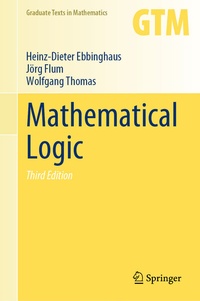
Mathematical Logic
Description

This textbook introduces first-order logic and its role in the foundations of mathematics by examining fundamental questions. What is a mathematical proof? How can mathematical proofs be justified? Are there limitations to provability? To what extent can machines carry out mathematical proofs? In answering these questions, this textbook explores the capabilities and limitations of algorithms and proof methods in mathematics and computer science.
The chapters are carefully organized, featuring complete proofs and numerous examples throughout. Beginning with motivating examples, the book goes on to present the syntax and semantics of first-order logic. After providing a sequent calculus for this logic, a Henkin-type proof of the completeness theorem is given. These introductory chapters prepare the reader for the advanced topics that follow, such as Gödel's Incompleteness Theorems, Trakhtenbrot's undecidability theorem, Lindström's theorems on the maximality of first-order logic, and results linking logic with automata theory. This new edition features many modernizations, as well as two additional important results: The decidability of Presburger arithmetic, and the decidability of the weak monadic theory of the successor function.
Mathematical Logic is ideal for students beginning their studies in logic and the foundations of mathematics. Although the primary audience for this textbook will be graduate students or advanced undergraduates in mathematics or computer science, in fact the book has few formal prerequisites. It demands of the reader only mathematical maturity and experience with basic abstract structures, such as those encountered in discrete mathematics or algebra.
Reviews / Votes
"This newest edition has been reclassified, fittingly, as a graduate text, and it is admirably suited to that role. . Those who are already well-versed in logic will find this text to be a valuable reference and a strong resource for teaching at the graduate level, while those who are new to the field will come to know not only how mathematical logic is studied but also, perhaps more importantly, why." (Stephen Walk, MAA Reviews, January 6, 2023)More details
Other editions
Additional editions
Persons
Jörg Flum is Professor Emeritus at the Mathematical Institute of the University of Freiburg. His research interests include mathematical logic, finite model theory, and parameterized complexity theory.
Wolfgang Thomas is Professor Emeritus at the Computer Science Department of RWTH Aachen University. His research interests focus on logic in computer science, in particular logical aspects of automata theory.