

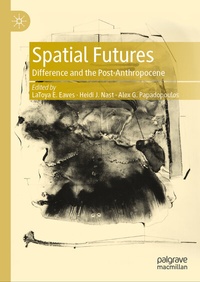
Spatial Futures
Description

Spatial Futures invites readers to imagine power and freedom through the lens of the 'Black Outdoors', a transdisciplinary spatial concept that operates beyond the planetary, stratigraphic confines of the 'Anthropocene'. The chapters collectively point to the ontological-epistemological contradictions involved in forging liberatory spatial futures. Bringing new spatial imaginaries to bear in and outside geography, the book refuses the strictures of the 'cenic', entertaining difference as world-making.
Reviews / Votes
"This collection brims with the insurgent thinking needed to imagine spatial futures beyond the enclosures and modes of valuation that nation, capital, property, and racial supremacy have deployed to devastating planetary effect. Working through, within, and from Blackness, this superb collection shows us how relational thought and practice can create spatial subjectivities of liberation."- Mabel Wilson, Professor and Co-Director of Global Africa Lab, Graduate School of Architecture, Planning and Preservation, Columbia University, USA and author of Negro Building: Black Americans in the World of Fairs and Museums"Here is a primer that tracks and unharnesses colonial time, offering capacious possibilities for otherworldbuilding. Drawing on wide-ranging analytical contexts, the collection draws attention to the multifarious ways that capital, finance, and militarism circulate through, bear down on, and generate alternative expressions of planetary well-being."--Katherine McKittrick, Professor and Canada Research Chair in Black Studies, Queen's University, Canada and author of Dear Science and Other Stories
"This collection plots new ontological ground for moving beyond the geo-logic violence of the Anthropocene, building on liberatory pathways, present and past." --Maano Ramutsindela, Professor, University of Cape Town, South Africa and author of Transfrontier Conservation in Africa: At the Confluence of Capital, Politics and Nature
More details
Other editions
Additional editions
Persons
LaToya E. Eaves, PhD, Associate Professor of Geography, University of Tennessee, Knoxville, is a scholar of Black geographies. Her research emphasizes questions of power, non-essentialism and embodiment, centering Blackness, gender, Black feminism, and the U.S. South.
Heidi J. Nast, PhD, Professor of International Studies, DePaul University, is interested in how difference evolutionarily, culturally, and ontologically unfolds and operates across worlds and psyches, the power that difference serves, and the difference that power makes.
Alex G. Papadopoulos, PhD, Professor of Geography, DePaul University. An urban and political geographer, his specialties range from geopolitics and applied diplomacy, to heritage studies, regional analysis, and LGBTIQ+ studies.
