

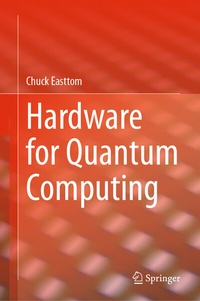
Hardware for Quantum Computing
Description

This book covers extensively the physical implementation of qubits and quantum architecture. The author demonstrates how quantum computing is implemented by the underlying physical implementation of qubits, including trapped ions, nitrogen vacancy centers, frozen neon, and other implementations. The book shows how, ultimately, the physical implementation of the qubit is the foundation of quantum computing, and that the choice of physical qubit will impact such things as decoherence times, computational efficiency, and even error rate. The book explores all the current approaches to physical qubit implementation and includes appendices that review basic quantum computing and physics.
More details
Other editions
Additional editions
Person
Dr. Chuck Easttom is the author of 42 books, including several on computer security, forensics, and cryptography. He is also an inventor with 26 patents and the author of over 70 research papers. He holds a Ph.D. in computer science, a Ph.D. in Nanotechnology, and a Doctor of Science in Cybersecurity, and four master's degrees (one in applied computer science, one in education, one in Strategic and Defense studies, and one in systems engineering). He is a senior member of both the IEEE and the ACM. He is also a Distinguished Speaker of the ACM and a Distinguished Visitor of the IEEE. Dr. Easttom is currently an adjunct professor for Georgetown University and for Vanderbilt University.
Content
Chapter 1. Trapped Ion Quantum Computing.- Chapter 2. Superconducting Quantum Computing.- Chapter 3. Photonic Quantum Computing.- Chapter 4. Bose - Einstein Condensate.- Chapter 5. Nitrogen Vacancy Centers.- Chapter 6. Nuclear Magnetic Resonance Quantum Computing.- Chapter 7. Electron Based Quantum Computing.- Chapter 8. Fullerene Based Quantum Computers.- Chapter 9. D-Wave and Adiabatic Quantum Computing.- Chapter 10. Topological Quantum Computing.- Chapter 11. Neutral Atom Based Quantum Computing.- Chapter 12. Reducing Noise and Error Correcting.
