

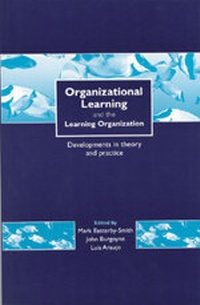
Organizational Learning and the Learning Organization
Developments in Theory and Practice
1st Edition
Published on 16. April 1999
256 pages
978-0-85702-209-7 (ISBN)
Description

`The introduction chaper by Mark Easterby-Smith and Luis Araujo introduces the reader to the unresolved issues with which the field is still grappling today.... All in all, this is an interesting and useful book for both researcher and manager alike. First, and perhaps most importantly, the book incorporates multiple perspectives on learning - the psychological, sociological and the philosophical... Second, the book is neither purely theory driven, nor purely empirically driven. Theoretical contributions are complemented by empirical studies which help to illustrate the application of the theoretical contructs. I suspect that this would be of immense value to the practicing manager. Finally, the book provides a critical commentary on the state of the field in a nice compact way which should enhance its value to scholars in this area... a book which is both useful and interesting' - Organisational Studies
`[M]ost importantly, the book incorporates multiple perspectives on learning - the psychological, sociological and the philosohical... provides a critical commentary on the state of the field in a nice, compact way which should enhance its value to scholars' - Organization Studies
`A valuable resource for academics and practitioners in management and corporate strategy, as well as those involved in mangement training and development' - European Foundation for Management Development
`This is a particularly interesting and useful work because it combines some chapters which deal primarily in concepts or indeed theories, and others which describe the experiences of trying to carry out the practices involved in creating both/either organisational learning and/or the learning organisation' -Industrial and Commercial Training
'The editors' overall assessment is that there has been insufficient dialogue between the two camps of action research and theorizing.... As a contribution to mapping this divided house, the text is an apt illustration of these problems. The editor's overview is of interest...' - Stephen Gibb, University of Strathclyde, MCB University Press
The debates surrounding concepts of `organizational learning' and the `learning organization' receive a welcome synthezis in this book. International experts explore the links between the two fields of enquiry, which hitherto, despite their intersecting concerns, have represented separate constituencies, literatures and perspectives.
The book provides a much-needed integrated framework of concepts and theories which draws on current insights from management cognition, theories of knowledge and learning, management practice and work psychology.
`[M]ost importantly, the book incorporates multiple perspectives on learning - the psychological, sociological and the philosohical... provides a critical commentary on the state of the field in a nice, compact way which should enhance its value to scholars' - Organization Studies
`A valuable resource for academics and practitioners in management and corporate strategy, as well as those involved in mangement training and development' - European Foundation for Management Development
`This is a particularly interesting and useful work because it combines some chapters which deal primarily in concepts or indeed theories, and others which describe the experiences of trying to carry out the practices involved in creating both/either organisational learning and/or the learning organisation' -Industrial and Commercial Training
'The editors' overall assessment is that there has been insufficient dialogue between the two camps of action research and theorizing.... As a contribution to mapping this divided house, the text is an apt illustration of these problems. The editor's overview is of interest...' - Stephen Gibb, University of Strathclyde, MCB University Press
The debates surrounding concepts of `organizational learning' and the `learning organization' receive a welcome synthezis in this book. International experts explore the links between the two fields of enquiry, which hitherto, despite their intersecting concerns, have represented separate constituencies, literatures and perspectives.
The book provides a much-needed integrated framework of concepts and theories which draws on current insights from management cognition, theories of knowledge and learning, management practice and work psychology.
Reviews / Votes
`The introduction chaper by Mark Easterby-Smith and Luis Araujo introduces the reader to the unresolved issues with which the field is still grappling today.... All in all, this is an interesting and useful book for both researcher and manager alike. First, and perhaps most importantly, the book incorporates multiple perspectives on learning - the psychological, sociological and the philosophical... Second, the book is neither purely theory driven, nor purely empirically driven. Theoretical contributions are complemented by empirical studies which help to illustrate the application of the theoretical contructs. I suspect that this would be of immense value to the practicing manager. Finally, the book provides a critical commentary on the state of the field in a nice compact way which should enhance its value to scholars in this area.... a book which is both useful and interesting' - Organisational Studies`A valuable resource for academics and practitioners in management and corporate strategy, as well as those involved in mangement training and development' - European Foundation for Management Development
'The editors' overall assessment is that there has been insufficient dialogue between the two camps of action research and theorizing. ... As a contribution to mapping this divided house, the text is an apt illustration of these problems. The editor's overview is of interest...' - Stephen Gibb, University of Strathclyde, MCB University Press
`This is a particularly interesting and useful work because it combines some chapters which deal primarily in concepts or indeed theories, and others which describe the experiences of trying to carry out the practices involved in creating both/either organisational learning and/or the learning organisation.... There are some excellent practical chapters.... For trainers and developers, this book is worthwhile particularly for the contributions of these last two authors, since it might enable them to avoid some of the problems which they might encounter in trying to facilitate the creation of organizational learning' - Industrial and Commercial Training
More details
Language
English
Place of publication
London
United Kingdom
Target group
College/higher education
Professional and scholarly
ISBN-13
978-0-85702-209-7 (9780857022097)
Copyright in bibliographic data and cover images is held by Nielsen Book Services Limited or by the publishers or by their respective licensors: all rights reserved.
Schweitzer Classification
Other editions
Additional editions
Mark Easterby-Smith | Luis Araujo | John G. Burgoyne
Organizational Learning and the Learning Organization
Developments in Theory and Practice
Book
04/1999
1st Edition
SAGE Publications Inc
€133.40
Shipment within 15-20 days
Mark Easterby-Smith | Luis Araujo | John G. Burgoyne
Organizational Learning and the Learning Organization
Developments in Theory and Practice
Book
04/1999
1st Edition
SAGE Publications Inc
€248.09
Article exhausted; check different version
Persons
Mark Easterby-Smith passed away in 2020. He was an Emeritus Professor at the University of Lancaster. His field was organizational learning. He had a first degree in Engineering Science and a PhD in Organizational Behaviour from Durham University and was an active researcher for over 30 years with primary interests in methodology and learning processes. He carried out evaluation studies in many European companies, and led research projects on management development, organizational learning, dynamic capabilities and knowledge transfer across international organizations in the UK, India and China.
Mark published numerous academic papers and over ten books including: Auditing Management Development (Gower, 1980); The Challenge to Western Management Development (Routledge, 1989); Evaluation of Management Education, Training and Development (Gower, 1994); Organizational Learning and the Learning Organization (Sage, 1998); The Handbook of Organizational Learning and Knowledge Management, 2nd edn (Wiley, 2011).
At Lancaster he was, variously, Director of the School's Doctoral Programme, Director of the Graduate Management School and Head of Department. Externally he spent several years as a visiting faculty member on the International Teachers' Programme, acting as Director when it was held at the London Business School in 1984. During the early 1990s he was national co-ordinator of the Management Teaching Fellowship Scheme funded by the UK's Economic and Social Research Council (ESRC), which was responsible for training 180 new faculty members across UK management schools. He was a former member of the ESRC Post-graduate Training Board and was President of the British Academy of Management in 2006 and Dean of Fellows in 2008.
I am broadly interested in understanding how and why industrial firms form and develop different types of exchange relationshipsa and engage in particular types of market practices. What follows is a description of my current interests. John Burgoyne is now semi-retired from the Department of Management Learning and Leadershi at Lancaster University. He is a visiting Professor at University Campus Suffolk, an Associate at Ashridge and Henley Business Schools, and a Trustee at Brathay Trust.
Mark published numerous academic papers and over ten books including: Auditing Management Development (Gower, 1980); The Challenge to Western Management Development (Routledge, 1989); Evaluation of Management Education, Training and Development (Gower, 1994); Organizational Learning and the Learning Organization (Sage, 1998); The Handbook of Organizational Learning and Knowledge Management, 2nd edn (Wiley, 2011).
At Lancaster he was, variously, Director of the School's Doctoral Programme, Director of the Graduate Management School and Head of Department. Externally he spent several years as a visiting faculty member on the International Teachers' Programme, acting as Director when it was held at the London Business School in 1984. During the early 1990s he was national co-ordinator of the Management Teaching Fellowship Scheme funded by the UK's Economic and Social Research Council (ESRC), which was responsible for training 180 new faculty members across UK management schools. He was a former member of the ESRC Post-graduate Training Board and was President of the British Academy of Management in 2006 and Dean of Fellows in 2008.
I am broadly interested in understanding how and why industrial firms form and develop different types of exchange relationshipsa and engage in particular types of market practices. What follows is a description of my current interests. John Burgoyne is now semi-retired from the Department of Management Learning and Leadershi at Lancaster University. He is a visiting Professor at University Campus Suffolk, an Associate at Ashridge and Henley Business Schools, and a Trustee at Brathay Trust.
Content
Organizational Learning - Mark Easterby-Smith and Luis Araujo
Current Debates and Opportunities
PART ONE: REVIEW AND CRITIQUES
Organizational Learning - Christiane Prange
Desperately Seeking Theory?
Organizational Learning as the Development of Stories - David Sims
Balancing Biases - Marleen Huysman
A Critical Review of the Literature on Organizational Learning
In Search of a Social Learning Theory - Bente Elkajaer
PART TWO: EVALUATIONS OF PRACTICE
The Role of Evaluative Inquiry in Creating Learning Organizations - Hallie Preskill and Rosalie Torres
Learning across Organizational Boundaries - Nancy Dixon
The Concept of the 'Learning Organization' Applied to the Transformation of the Public Sector - Matthias Finger and Silvia B[um]urgin Brand
Learning, Trust and Organizational Change - Amy Edmondson and Bertrand Moingeon
Project Design for Learning and Innovation - Karen Ayas
Organizational Learning and Organizational Forgetting - Frank Blackler, Norman Crump and Seonaidh McDonald
Developing Learning Managers within Learning Organizations - Elena Anthonocopoulou
Current Debates and Opportunities
PART ONE: REVIEW AND CRITIQUES
Organizational Learning - Christiane Prange
Desperately Seeking Theory?
Organizational Learning as the Development of Stories - David Sims
Balancing Biases - Marleen Huysman
A Critical Review of the Literature on Organizational Learning
In Search of a Social Learning Theory - Bente Elkajaer
PART TWO: EVALUATIONS OF PRACTICE
The Role of Evaluative Inquiry in Creating Learning Organizations - Hallie Preskill and Rosalie Torres
Learning across Organizational Boundaries - Nancy Dixon
The Concept of the 'Learning Organization' Applied to the Transformation of the Public Sector - Matthias Finger and Silvia B[um]urgin Brand
Learning, Trust and Organizational Change - Amy Edmondson and Bertrand Moingeon
Project Design for Learning and Innovation - Karen Ayas
Organizational Learning and Organizational Forgetting - Frank Blackler, Norman Crump and Seonaidh McDonald
Developing Learning Managers within Learning Organizations - Elena Anthonocopoulou
