

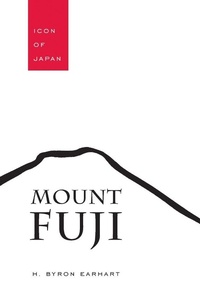
Mount Fuji
Description

The first comprehensive English-language study of the evolving religious and aesthetic symbolism of the world's most famous mountain
Illustrated with color and black-and-white images of the mountain and its associated religious practices, H. Byron Earhart's study utilizes his decades of fieldwork-including climbing Fuji with three pilgrimage groups-and his research into Japanese and Western sources to offer a comprehensive overview of the evolving imagery of Mount Fuji from ancient times to the present day. Included in the book is a link to his twenty-eight minute streaming video documentary of Fuji pilgrimage and practice, Fuji: Sacred Mountain of Japan.
Beginning with early reflections on the beauty and power associated with the mountain in medieval Japanese literature, Earhart examines how these qualities fostered spiritual practices such as Shugendo, which established rituals and a temple complex at the mountain as a portal to an ascetic otherworld. As a focus of worship, the mountain became a source of spiritual insight, rebirth, and prophecy through the practitioners Kakugyo and Jikigyo, whose teachings led to social movements such as Fujido (the way of Fuji) and to a variety of pilgrimage confraternities making images and replicas of the mountain for use in local rituals.
Earhart shows how the seventeenth-century commodification of Mount Fuji inspired powerful interpretive renderings of the "peerless" mountain of Japan, such as those of the nineteenth-century print masters Hiroshige and Hokusai, which were largely responsible for creating the international reputation of Mount Fuji. In the eighteenth and nineteenth centuries, images of Fuji served as an expression of a unique and superior Japanese culture. With its distinctive shape firmly embedded in Japanese culture but its ethical, ritual, and spiritual associations made malleable over time, Mount Fuji came to symbolize ultranationalistic ambitions in the 1930s and early 1940s, peacetime democracy as early as 1946, and a host of artistic, naturalistic, and commercial causes, even the exotic and erotic, in the decades since.
All prices
More details
Other editions
Additional editions
Person
For more than four decades H. Byron Earhart has taught and published in the areas of comparative religion and Japanese religion. An emeritus professor of comparative religion at Western Michigan University, he is the author of Japanese Religion: Unity and Diversity, Religions of Japan: Many Traditions within One Sacred Way, and other books. Earhart lives in San Diego.
Content
- Cover
- Title
- Copyright
- Contents
- List of Illustrations
- Series Editor's Preface
- Acknowledgments
- Preface: Invitation to Fuji
- A Note on Japanese Names and Terms and on Citations
- Part 1 The Power and Beauty of a Mountain
- 1 The Power of the Volcano: Fire and Water
- The Story of a Mountain: Natural and Cultural
- From Volcano to Sacred Mountain
- 2 The Beauty of the Ideal Mountain: Early Poetry and Painting
- Fuji in Early Writing
- Fuji in Classical Painting
- 3 Asceticism: Opening the Mountain
- Fuji Pioneers: En no Gyoja and Matsudai Shonin
- Shugendo: Fuji as an Ascetic Otherworld
- Part 2 The Dynamics of a Cosmic Mountain
- 4 The Mountain Becomes the World
- Kakugyo: Rebirth from Fuji
- Minuki: Fuji as a Mountain Mandala
- 5 Touchstone of Ethical Life
- Jikigyo Miroku: From Oil Merchant to Religious Reformer
- Fasting to Death on Fuji and Transformation of Society
- 6 Cosmic Model and World Renewal
- Fujido: Fuji as a Cosmic Mountain
- Furikawari: The "Way of Fuji" as the Revolution of Society
- 7 Pilgrimage Confraternities: People Come to the Mountain
- The "Eight Hundred and Eight" Fujiko
- Fujiko: Pilgrimage to the Mountain
- 8 Miniature Fuji: The Mountain Comes to the People
- Fujiko: Enshrining the Mountain
- Fujizuka: Creating Miniature Fuji
- Part 3 Fuji as Visual Ideal and Political Idea
- 9 Woodblock Prints and Popular Arts
- Ukiyo-e: Fuji in the Floating World of Japan
- Ukiyo-e: Fuji in the Floating World of Hiroshige and Hokusai
- Fuji as Decoration and Souvenir
- 10 Western "Discovery" of Woodblock Prints
- Ukiyo-e: Fuji in the Floating World of Japonisme
- Japonaiserie Forever
- Japanese "Rediscovery" of Woodblock Prints
- 11 The Enduring Image of Fuji in Modern Times
- Giving Form to Japan's Identity: Fuji and the Ideology of Nationalism
- Framing Japan's Identity: Money and Postage Stamps
- Part 4 Fuji Devotion in Contemporary Japan
- 12 A Contemporary Fujiko
- The Decline of Fujiko in Modern Times
- Miyamotoko: Edo Customs in Tokyo
- 13 New Religions and Fuji
- Maruyamakyo: The Crater of Fuji as a Mecca
- Gedatsukai: Old Traditions in a New Religion
- 14 Surveying Contemporary Fuji Belief and Practice
- Statistics and Personal Statements on Fuji Spirituality
- Three Views of Fuji
- Part 5 Fuji the Flexible Symbol
- 15 War and Peace
- The Mobilization of Fuji
- Fuji as the Emblem of Peace
- 16 The Future of an Icon
- Stereotype and Commercial Logo, Erotica and Exotica
- Secular Image and Patriotic Mantra
- Epilogue: Descent from the Mountain
- Appendix: Sino-Japanese Characters
- Notes
- Bibliography
- Index
- A
- B
- C
- D
- E
- F
- G
- H
- I
- J
- K
- L
- M
- N
- O
- P
- Q
- R
- S
- T
- U
- V
- W
- Y
- Colour Plate

