

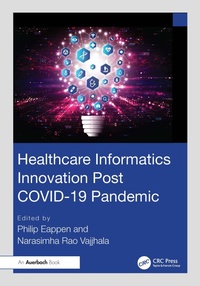
Healthcare Informatics Innovation Post COVID-19 Pandemic
1st Edition
Published on 30. June 2025
318 pages
978-1-040-36775-9 (ISBN)
Description

This book is essential reading for those in healthcare informatics, as well as healthcare administrators, clinicians, and regulators, as they navigate the evolving landscape of healthcare post-pandemic. -Dr. Steven D. Berkshire, professor and director of the Doctor of Health Administration Program, Central Michigan University
The coronavirus disease 2019 (COVID-19) pandemic brought unprecedented challenges to global healthcare systems, revealing vulnerabilities and pushing the boundaries of healthcare informatics. In response, the rapid adoption of digital tools and innovative technologies reshaped the way healthcare is delivered, managed, and analyzed. This transformation has not only revolutionized patient care but also underscored the importance of adopting new strategies to ensure data security, interoperability, and equitable access to healthcare services.
Healthcare Informatics Innovation Post-COVID-19 Pandemic explores the lasting impact of these innovations on the healthcare sector. The book examines the key lessons learned from the pandemic, as well as the challenges and opportunities that have emerged in its wake. It covers a broad range of topics, including telehealth, artificial intelligence (AI), the Internet of Things (IoT), and cybersecurity, and examines the critical role each plays in transforming healthcare delivery.
Highlights include:
Bridging the digital divide with telehealth
AI in post-pandemic healthcare
Navigating post-pandemic mental health challenges with AI
Genomics and personalized medicine
Ethics, privacy, and security in healthcare informatics
The book's chapters were written by contributors from diverse academic and professional backgrounds.Together, they share their expertise in healthcare, information technology, and policy. Through their insights, the book provides a comprehensive overview of the current state of healthcare informatics and offers a roadmap for future advancements. This book was written to address the growing recognition that healthcare systems worldwide must be resilient, adaptable, and equipped with cutting-edge tools to navigate future public health crises. As healthcare professionals, academics, policymakers, and technologists work together, it is crucial to share knowledge and collaborate on innovative solutions that can sustain the progress made during the pandemic.
The coronavirus disease 2019 (COVID-19) pandemic brought unprecedented challenges to global healthcare systems, revealing vulnerabilities and pushing the boundaries of healthcare informatics. In response, the rapid adoption of digital tools and innovative technologies reshaped the way healthcare is delivered, managed, and analyzed. This transformation has not only revolutionized patient care but also underscored the importance of adopting new strategies to ensure data security, interoperability, and equitable access to healthcare services.
Healthcare Informatics Innovation Post-COVID-19 Pandemic explores the lasting impact of these innovations on the healthcare sector. The book examines the key lessons learned from the pandemic, as well as the challenges and opportunities that have emerged in its wake. It covers a broad range of topics, including telehealth, artificial intelligence (AI), the Internet of Things (IoT), and cybersecurity, and examines the critical role each plays in transforming healthcare delivery.
Highlights include:
Bridging the digital divide with telehealth
AI in post-pandemic healthcare
Navigating post-pandemic mental health challenges with AI
Genomics and personalized medicine
Ethics, privacy, and security in healthcare informatics
The book's chapters were written by contributors from diverse academic and professional backgrounds.Together, they share their expertise in healthcare, information technology, and policy. Through their insights, the book provides a comprehensive overview of the current state of healthcare informatics and offers a roadmap for future advancements. This book was written to address the growing recognition that healthcare systems worldwide must be resilient, adaptable, and equipped with cutting-edge tools to navigate future public health crises. As healthcare professionals, academics, policymakers, and technologists work together, it is crucial to share knowledge and collaborate on innovative solutions that can sustain the progress made during the pandemic.
More details
Edition
1. Auflage
Language
English
Place of publication
London
United Kingdom
Publishing group
Taylor & Francis Ltd
Target group
Professional and scholarly
College/higher education
Illustrations
12 Tables, black and white; 10 Line drawings, color; 30 Line drawings, black and white; 3 Halftones, color; 3 Halftones, black and white; 13 Illustrations, color; 33 Illustrations, black and white
File size
16,01 MB
ISBN-13
978-1-040-36775-9 (9781040367759)
Copyright in bibliographic data and cover images is held by Nielsen Book Services Limited or by the publishers or by their respective licensors: all rights reserved.
Schweitzer Classification
Other editions
Additional editions
Philip Eappen | Narasimha Rao Vajjhala
Healthcare Informatics Innovation Post COVID-19 Pandemic
Book
06/2025
1st Edition
Auerbach
€264.20
Shipment within 10-20 days
Philip Eappen | Narasimha Rao Vajjhala
Healthcare Informatics Innovation Post COVID-19 Pandemic
Book
06/2025
1st Edition
Auerbach
€112.00
Shipment within 10-20 days
Persons
Dr. Philip Eappen is an Assistant Professor of Healthcare Management at Cape Breton University. He also served as the director of clinical services and transition to community at the Breton Ability Center. With over a decade of experience in hospital and healthcare management operations, Dr. Eappen has a solid academic background. Before joining Cape Breton University, he taught healthcare management at the University of Toronto, the Southern Alberta Institute of Technology, and Fanshawe College. Dr. Eappen is a board director on various boards, including the American College of Healthcare Executives, Myeloma Canada, and Aplastic Anemia and Myelodysplasia Canada. Dr. Eappen is also a long-serving member of the American College of Healthcare Executives and the Canadian College of Health Leaders. His research interests are focused on healthcare innovations, particularly healthcare informatics, and he has published various articles, book chapters, and books on the subject in recent years.
Dr. Narasimha Rao Vajjhala currently serves as the Dean of the Faculty of Engineering and Architecture at the University of New York Tirana in Albania. He previously held the position of Chair for the Computer Science and Software Engineering programs at the American University of Nigeria. Dr. Vajjhala is a senior member of both the ACM and IEEE. He is the Editor-in-Chief of the International Journal of Risk and Contingency Management (IJRCM) and a member of the Risk Management Society (RIMS) and the Project Management Institute (PMI). With over 23 years of experience, Dr. Vajjhala has taught programming and database-related courses across Europe and Africa at both graduate and undergraduate levels. He has also worked as a consultant for technology firms in Europe and participated in EU-funded projects. Dr. Vajjhala holds a Doctorate in Information Systems and Technology from the United States, a Master of Science in Computer Science and Applications from India, and a Master of Business Administration specializing in Information Systems from Switzerland.
Dr. Narasimha Rao Vajjhala currently serves as the Dean of the Faculty of Engineering and Architecture at the University of New York Tirana in Albania. He previously held the position of Chair for the Computer Science and Software Engineering programs at the American University of Nigeria. Dr. Vajjhala is a senior member of both the ACM and IEEE. He is the Editor-in-Chief of the International Journal of Risk and Contingency Management (IJRCM) and a member of the Risk Management Society (RIMS) and the Project Management Institute (PMI). With over 23 years of experience, Dr. Vajjhala has taught programming and database-related courses across Europe and Africa at both graduate and undergraduate levels. He has also worked as a consultant for technology firms in Europe and participated in EU-funded projects. Dr. Vajjhala holds a Doctorate in Information Systems and Technology from the United States, a Master of Science in Computer Science and Applications from India, and a Master of Business Administration specializing in Information Systems from Switzerland.
Content
1. Healthcare Informatics Innovation Post-COVID-19: Lessons, Challenges, and Opportunities 2. Lessons Learned: COVID-19 and the Future of Healthcare Informatics 3. Telehealth Revolution: Bridging the Digital Divide 4. Artificial Intelligence in Post-Pandemic Healthcare 5. Navigating Post-Pandemic Mental Health Challenges: Unleashing the Potential of Artificial Intelligence 6. Leveraging Digital Health Technologies in Healthcare Teams: A Discussion of Policy and Practice in Canada 7. How Data-Driven Insights Can Improve Patient Outcomes, Public Health Strategies, and Decision-Making 8. Genomics and Personalized Medicine: An Insight from The Healthcare Perspective 9. Preferences and Selection of Vaccines by Health Consumers 10. Innovation Management Practices in Kazakhstan's Healthcare Sector 11. Advancing Healthcare Informatics in Fluorescence Microscopy Using Computational Imaging Techniques 12. Global Healthcare Informatics - Structural Considerations and Workforce Training Challenges and Solutions 13. Ethics, Privacy, and Security in Healthcare Informatics 14. Cybersecurity Challenges in Healthcare Informatics 15. Impact of Cybersecurity and Artificial Intelligence in Healthcare Operations 16. Healthcare Cyberattacks Over the 2014-2023 Period: Trends, Lessons Learned, and Potential Paths Forward 17. Intelligent Transportation System for Healthcare Improvement 18. COVID-19: Predicting Daily Caseload and Mortality during Multiple Waves of the Epidemic in Different Countries
