

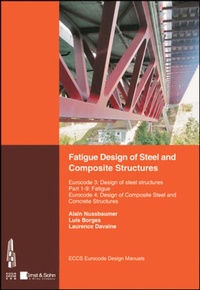
Fatigue Design of Steel and Composite Structures.
Eurocode 3: Design of Steel Structures. Part 1-9 Fatigue. Eurocode 4: Design of Composite Steel and Concrete Structures.
1st Edition
Published on 9. January 2012
XXIII, 311 pages
978-3-433-60121-1 (ISBN)
Description

This volume addresses the specific subject of fatigue, a subject not familiar to many engineers, but still relevant for proper and good design of numerous steel structures. It explains all issues related to the subject: Basis of fatigue design, reliability and various verification formats, determination of stresses and stress ranges, fatigue strength, application range and limitations. It contains detailed examples of applications of the concepts, computation methods and verifications.
More details
Other editions
Additional editions
Alain Nussbaumer | Luis Borges | Laurence Davaine
Fatigue Design of Steel and Composite Structures
Eurocode 3: Design of Steel Structures, Part 1-9 Fatigue; Eurocode 4: Design of Composite Steel and Concrete Structures
Software
01/2012
Ernst & Sohn
€82.61
Article exhausted; check different version
ECCS - European Convention for Constructional Steelwork | Associacao Portuguesa de Construcao Metalica e Mista
Fatigue Design of Steel and Composite Structures.
Eurocode 3: Design of Steel Structures. Part 1-9 Fatigue. Eurocode 4: Design of Composite Steel and Concrete Structures.
Book
10/2011
Ernst & Sohn
€59.00
Article exhausted; check for reprint
Persons
Alain Nussbaumer is professor of steel construction (laboratory ICOM) at the Swiss Federal Institute of Technology in Lausanne (EPFL). He is a member of CEN TC 250-SC3 and chairman of the Swiss committee SIA 263 on steel structures. He is a member and the former chairman of the technical committee TC6 - Fatigue of ECCS.
Luís Borges is a structural engineer at BG Consulting Engineers Ltd., Lausanne. He holds a doctoral degree from EPFL in the domain of fatigue of tubular bridges and is a specialist for steel and steel-concrete composite structures. He is a member of the technical committee TC6 - Fatigue of ECCS.
Laurence Davaine is a senior engineer at France's national railway company (SNCF) and is a specialist for steel and steel-concrete composite bridges. She holds a doctoral degree from the French National school of Bridges and Roads (ENPC) in the domain of stability of plated girders for bridge applications. She is a member of the technical committee TC6 - Fatigue of ECCS.
Luís Borges is a structural engineer at BG Consulting Engineers Ltd., Lausanne. He holds a doctoral degree from EPFL in the domain of fatigue of tubular bridges and is a specialist for steel and steel-concrete composite structures. He is a member of the technical committee TC6 - Fatigue of ECCS.
Laurence Davaine is a senior engineer at France's national railway company (SNCF) and is a specialist for steel and steel-concrete composite bridges. She holds a doctoral degree from the French National school of Bridges and Roads (ENPC) in the domain of stability of plated girders for bridge applications. She is a member of the technical committee TC6 - Fatigue of ECCS.
Content
PREFACE
ACKNOWLEDGMENTS
SYMBOLOGY
TERMINOLOGY
1 INTRODUCTION
1.1 Basis of fatigue design in steel structures
1.2 Damage equivalent factor concept
1.3 Codes of Practice
1.4 Description of the structures used in the worked examples
2 APPLICATION RANGE AND LIMITATIONS
2.1 Introduction
2.2 Materials
2.3 Corrosion
2.4 Temperature
2.5 Loading rate
2.6 Limiting stress ranges
3 DETERMINATION OF STRESSES AND STRESS RANGES
3.1 Fatigue loads
3.2 Damage equivalent factors
3.3 Calculation of stresses
3.4 Modified nominal stresses and concentration factors
3.5 Geometric stresses (hot spot stresses)
3.6 Stresses in orthotropic decks
3.7 Calculation of stress ranges
3.8 Modified Nominal stress ranges
3.9 Geometric stress ranges
4 FATIGUE STRENGTH
4.1 Introduction
4.2 Fatigue detail tables
4.3 Determination of fatigue strength or life by testing
5 RELIABILITY AND VERIFICATION
5.1 Generalities
5.2 Strategies
5.3 Partial factors
5.4 Verification
6 BRITTLE FRACTURE
6.1 Introduction
6.2 Steel quality
6.3 Relationship between different fracture toughness test results
6.4 Fracture concept in EN 1993-1-10
6.5 Standardisation of choice of material: maximum allowable thicknesses
REFERENCES
ANNEX A STANDARDS FOR STEEL CONSTRUCTION
ANNEX B FATIGUE DETAIL TABLES WITH COMMENTARY
ANNEX C MAXIMUM PERMISSIBLE THICKNESSES TABLES
ACKNOWLEDGMENTS
SYMBOLOGY
TERMINOLOGY
1 INTRODUCTION
1.1 Basis of fatigue design in steel structures
1.2 Damage equivalent factor concept
1.3 Codes of Practice
1.4 Description of the structures used in the worked examples
2 APPLICATION RANGE AND LIMITATIONS
2.1 Introduction
2.2 Materials
2.3 Corrosion
2.4 Temperature
2.5 Loading rate
2.6 Limiting stress ranges
3 DETERMINATION OF STRESSES AND STRESS RANGES
3.1 Fatigue loads
3.2 Damage equivalent factors
3.3 Calculation of stresses
3.4 Modified nominal stresses and concentration factors
3.5 Geometric stresses (hot spot stresses)
3.6 Stresses in orthotropic decks
3.7 Calculation of stress ranges
3.8 Modified Nominal stress ranges
3.9 Geometric stress ranges
4 FATIGUE STRENGTH
4.1 Introduction
4.2 Fatigue detail tables
4.3 Determination of fatigue strength or life by testing
5 RELIABILITY AND VERIFICATION
5.1 Generalities
5.2 Strategies
5.3 Partial factors
5.4 Verification
6 BRITTLE FRACTURE
6.1 Introduction
6.2 Steel quality
6.3 Relationship between different fracture toughness test results
6.4 Fracture concept in EN 1993-1-10
6.5 Standardisation of choice of material: maximum allowable thicknesses
REFERENCES
ANNEX A STANDARDS FOR STEEL CONSTRUCTION
ANNEX B FATIGUE DETAIL TABLES WITH COMMENTARY
ANNEX C MAXIMUM PERMISSIBLE THICKNESSES TABLES
