

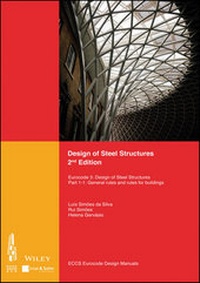
Design of Steel Structures
Eurocode 3: Design of steel structures. Part 1-1: General rules and rules for buildings.
2nd Edition
Published on 4. October 2016
462 pages
978-3-433-60768-8 (ISBN)
Description

This book introduces the fundamental design concepts of Eurocode 3 for steel structures in building construction, and their practical application.
Following a discussion of the basis of design, above all the principles of the limit state approach, the material standards and their use are detailed. The fundamentals of structural analysis and modeling are presented, followed by the design criteria and approaches for various types of structural members. The following chapters expand on the principles and applications of elastic and plastic design, each exemplified by the step-by-step design calculation of a braced steel-framed building and an industrial building, respectively.
Besides providing the necessary theoretical concepts for a good understanding, this manual intends to be a supporting tool for practicing engineers. To that end, numerous worked examples are provided throughout the book, concerning the analysis of steel structures and the design of elements under several types of actions. These examples facilitate the application of Eurocode regulations in practice.
The second edition contains more worked examples and extended explications on issues like torsion.
Following a discussion of the basis of design, above all the principles of the limit state approach, the material standards and their use are detailed. The fundamentals of structural analysis and modeling are presented, followed by the design criteria and approaches for various types of structural members. The following chapters expand on the principles and applications of elastic and plastic design, each exemplified by the step-by-step design calculation of a braced steel-framed building and an industrial building, respectively.
Besides providing the necessary theoretical concepts for a good understanding, this manual intends to be a supporting tool for practicing engineers. To that end, numerous worked examples are provided throughout the book, concerning the analysis of steel structures and the design of elements under several types of actions. These examples facilitate the application of Eurocode regulations in practice.
The second edition contains more worked examples and extended explications on issues like torsion.
More details
Other editions
Additional editions
ECCS - European Convention for Constructional Steelwork | Associacao Portuguesa de Construcao
Design of Steel Structures
Eurocode 3: Designof Steel Structures, Part 1-1: General Rules and Rules for Buildings
Software
10/2016
Ernst & Sohn
€99.13
Article exhausted; check different version
ECCS - European Convention for Constructional Steelwork | Associacao Portuguesa de Construcao Metalica e Mista
Design of Steel Structures
Eurocode 3: Design of steel structures. Part 1-1: General rules and rules for buildings.
Book
10/2016
2nd Edition
Ernst & Sohn
€70.00
Shipment within 5-7 days
Persons
Luís Simões da Silva is Professor of Steel Construction at the Civil Engineering Dept. of the University of Coimbra/ Portugal, where he is responsible for the Steel and Mixed Building Technologies Research Centre. He is President of the Portuguese Steelwork Association (CMM) and member of the Executive Board and President of the Technical Management Board of the ECCS. He has authored over 300 scientific articles in this field.
Rui A. D. Simões is Professor at the Civil Engineering Dept. of the University of Coimbra/ Portugal, where he got his BSc in 1990, his MSc in 1995 and his PhD in 2000. He is heavily involved in experimental research work and teaching of steel related courses in the BSc, MSc, PhD and continues education programs.
Helena Gervásio is Visiting Professor at the Civil Engineering Department of the University of Coimbra/ Portugal. She is Technical Director of the GIPAC Lda., an engineering consultancy company specialized in structural engineering. She is member of the Technical Committee TC14-Sustainability of ECCS.
Rui A. D. Simões is Professor at the Civil Engineering Dept. of the University of Coimbra/ Portugal, where he got his BSc in 1990, his MSc in 1995 and his PhD in 2000. He is heavily involved in experimental research work and teaching of steel related courses in the BSc, MSc, PhD and continues education programs.
Helena Gervásio is Visiting Professor at the Civil Engineering Department of the University of Coimbra/ Portugal. She is Technical Director of the GIPAC Lda., an engineering consultancy company specialized in structural engineering. She is member of the Technical Committee TC14-Sustainability of ECCS.
Content
INTRODUCTION
General Observations
Codes of Practice and Normalization
Basis of Design
Ultimate limit states
Serviceability limit states
Durability
Sustainability
Materials
Material specification
Mechanical properties
Toughness and through thickness properties
Fatigue properties
Corrosion resistance
Geometric Characteristics and Tolerances
STRUCTURAL ANALYSIS
Structural Modelling, Worked Examples
Global Analysis of Steel Structures, Worked Examples
Classification of Cross Sections
DESIGN OF MEMBERS
Tension, Worked Examples
Laterally Restrained Beams, Worked Examples
Torsion, Worked Examples
Compression, Worked Examples
Laterally Unrestrained Beams, Worked Examples
Beam-Columns, Worked Examples
ELASTIC DESIGN OF STEEL STRUCTURES
Simplified Methods of Analysis
Amplified sway-moment method
Sway-mode buckling length method
Worked Example
Member Stability of Non-prismatic Members and Components
Non-prismatic members
Members with intermediate restraints
General method
Worked Example
Design Example 1: Elastic Design of Braced Steel-Framed Building
PLASTIC DESIGN OF STEEL STRUCTURES 345
General Rules for Plastic Design
Plastic limit analysis: method of mechanisms
Code requirements for plastic analysis
Methods of Analysis
Approximate methods for pre-design
Computational analysis
2nd order effects
Worked Example
Member Stability and Buckling Resistance
General criteria for the verification of the stability of members with plastic hinges
Bracings
Verification of the stability of members with plastic hinges
Worked Examples
Design Example 2: Plastic Design of Industrial Building
REFERENCES
General Observations
Codes of Practice and Normalization
Basis of Design
Ultimate limit states
Serviceability limit states
Durability
Sustainability
Materials
Material specification
Mechanical properties
Toughness and through thickness properties
Fatigue properties
Corrosion resistance
Geometric Characteristics and Tolerances
STRUCTURAL ANALYSIS
Structural Modelling, Worked Examples
Global Analysis of Steel Structures, Worked Examples
Classification of Cross Sections
DESIGN OF MEMBERS
Tension, Worked Examples
Laterally Restrained Beams, Worked Examples
Torsion, Worked Examples
Compression, Worked Examples
Laterally Unrestrained Beams, Worked Examples
Beam-Columns, Worked Examples
ELASTIC DESIGN OF STEEL STRUCTURES
Simplified Methods of Analysis
Amplified sway-moment method
Sway-mode buckling length method
Worked Example
Member Stability of Non-prismatic Members and Components
Non-prismatic members
Members with intermediate restraints
General method
Worked Example
Design Example 1: Elastic Design of Braced Steel-Framed Building
PLASTIC DESIGN OF STEEL STRUCTURES 345
General Rules for Plastic Design
Plastic limit analysis: method of mechanisms
Code requirements for plastic analysis
Methods of Analysis
Approximate methods for pre-design
Computational analysis
2nd order effects
Worked Example
Member Stability and Buckling Resistance
General criteria for the verification of the stability of members with plastic hinges
Bracings
Verification of the stability of members with plastic hinges
Worked Examples
Design Example 2: Plastic Design of Industrial Building
REFERENCES
