

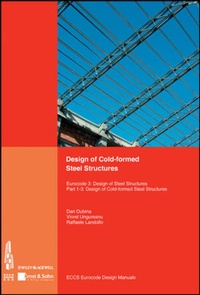
Design of Cold-formed Steel Structures.
Eurocode 3: Design of Steel Structures. Part 1-3 Design of cold-formed Steel Structures.
1st Edition
Published on 6. August 2013
654 pages
978-3-433-60228-7 (ISBN)
Description

The book is concerned with design of cold-formed steel structures in building based on the Eurocode 3 package, particularly on EN 1993-1-3.
It contains the essentials of theoretical background and design rules for cold-formed steel sections and sheeting, members and connections for building applications.
Elaborated examples and design applications - more than 200 pages - are included in the respective chapters in order to provide a better understanding to the reader.
It contains the essentials of theoretical background and design rules for cold-formed steel sections and sheeting, members and connections for building applications.
Elaborated examples and design applications - more than 200 pages - are included in the respective chapters in order to provide a better understanding to the reader.
More details
Other editions
Additional editions

ECCS - European Convention for Constructional Steelwork | Associacao Portuguesa de
Design of Cold-Formed Steel Structures
Eurocode 3: Design of Steel Structures. Part 1-3 Design of Cold-Formed Steel Structures
Software
08/2013
Ernst & Sohn
€97.19
No shipping information available
ECCS - European Convention for Constructional Steelwork | Associacao Portuguesa de Construcao Metalica e Mista
Design of Cold-formed Steel Structures.
Eurocode 3: Design of Steel Structures. Part 1-3 Design of cold-formed Steel Structures.
Book
10/2012
1st Edition
Ernst & Sohn
€71.90
Article exhausted; check different version
Persons
Dan Dubina is professor and head of the Department of Steel Structures and Structural Mechanics at the Politehnica University of Timisoara, Romania. He has published more than 400 scientific papers and 25 books in the field of cold-formed steel structures, steel structures in seismic areas, structural connections, and structural analysis. He is a member of the ECCS Technical Committees TC 7 (Cold Formed Thin Walled Sheet Steel in Building), TC 8 (Stability), TC 10 (Connections), and TC 13 (Seismic Design). He has been awarded with the ECCS European Steel Design Award twice.
Raffaele Landolfo is professor of structural engineering at the University of Naples "Federico II". He is external examiner for MSc in earthquake engineering and structural steel design at the Imperial College London and he also teaches in several PhD and master courses. He is head of the Department of Constructions and Mathematical Methods in architecture at the University of Naples. He was engaged in the activities of both national working groups and European project teams dealing with the conversion from ENV to EN of the EN 1993-1-3, and he is chairing the ECCS Technical Committee TC 13 (Seismic Design).
Viorel Ungureanu is associate professor at the Politehnica University of Timisoara, Romania. His research is focused on the field of steel structures and especially cold-formed thin-walled structures. He contributed to the translation of EN 1993-1-3 into Romanian and was part of the team which elaborated the Romanian National Annexes for this document. He is a member of the ECCS TC 7 (Cold Formed Thin Walled Sheet Steel in Building).
Raffaele Landolfo is professor of structural engineering at the University of Naples "Federico II". He is external examiner for MSc in earthquake engineering and structural steel design at the Imperial College London and he also teaches in several PhD and master courses. He is head of the Department of Constructions and Mathematical Methods in architecture at the University of Naples. He was engaged in the activities of both national working groups and European project teams dealing with the conversion from ENV to EN of the EN 1993-1-3, and he is chairing the ECCS Technical Committee TC 13 (Seismic Design).
Viorel Ungureanu is associate professor at the Politehnica University of Timisoara, Romania. His research is focused on the field of steel structures and especially cold-formed thin-walled structures. He contributed to the translation of EN 1993-1-3 into Romanian and was part of the team which elaborated the Romanian National Annexes for this document. He is a member of the ECCS TC 7 (Cold Formed Thin Walled Sheet Steel in Building).
Content
1 Introduction to cold-formed steel design
1.1 General remarks
1.2 Cold-formed steel sections
1.3 Specific problems of cold-formed steel design
1.4 Examples of application of cold-formed steel sections
2 Basis of design
2.1 Limit states and verifications against their exceeding
2.2 Determination of design values
2.3 Combinations of actions
2.4 Materials
2.5 Methods of analysis and design
2.6 Imperfections
3 Behaviour and resistance of cross-section
3.1 General
3.2 Properties of gross cross-section
3.3 Imperfections of cold-formed steel sections
3.4 Flange curling
3.5 Shear lag
3.6 Local Buckling
3.9 Distortional Buckling:
3.10 Effective geometric characteristics and design against local and distortional buckling
3.11 Axial tension
3.12 Axial compression
3.13 Bending moment
3.14 Combined tension and bending
3.15 Combined compression and bending
3.16 Torsional moment
3.17 Shear force
3.18 Local transverse forces
3.19 Combined shear force and bending moment
3.20 Combined bending moment and local load or support reaction
3.21 Numerical examples
4 Behaviour and design resistance of bar members
4.1 General
4.2 Compression members
4.3 Beams
4.4 Members with combined axial force and moment
4.5 Beams restrained by sheeting
5 Sheeting acting as a diaphragm (stressed skin design)
5.1 Introduction
5.2 General design considerations on diaphragm action
5.3 Conditions and restrictions to using stressed skin design
5.4 Design criteria
5.5 Interaction of the shear diaphragms with supporting framing
6 Structural liner trays
6.1 Introduction
6.2 Design procedures for cassette sections
6.3 Design procedures for cassette panels acting as diaphragm
6.4 Combined effects
6.5 Design application
7 Connections
7.1 Introduction
7.2 Fastening techniques of the cold-formed steel constructions
7.3 Mechanical properties of connections
7.4 Design of connections
7.5 Recommendations to testing cold-formed fastener specimens
8 Building framing
8.1 Introduction
8.2 Conceptual design of cold formed building structures
8.3 Design examples
References
1.1 General remarks
1.2 Cold-formed steel sections
1.3 Specific problems of cold-formed steel design
1.4 Examples of application of cold-formed steel sections
2 Basis of design
2.1 Limit states and verifications against their exceeding
2.2 Determination of design values
2.3 Combinations of actions
2.4 Materials
2.5 Methods of analysis and design
2.6 Imperfections
3 Behaviour and resistance of cross-section
3.1 General
3.2 Properties of gross cross-section
3.3 Imperfections of cold-formed steel sections
3.4 Flange curling
3.5 Shear lag
3.6 Local Buckling
3.9 Distortional Buckling:
3.10 Effective geometric characteristics and design against local and distortional buckling
3.11 Axial tension
3.12 Axial compression
3.13 Bending moment
3.14 Combined tension and bending
3.15 Combined compression and bending
3.16 Torsional moment
3.17 Shear force
3.18 Local transverse forces
3.19 Combined shear force and bending moment
3.20 Combined bending moment and local load or support reaction
3.21 Numerical examples
4 Behaviour and design resistance of bar members
4.1 General
4.2 Compression members
4.3 Beams
4.4 Members with combined axial force and moment
4.5 Beams restrained by sheeting
5 Sheeting acting as a diaphragm (stressed skin design)
5.1 Introduction
5.2 General design considerations on diaphragm action
5.3 Conditions and restrictions to using stressed skin design
5.4 Design criteria
5.5 Interaction of the shear diaphragms with supporting framing
6 Structural liner trays
6.1 Introduction
6.2 Design procedures for cassette sections
6.3 Design procedures for cassette panels acting as diaphragm
6.4 Combined effects
6.5 Design application
7 Connections
7.1 Introduction
7.2 Fastening techniques of the cold-formed steel constructions
7.3 Mechanical properties of connections
7.4 Design of connections
7.5 Recommendations to testing cold-formed fastener specimens
8 Building framing
8.1 Introduction
8.2 Conceptual design of cold formed building structures
8.3 Design examples
References
