

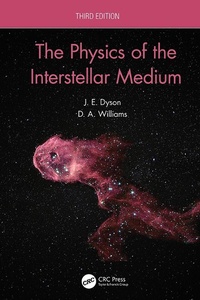
The Physics of the Interstellar Medium
3rd Edition
Published on 26. July 2020
206 pages
978-1-000-16315-5 (ISBN)
Description

This third edition of The Physics of the Interstellar Medium continues to introduce advanced undergraduates to the fundamental processes and the wide range of disciplines needed to understand observations of the interstellar medium and its role in the Milky Way galaxy. The book is suitable for undergraduate students studying physics, astronomy, and astrophysics. The book also provides concise and straightforward discussions of interstellar physics and chemistry that are useful for more experienced readers.
The book leads readers through the range of physical processes operating on both large and small scales that occur in the interstellar medium. It explores the relationship between the dusty, tenuous gas in interstellar space and the formation of stars and planets. This new edition also describes exciting developments in the field of astrochemistry and its interaction with interstellar physics, and the roles played by interstellar dust grains in interstellar physics and chemistry.
Simple models in each chapter, together with problems at the end of each chapter, encompass interdisciplinary applications in atomic, molecular, solid state, and surface physics, and gas dynamics. This popular textbook provides a useful overview and grounding in the study of the interstellar medium and brings insight into many aspects of physics.
Features
An authoritative textbook in the field at this academic level
Provides a wide introduction to the interstellar medium whilst remaining accessible and concise
Revised throughout, presenting a modern understanding of the interstellar medium
The book leads readers through the range of physical processes operating on both large and small scales that occur in the interstellar medium. It explores the relationship between the dusty, tenuous gas in interstellar space and the formation of stars and planets. This new edition also describes exciting developments in the field of astrochemistry and its interaction with interstellar physics, and the roles played by interstellar dust grains in interstellar physics and chemistry.
Simple models in each chapter, together with problems at the end of each chapter, encompass interdisciplinary applications in atomic, molecular, solid state, and surface physics, and gas dynamics. This popular textbook provides a useful overview and grounding in the study of the interstellar medium and brings insight into many aspects of physics.
Features
An authoritative textbook in the field at this academic level
Provides a wide introduction to the interstellar medium whilst remaining accessible and concise
Revised throughout, presenting a modern understanding of the interstellar medium
More details
Edition
3rd edition
Language
English
Place of publication
London
United Kingdom
Publishing group
Taylor & Francis Ltd
Target group
College/higher education
Professional and scholarly
Product notice
Reflowable
Illustrations
10 Tables, black and white; 3 Line drawings, color; 39 Line drawings, black and white; 24 Halftones, color
ISBN-13
978-1-000-16315-5 (9781000163155)
Copyright in bibliographic data and cover images is held by Nielsen Book Services Limited or by the publishers or by their respective licensors: all rights reserved.
Schweitzer Classification
Other editions
Additional editions
J.E. Dyson | D.A. Williams
The Physics of the Interstellar Medium
Book
07/2020
3rd Edition
CRC Press
€79.22
Shipment within 15-20 days
J.E. Dyson | D.A. Williams
The Physics of the Interstellar Medium
Book
07/2020
3rd Edition
CRC Press
€198.08
Shipment within 15-20 days
Persons
John Dyson made outstanding research contributions over many years to our
understanding of the responses of interstellar media to winds from stars and
from active galaxies. He had a huge influence on these subjects and his work
gained an international reputation. Much of his career was at the University of
Manchester where he became Professor of Astronomy and Head of Astrophysics.
He moved in 1996 to the University of Leeds, becoming Dean of Research, and
was appointed Emeritus Research Professor in 2006.
He died in 2010 and is much missed by friends and colleagues world-wide
who valued his scientific insight, quick wit, kindness and generosity.
David Williams is currently Emeritus Perren Professor of Astronomy at University
College London. While at NASA's Goddard Space Flight Center in the 1960s he
became interested in interstellar molecules and interstellar dust as potential
probes of the interstellar medium. When John Dyson and David were both
working in Manchester, John emphasised the importance of cosmic gas dynamics
in understanding interstellar chemistry and dust, and David built a research
group at UMIST to investigate these and other topics. He left Manchester in
1994 for UCL and has continued to study problems in interstellar physics and
chemistry.
understanding of the responses of interstellar media to winds from stars and
from active galaxies. He had a huge influence on these subjects and his work
gained an international reputation. Much of his career was at the University of
Manchester where he became Professor of Astronomy and Head of Astrophysics.
He moved in 1996 to the University of Leeds, becoming Dean of Research, and
was appointed Emeritus Research Professor in 2006.
He died in 2010 and is much missed by friends and colleagues world-wide
who valued his scientific insight, quick wit, kindness and generosity.
David Williams is currently Emeritus Perren Professor of Astronomy at University
College London. While at NASA's Goddard Space Flight Center in the 1960s he
became interested in interstellar molecules and interstellar dust as potential
probes of the interstellar medium. When John Dyson and David were both
working in Manchester, John emphasised the importance of cosmic gas dynamics
in understanding interstellar chemistry and dust, and David built a research
group at UMIST to investigate these and other topics. He left Manchester in
1994 for UCL and has continued to study problems in interstellar physics and
chemistry.
Content
Contents
Preface to the Third Edition ............................................................................vii
Some Relevant Physical and Astronomical Information...................................ix
Authors.............................................................................................................xi
Chapter 1 Introduction..................................................................................... 1
Chapter 2 How We Obtain Information about the Interstellar Medium........... 9
Chapter 3 Microscopic Processes in the Interstellar Medium ......................... 31
Chapter 4 Interstellar Grains.......................................................................... 51
Chapter 5 Radiatively Excited Regions........................................................... 79
Chapter 6 Introduction to Gas Dynamics .................................................... 103
Chapter 7 Gas Dynamical Effects of Stars on the Interstellar Medium........ 135
Chapter 8 Star Formation and Star-Forming Regions.................................. 169
Answers to Problems ...................................................................................... 187
Index.............................................................................................................. 191
Preface to the Third Edition ............................................................................vii
Some Relevant Physical and Astronomical Information...................................ix
Authors.............................................................................................................xi
Chapter 1 Introduction..................................................................................... 1
Chapter 2 How We Obtain Information about the Interstellar Medium........... 9
Chapter 3 Microscopic Processes in the Interstellar Medium ......................... 31
Chapter 4 Interstellar Grains.......................................................................... 51
Chapter 5 Radiatively Excited Regions........................................................... 79
Chapter 6 Introduction to Gas Dynamics .................................................... 103
Chapter 7 Gas Dynamical Effects of Stars on the Interstellar Medium........ 135
Chapter 8 Star Formation and Star-Forming Regions.................................. 169
Answers to Problems ...................................................................................... 187
Index.............................................................................................................. 191
