

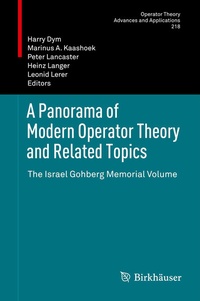
A Panorama of Modern Operator Theory and Related Topics
Description

This book is dedicated to the memory of Israel Gohberg (1928-2009) - one of the great mathematicians of our time - who inspired innumerable fellow mathematicians and directed many students. The volume reflects the wide spectrum of Gohberg's mathematical interests. It consists of more than 25 invited and peer-reviewed original research papers written by his former students, co-authors and friends. Included are contributions to single and multivariable operator theory, commutative and non-commutative Banach algebra theory, the theory of matrix polynomials and analytic vector-valued functions, several variable complex function theory, and the theory of structured matrices and operators. Also treated are canonical differential systems, interpolation, completion and extension problems, numerical linear algebra and mathematical systems theory.
More details
Other editions
Additional editions
Persons
Content
- Intro
- A Panorama of Modern Operater Theory and Related Topics
- Contents
- Preface
- An Interpolation Problem for Functions with Values in a Commutative Ring
- 1. Introduction
- 2. The white noise space
- 3. The ring R
- 4. Analytic functions with values in R
- 5. Nevanlinna-Pick Interpolation
- 6. More general interpolation problem
- References
- Minimal and Maximal Invariant Spaces of Holomorphic Functions on Bounded Symmetric Domains
- 1. Bounded symmetric domains and Jordan triples
- 2. Hilbert spaces of holomorphic functions
- 3. Invariant Banach spaces of holomorphic functions
- 4. Invariant Banach spaces of vector-valued holomorphic functions
- 5. Minimal spaces for non-tube type domains
- References
- B-regular J-inner Matrix-valued Functions
- 1. Introduction
- 2. A unitary operator from H(U) onto H(U~)
- 3. Some properties of the class UBR(J)
- 4. Canonical systems with B-regular matrizants
- 5. Direct and inverse monodromy problems
- 6. Connections with the theory of characteristic functions
- 7. de Branges spaces
- 8. An example
- References
- Canonical Transfer-function Realization for Schur-Agler-class Functions of the Polydisk
- 1. Introduction
- 1.1. The classical setting and the legacy of Israel Gohberg
- 1.2. Extensions to several variables
- 1.3. The plan of the paper
- 2. Preliminaries
- 3. Weakly coisometric realizations
- 3.1. Characterization of left Agler decompositions
- 3.2. Weakly coisometric versus coisometric c.f.m.'s
- 4. Weakly isometric realizations
- 5. Weakly unitary realizations
- References
- Spectral Regularity of Banach Algebras and Non-commutative Gelfand Theory
- 1. Introduction
- 2. Preliminaries and review of earlier results
- 3. A new Gelfand type criterion for spectral regularity
- 4. Applications
- 4.1. Subalgebras and quotients
- 4.2. Algebras of l8-type
- 4.3. Abstract matrix algebras
- 4.4. Algebras of operators with prescribed invariant subspaces
- 4.5. Algebras of Toeplitz and singular integral operators
- 5. Concluding remarks
- Acknowledgement
- References
- Banach Algebras of Commuting Toeplitz Operators on the Unit Ball via the Quasi-hyperbolic Group
- 1. Introduction
- 2. The domains ...., .... and .
- 3. Weighted Bergman spaces over ...., ...., and .
- 4. Polar-type coordinates in .
- 5. The operators R0 and R
- 6. Toeplitz operators with quasi-hyperbolic symbols
- 7. Hyperbolic k-quasi-radial symbols
- 8. Hyperbolic k-quasi-homogeneous functions
- 9. Commutativity results
- Appendix
- References
- Canonical Models for Bi-isometries
- 1. Introduction
- 2. Preliminaries about commuting isometries
- 3. Inductive construction of commuting isometries
- 4. The structure of bi-isometries
- 5. Functional representation
- 6. The structure of bi-shifts
- 7. The unitary invariants of a functional model
- 8. Examples of irreducible bi-isometries and direct integral decompositions
- References
- First-order Trace Formulae for the Iterates of the Fox-Li Operator
- 1. Introduction and main results
- 2. Wiener-Hopf operators
- 3. An oscillatory multivariate integral
- 4. The logarithmic spiral ansatz
- 5. Symbols with a Fox-Li discontinuity
- References
- Factorization Versus Invertibility of Matrix Functions on Compact Abelian Groups
- 1. Introduction
- 2. Denseness of GLB(B) in GL(B)
- 3. Nondenseness
- 4. Topological properties of GLF(Bn×n)
- 5. Small Bohr-Fourier spectra
- 6. Proof of Theorem 5.2
- 7. Wiener-Hopf equivalence
- Acknowledgment
- References
- Banded Matrices, Banded Inverses and Polynomial Representations for Semi-separable Operators
- 1. Introduction: Semi-separable systems and the 'one pass' URV method
- 2. Matrix polynomial representations
- 2.1. Polynomial representations
- Bezout relations
- 3. Polynomial interpolation theory for matrices: An approach
- 4. Some further remarks
- 5. Appendix: Methods to compute pre-images and the numerical calculation of the F matrix
- References
- Description of Helson-Szegö Measures in Terms of the Schur Parameter Sequences of Associated Schur Functions
- 1. Interrelated quadruples consisting of a probability measure, a normalized Carathéodory function, a Schur function and a sequence of contractive complex numbers
- 2. A unitary colligation associated with a Borelian probability measure on the unit circle
- 3. On the connection between the Riesz projection P+ and the projection ... which projects ... onto ... parallel to ...
- 4. On the connection of the Riesz projection P+ with the orthogonal projections from .... onto the subspaces ... and ...
- 5. Matrix representation of the operator ....,.. in terms of the Schur parameters associated with the measure ..
- 6. Characterization of Helson-Szeg.o measures in terms of the Schur parameters of the associated Schur function
- References
- Divide and Conquer Method for Eigenstructure of Quasiseparable Matrices Using Zeroes of Rational Matrix Functions
- 1. Introduction
- 2. Notation and definitions
- 3. Divide step
- 3.1. The main theorem
- 3.2. Hermitian and/or tridiagonal matrices
- 3.3. Algorithms to obtain suitable quasiseparable generators for the divided matrices and the entries of the perturbation matric
- Algorithm for Hermitian matrices
- 4. Conquer step and eigenproblem of rational matrix functions
- 4.1. The link between the eigenproblem of A and an eigenproblem for a rational matrix function
- 4.2. Order one quasiseparable matrices with scalar entries
- 4.3. Order one quasiseparable matrix A and diagonalizable matrices B and C with distinct eigenvalues
- 5. Complete algorithm for Hermitian matrices
- 5.1. Hermitian order one quasiseparable matrix A
- 5.2. The rational function approximation method and the convexifying method for finding zeroes in (5.1)
- 5.3. Repeated diagonal entries and zero components for z
- 5.4. Diagonalizing D + zz*
- 5.5. The complete algorithm
- 6. Conclusions
- References
- An Identity Satisfied by Certain Orthogonal Vector-valued Functions
- Introduction
- 1. A scalar product
- 2. An orthogonal system
- 3. An identity
- References
- Invertibility of Certain Fredholm Operators
- 1. Introduction
- 2. The structure of compact operators in FF-subalgebras of L(B)
- 3. The closure of FF-subalgebras
- 4. Some illustrative examples and open questions
- References
- Bernstein Widths and Super Strictly Singular Inclusions
- 0. Introduction
- 1. Inclusion of L8 into r.i. spaces: Generalization of Grothendieck's result
- 2. Strong inclusions
- 3. SSS inclusions
- References
- On Inversion of Certain Structured Linear Transformations Related to Block Toeplitz Matrices
- 1. Introduction
- 2. Proof of the main result
- 3. Comments and an example
- References
- The Inverse of a Two-level Positive Definite Toeplitz Operator Matrix
- 1. Introduction
- 2. Proof of the main result
- 3. Implementation of the formula in Matlab
- 4. Inversion algorithm and numerical results
- References
- Parametrizing Structure Preserving Transformations of Matrix Polynomials
- 1. Introduction
- 2. General complex matrix polynomials
- 2.1. Diagonalizable quadratic systems
- 3. Real matrix polynomials
- 3.1. Diagonalizable real quadratic systems
- 4. Hermitian matrix polynomials
- 4.1. The set G in terms of canonical structures
- 5. Real symmetric matrix polynomials
- Acknowledgement
- References
- A Review of Canonical Forms for Selfadjoint Matrix Polynomials
- 1. Introduction
- 2. Standard pairs and triples
- 3. Standard triples and hermitian systems
- 4. Canonical structures for hermitian polynomials
- 4.1. The complex hermitian case
- 4.2. The real symmetric case
- 5. Chains of generalized eigenvectors
- 5.1. Real Jordan triples and real eigenvector chains
- 5.2. Real chains for non-real eigenvalues
- 5.3. Real chains from complex chains
- References
- Linearization, Factorization, and the Spectral Compression of a Self-adjoint Analytic Operator Function Under the Condition (VM)
- 1. Introduction
- 2. The linearization and its uniqueness
- 3. Factorization of A(z)
- 4. The spectral compression of A(z), I
- 5. Pseudoinvariance
- 6. The spectral compression of A(z), II
- References
- An Estimate for the Splitting of Holomorphic Cocycles. One Variable
- 1. Introduction
- 2. Notation
- 3. An estimate for the Pompeiju integral
- 4. The main result
- 5. An estimate for the equation ...
- 6. Partitions of unity with estimates
- 7. Continuous functions with continuous Cauchy-Riemann derivative. The additive case
- 8. Continuous functions with continuous Cauchy-Riemann derivative. The multiplicative case
- 9. Proof of Theorem 4.2
- References
- The Discrete Algebraic Riccati Equation and Hermitian Block Toeplitz Matrices
- 1. Introduction
- 2. Preliminaries on the discrete algebraic Riccati equation
- 3. Non-invertible solutions
- 4. Riccati equations with coefficients of companion type
- 5. Computations and examples
- 6. Connection with the Popov function
- References
- On Cyclic and Nearly Cyclic Multiagent Interactions in the Plane
- 1. Introduction
- 2. Analyzing swarm evolution via mode decoupling
- 3. Diagonalization of factor circulants
- 4. Dynamics of a cyclically interacting swarm
- 4.1. Darboux's polygon evolution and extensions
- 4.2. Centroid gathering evolution and extensions
- 5. Concluding remarks
- Acknowledgment
- References
- A Trace Formula for Differential Operators of Arbitrary Order
- 1. Introduction
- 2. Resolvent kernel
- 3. Dual problem
- 4. Trace formula
- 5. Integral equations
- 6. The Wronskian and the perturbation determinant
- References
- Jordan Structures and Lattices of Invariant Subspaces of Real Matrices
- 1. Introduction
- 2. Matrices with the same Jordan structure
- 3. Structure preserving neighborhoods
- 4. Concluding remarks
- References
- Pseudospectral Functions for Canonical Differential Systems. II
- 1. Introduction
- 2. Taylor expansions and their coefficients
- 3. Root spaces and eigenchains
- 4. Main results
- References
- Operator Identities for Subnormal Tuples of Operators
- 1. Introduction
- 2. Analytic model for a subnormal k-tuple of operators
- 3. Calculation of ...
- 4. Some operator identities for a commuting k-tuple of operators
- 5. Resolvents formula for a commuting k-tuple of operators
- References
