

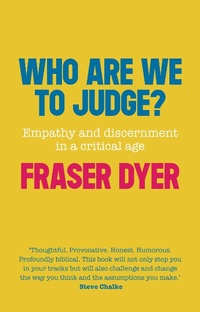
Who Are We To Judge
Description

Jesus says 'Do not judge' yet our human instinct often leads us to harsh judgements of others. In a world where snap judgements are made in seconds on social media, how can Christians resist the urge to join in?
Christians may be especially adept at dressing up their
judgement of others as righteousness and being a witness for Christ without recognising the psychological and spiritual
pitfalls. It remains easier to point the finger at clearer and more
observable sins than to recognise the way judgementalism corrupts us.
In this insightful and wise book, Fraser Dyer helps us to understand
what compels Christians to be judgemental towards others. He
explores the condemnation of judgementalism throughout scripture, and particularly in the ministry and teaching of
Christ. He also includes a set of practical approaches, rooted in
Christian spirituality, to enable us to journey from the self-righteousness of judgementalism towards love of God and neighbour.
More details
Other editions
Additional editions
Person
The Revd Fraser Dyer is an Anglican priest in an inner-city parish in south London. Prior to ordination, he worked in the voluntary sector, leading volunteer programmes for Traidcraft and Greenpeace UK, before spending twenty years as a consultant
and trainer. He is the author of Why do I do this every day? Finding meaning in your work (Lion Hudson, 2005).
Content
- Intro
- About the author
- Title page
- Imprint
- Table of contents
- Acknowledgements
- Introduction
- Part 1: Understanding Judgementalism
- 1. The urge to judge
- 2. Tribalism
- 3. Fear
- 4. Blame and scapegoating
- 5. Pride and ignorance
- 6. Shame and self-judgement
- Part 2: Jesus and Judgement
- 7. How did Christians become so judgemental?
- 8. The judge judged
- 9. Breaking down barriers
- 10. The offer of loving acceptance
- 11. Seeing ourselves, and others, for who we really are
- 12. Tearing the doors off their hinges
- Part 3: Towards Discernment
- 13. Getting at the truth
- 14. Discernment
- 15. Prophetic witness
- Notes
