

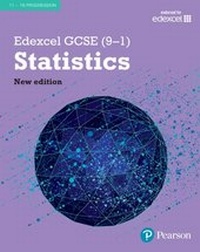
Edexcel GCSE (9-1) Statistics Student Book
1st Edition
Published on 18. August 2017
440 pages
978-1-292-19042-6 (ISBN)
Description

Exam Board: EdexcelLevel: GCSESubject: StatisticsFirst teaching: September 2017First exams: June 2019Developed in line with the key principles of the new specification, our new Student Book for Edexcel GCSE (9-1) Statistics: - gives you comprehensive and accessible support for the new Edexcel GCSE (9-1) Statistics specification - includes engaging opportunities to work with authentic data plenty of real-life statistics in every unit to bring the subject to life and highlight important applications- helps students prepare for the new linear exams includes more support for exam preparation than ever before.
More details
Other editions
Additional editions
Gillian Dyer | Jane Dyer | Kathryn Hipkiss
Edexcel GCSE (9-1) Statistics Student Book
Book
09/2017
Pearson Education Limited
€49.00
Shipment within 10-20 days
Content
- Front Cover
- Contents
- How to use this book
- Chapter 1: Collection of data
- 1.1: Describing data
- 1.2: Grouping data
- 1.3: Primary and secondary data
- 1.4: Populations
- 1.5: Petersen capture-recapture formula
- 1.6: Random sampling
- 1.7: Non-random sampling
- 1.8: Stratified sampling
- 1.9: Collection of data
- 1.10: Questionnaires and interviews
- 1.11: Problems with collected data
- 1.12: Controlling extraneous variables
- 1.13: Hypotheses
- 1.14: Designing investigations
- Check up
- Strengthen
- Extend
- Summary
- Test
- Chapter 2: Processing and representing data
- 2.1: Tables
- 2.2: Two-way tables
- 2.3: Pictograms
- 2.4: Bar charts
- 2.5: Stem and leaf diagrams
- 2.6: Pie charts
- 2.7: Comparative pie charts
- 2.8: Population pyramids
- 2.9: Choropleth maps
- 2.10: Histograms and frequency polygons
- 2.11: Cumulative frequency charts
- 2.12: The shape of a distribution
- 2.13: Histograms with unequal class widths
- 2.14: Misleading diagrams
- 2.15: Choosing the right format
- Check up
- Strengthen
- Extend
- Summary
- Test
- Chapter 3: Summarising data
- 3.1: Averages
- 3.2: Averages from frequency tables
- 3.3: Averages from grouped data
- 3.4: Transforming data
- 3.5: Geometric mean and weighted mean
- 3.6: Measures of dispersion for discrete data
- 3.7: Measures of dispersion for grouped data
- 3.8: Standard deviation
- 3.9: Box plots and outliers
- 3.10: Skewness
- 3.11: Deciding which average to use
- 3.12: Comparing data sets
- 3.13: Making estimates
- Check up
- Strengthen
- Extend
- Summary
- Test
- Chapter 4: Scatter diagrams and correlation
- 4.1: Scatter diagrams
- 4.2: Correlation
- 4.3: Causal relationships
- 4.4: Line of best fit
- 4.5: Interpolation and extrapolation
- 4.6: The equation of a line of best fit
- 4.7: Spearman's rank correlation coefficient
- 4.8: Calculating Spearman's rank correlation coefficient
- 4.9: Pearson's product moment correlation coefficient
- Check up
- Strengthen
- Extend
- Summary
- Test
- Chapter 5: Time series
- 5.1: Line graphs and time series
- 5.2: Trend lines
- 5.3: Variations in a time series
- 5.4: Moving averages
- 5.5: Estimating seasonal variations and making predictions
- Check up
- Strengthen
- Extend
- Summary
- Test
- Chapter 6: Probability
- 6.1: The meaning of probability
- 6.2: Experimental probability
- 6.3: Using probability to assess risk
- 6.4: Sample space diagrams
- 6.5: Venn diagrams
- 6.6: Mutually exclusive and exhaustive events
- 6.7: The general addition law
- 6.8: Independent events
- 6.9: Tree diagrams
- 6.10: Conditional probability
- 6.11: The formula for conditional probability
- Check up
- Strengthen
- Extend
- Summary
- Test
- Chapter 7: Index numbers
- 7.1: Index numbers
- 7.2: RPI, CPI and GDP
- 7.3: Chain base index numbers
- 7.4: Rates of change
- Check up
- Strengthen
- Extend
- Summary
- Test
- Chapter 8: Probability distributions
- 8.1: Binomial distributions
- 8.2: Normal distributions
- 8.3: Standardised scores
- 8.4: Quality assurance and control charts
- Check up
- Strengthen
- Extend
- Summary
- Test
- Thinking statistically
- The statistical enquiry cycle
- Writing a plan
- Calculator skills
- Preparing for your exams
- Collection of data
- Processing and representing data
- Summarising data
- Scatter diagrams and correlation
- Time series
- Probability
- Index numbers
- Probability distributions
- Answers
- Index
- Back Cover
