

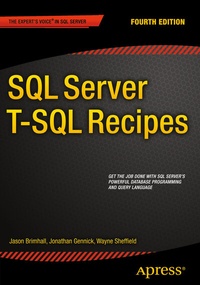
SQL Server T-SQL Recipes
Description

SQL Server T-SQL Recipes is an example-based guide to the Transact-SQL language that is at the core of SQL Server. This edition has been lightly updated for SQL Server 2014 and provides ready-to-implement solutions to common programming and database administration tasks. Learn to create databases, create in-memory tables and stored procedures, insert and update data, generate reports, secure your data, and more. Tasks and their solutions are broken down into a problem/solution format that is quick and easy to read so that you can get the job done fast when the pressure is on.
Solutions in this book are divided into chapters by problem domain. Each chapter is a collection of solutions around a single facet of the language such as writing queries, managing indexes, error handling, and query performance. Each solution is presented code-first, giving you a working code example to copy from and implement immediately in your own environment. Following each example is an in-depth description of how and why the given solution works. Tradeoffs and alternative approaches are also discussed.
- Focused on solutions: Look up what you need to do. Learn how to do it. Do it.
- Current: Lightly updated for SQL Server 2014
- Comprehensive: Covers all common T-SQL problem domains
More details
Other editions
Additional editions
Persons
Content
1. Getting Started with SELECT
2. Elementary Programming
3. Working with NULLS
4. Combining Data from Multiple Tables
5. Aggregations and Grouping
6. Advanced SELECT Techniques
7. Windowing
8. Inserting, Updating, Deleting
9. Working with Strings
10. Working with Dates
11. Working with Numbers
12. Transactions, Locking, Blocking, Deadlockin
13. Managing Tables
14. Managing Views
15. Managing Indexes
16. Managing Large Tables
17. Stored Procedures
18. User-Defined Functions
19. In-Memory T-SQL
20. Triggers
21. Error Handling
22. Query Performance
23. Hints
24. Index Tuning and Statistics
25. XML
26. Files, Filegroups, and Integrity
27. Backup
28. Recovery
29. Principals and Users
30. Securables and Permissions
31. Objects and Dependencies
