

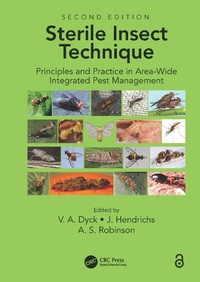
Sterile Insect Technique
Principles And Practice In Area-Wide Integrated Pest Management
2nd Edition
Published on 5. January 2021
1216 pages
978-1-000-37776-7 (ISBN)
Description

The sterile insect technique (SIT) is an environment-friendly method of pest control that integrates well into area-wide integrated pest management (AW-IPM) programmes. This book takes a generic, thematic, comprehensive, and global approach in describing the principles and practice of the SIT. The strengths and weaknesses, and successes and failures, of the SIT are evaluated openly and fairly from a scientific perspective. The SIT is applicable to some major pests of plant-, animal-, and human-health importance, and criteria are provided to guide in the selection of pests appropriate for the SIT. In the second edition, all aspects of the SIT have been updated and the content considerably expanded. A great variety of subjects is covered, from the history of the SIT to improved prospects for its future application. The major chapters discuss the principles and technical components of applying sterile insects. The four main strategic options in using the SIT - suppression, containment, prevention, and eradication - with examples of each option are described in detail. Other chapters deal with supportive technologies, economic, environmental, and management considerations, and the socio-economic impact of AW-IPM programmes that integrate the SIT. In addition, this second edition includes six new chapters covering the latest developments in the technology: managing pathogens in insect mass-rearing, using symbionts and modern molecular technologies in support of the SIT, applying post-factory nutritional, hormonal, and semiochemical treatments, applying the SIT to eradicate outbreaks of invasive pests, and using the SIT against mosquito vectors of disease. This book will be useful reading for students in animal-, human-, and plant-health courses. The in-depth reviews of all aspects of the SIT and its integration into AW-IPM programmes, complete with extensive lists of scientific references, will be of great value to researchers, teachers, animal-, human-, and plant-health practitioners, and policy makers.
More details
Edition
2nd edition
Language
English
Place of publication
London
United Kingdom
Publishing group
Taylor & Francis Ltd
Target group
Professional and scholarly
Illustrations
52 Tables, black and white; 22 Line drawings, color; 71 Line drawings, black and white; 39 Halftones, color; 1 Halftones, black and white; 61 Illustrations, color; 72 Illustrations, black and white
File size
28,05 MB
ISBN-13
978-1-000-37776-7 (9781000377767)
Copyright in bibliographic data and cover images is held by Nielsen Book Services Limited or by the publishers or by their respective licensors: all rights reserved.
Schweitzer Classification
Other editions
Additional editions
Victor A. Dyck | Jorge Hendrichs | A.S. Robinson
Sterile Insect Technique
Principles And Practice In Area-Wide Integrated Pest Management
Book
04/2021
2nd Edition
CRC Press
€235.44
Article not available at the moment
Persons
Victor A. Dyck, Jorge Hendrichs, A.S. Robinson
Content
PART I. INTRODUCTION . History Of The Sterile Insect Technique. Misconceptions And Constraints Driving Opportunities. PART II. PRINCIPLES OF THE STERILE INSECT TECHNIQUE. Area-Wide Integrated Pest Management And The Sterile Insect Technique. Biological Basis Of The Sterile Insect Technique. Genetic Basis Of The Sterile Insect Technique. Inherited Sterility In Insects. Mathematical Models For Using Sterile Insects. PART III. TECHNICAL COMPONENTS OF THE STERILE INSECT TECHNIQUE. Role Of Population And Behavioural Ecology In The Sterile Insect Technique. Mass-Rearing For The Sterile Insect Technique. Managing Pathogens In Insect Massrearing For The Sterile Insect Technique, With The Tsetse Fly Salivary Gland Hypertrophy Virus As An Example. Sterilizing Insects With Ionizing Radiation. Sterile Insect Quality Control/Assurance. Supply, Emergence, And Release Of Sterile Insects. Monitoring Sterile And Wild Insects In Area-Wide Integrated Pest Management Programmes. PART IV. SUPPORTIVE TECHNOLOGIES TO IMPROVE THE STERILE INSECT TECHNIQUE. Role Of Population Genetics In The Sterile Insect Technique. Population Suppression In Support Of The Sterile Insect Technique. Practical And Operational Genetic Sexing Systems Based On Classical Genetic Approaches In Fruit Flies, An Example For Other Species Amenable To Large-Scale Rearing For The Sterile Insect Technique. Insect Symbiosis In Support Of The Sterile Insect Technique. Improving Post-Factory Performance Of Sterile Male Fruit Flies In Support Of The Sterile Insect Technique. Applying Modern Molecular Technologies In Support Of The Sterile Insect Technique. Using Geographic Information Systems And Spatial Modelling In Area-Wide Integrated Pest Management Programmes That Integrate The Sterile Insect Technique. PART V. ECONOMIC, ENVIRONMENTAL, AND MANAGEMENT CONSIDERATIONS. Design And Economic Evaluation Of Programmes Integrating The Sterile Insect Technique. Environment And The Sterile Insect Technique. Management Of Area-Wide Pest Management Programmes That Integrate The Sterile Insect Technique. Communication And Stakeholder Engagement In Area-Wide Pest Management Programmes That Integrate The Sterile Insect Technique. PART VI. APPLICATION OF THE STERILE INSECT TECHNIQUE. Strategic Options In Using Sterile Insects For Area-Wide Integrated Pest Management. Invasive Insect Pests: Challenges And The. Role Of The Sterile Insect Technique In Their Prevention, Containment, And Eradication. Procedures For Declaring Pest Free Status. PART VII. IMPACT OF AREA-WIDE PEST MANAGEMENT PROGRAMMES THAT INTEGRATE THE STERILE INSECT TECHNIQUE. Impact Of Screwworm Eradication Programmes Using The Sterile Insect Technique. Impact Of Fruit Fly Control Programmes Using The Sterile Insect Technique. Impact Of Moth Suppression/Eradication Programmes Using The Sterile Insect Technique Or Inherited Sterility. Impact Of Tsetse Fly Eradication Programmes Using The Sterile Insect Technique. Potential Impact Of Integrating The Sterile Insect Technique Into The Fight Against Disease-Transmitting Mosquitoes.Prospects For The Future Development And Application Of The Sterile Insect Technique
