

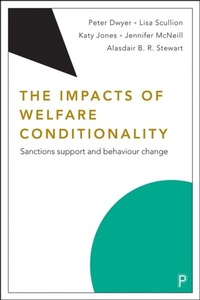
The Impacts of Welfare Conditionality
Sanctions Support and Behaviour Change
1st Edition
Published on 22. November 2022
218 pages
978-1-4473-4372-1 (ISBN)
Description

Should a citizen's right to social welfare be contingent on their personal behaviour?
Welfare conditionality, linking citizens' eligibility for social benefits and services to prescribed compulsory responsibilities or behaviours, has become a key component of welfare reform in many nations.
This book uses qualitative longitudinal data, from repeat interviews with people subject to compulsion and sanction in their everyday lives, to analyse the effectiveness and ethicality of welfare conditionality in promoting and sustaining behaviour change in the UK.
Given the negative outcomes that welfare conditionality routinely triggers, this book calls for the abandonment of these sanctions and reiterates the importance of genuinely supportive policies that promote social security and wider equality.
Welfare conditionality, linking citizens' eligibility for social benefits and services to prescribed compulsory responsibilities or behaviours, has become a key component of welfare reform in many nations.
This book uses qualitative longitudinal data, from repeat interviews with people subject to compulsion and sanction in their everyday lives, to analyse the effectiveness and ethicality of welfare conditionality in promoting and sustaining behaviour change in the UK.
Given the negative outcomes that welfare conditionality routinely triggers, this book calls for the abandonment of these sanctions and reiterates the importance of genuinely supportive policies that promote social security and wider equality.
More details
Series
Edition
First Edition
Language
English
Place of publication
Bristol
United Kingdom
Publishing group
Bristol University Press
Target group
Professional and scholarly
Illustrations
2 s/w Abbildungen, 5 s/w Tabellen, 23 s/w Zeichnungen
23 Line drawings, black and white; 5 Tables, black and white; 2 Illustrations, black and white
ISBN-13
978-1-4473-4372-1 (9781447343721)
DOI
https://doi.org/10.51952/9781447343721
Copyright in bibliographic data and cover images is held by Nielsen Book Services Limited or by the publishers or by their respective licensors: all rights reserved.
Schweitzer Classification
Other editions
Additional editions
Simone Baglioni | Stephen Sinclair
The Impacts of Welfare Conditionality
Sanctions Support and Behaviour Change
Book
11/2022
1st Edition
Policy Press
€137.50
Shipment within 15-20 days
Peter Dwyer | Lisa Scullion | Katy Jones
The Impacts of Welfare Conditionality
Sanctions Support and Behaviour Change
E-Book
11/2022
1st Edition
Policy Press
€44.99
Available for download
Peter Dwyer | Lisa Scullion | Katy Jones
The Impacts of Welfare Conditionality
Sanctions Support and Behaviour Change
Book
11/2022
1st Edition
Policy Press
€43.00
Shipment within 15-20 days
Persons
Peter Dwyer is Emeritus Professor of Social Policy at the University of York. His research and teaching focuses on social citizenship. He led the large ESRC funded Welfare Conditionality: Sanctions Support and Behaviour Change (2013-2019) project.
Lisa Scullion is Professor of Social Policy and Co-Director in the Sustainable Housing and Urban Studies Unit at the University of Salford.
Katy Jones is Research Fellow in the Centre for Decent Work and Productivity at Manchester Metropolitan University.
Jenny McNeill is Project Manager at Groundswell, and previously worked at the University of Sheffield and University of York on the Welfare Conditionality project.
Alasdair B. R. Stewart is Lecturer in Social and Public Policy in the School of Social and Political Sciences at the University of Glasgow.
Lisa Scullion is Professor of Social Policy and Co-Director in the Sustainable Housing and Urban Studies Unit at the University of Salford.
Katy Jones is Research Fellow in the Centre for Decent Work and Productivity at Manchester Metropolitan University.
Jenny McNeill is Project Manager at Groundswell, and previously worked at the University of Sheffield and University of York on the Welfare Conditionality project.
Alasdair B. R. Stewart is Lecturer in Social and Public Policy in the School of Social and Political Sciences at the University of Glasgow.
Content
1. Introduction
2. Conditionality in the UK Welfare State
3. Welfare Conditionality and Behaviour Change
4. From Welfare to Work? The Effectiveness of Welfare Conditionality in Moving People into Paid Employment
5. Welfare Conditionality and Problematic or Antisocial Behaviour
6. Unintended Outcomes? The Wider Impacts of Compulsion and Benefit Sanctions in Social Security
7. Ethical Debates
8. Conclusions
2. Conditionality in the UK Welfare State
3. Welfare Conditionality and Behaviour Change
4. From Welfare to Work? The Effectiveness of Welfare Conditionality in Moving People into Paid Employment
5. Welfare Conditionality and Problematic or Antisocial Behaviour
6. Unintended Outcomes? The Wider Impacts of Compulsion and Benefit Sanctions in Social Security
7. Ethical Debates
8. Conclusions
