

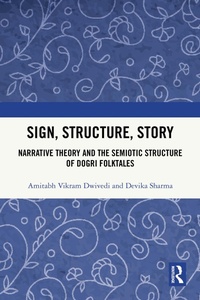
Sign, Structure, Story
Narrative Theory and the Semiotic Structure of Dogri Folktales
Will be published approx. on 26. June 2026
290 pages
978-1-040-94528-5 (ISBN)
Description

This comprehensive volume offers a framework for understanding the descriptive and prescriptive functions of oral narratives. Drawing upon narratological theory and linguistic analysis, it traces the evolution of folktales across generations, showcasing how they adapt to changing societal contexts while maintaining their core functions.
The book investigates the intersections of language, culture, and narrative, offering a rich, cross-disciplinary perspective that highlights the enduring relevance of oral traditions in constructing and preserving ethnic identity. It examines how narrative forms contribute to the continuity of cultural memory, linguistic diversity, and social cohesion. Exploring the narratological and linguistic structures of Dogri folktales, this study illuminates a crucial facet of the cultural heritage of the Dogra community in Jammu and Kashmir. Folktales are presented not merely as entertainment but as powerful tools of cultural transmission, embodying deeply rooted moral, social, and philosophical values.
This book will be of great interest to students, researchers, and educators in the fields of linguistics, folklore studies, cultural anthropology, literature, and South Asian studies. It will also serve as a valuable resource for policymakers, cultural preservationists, and general readers.
The book investigates the intersections of language, culture, and narrative, offering a rich, cross-disciplinary perspective that highlights the enduring relevance of oral traditions in constructing and preserving ethnic identity. It examines how narrative forms contribute to the continuity of cultural memory, linguistic diversity, and social cohesion. Exploring the narratological and linguistic structures of Dogri folktales, this study illuminates a crucial facet of the cultural heritage of the Dogra community in Jammu and Kashmir. Folktales are presented not merely as entertainment but as powerful tools of cultural transmission, embodying deeply rooted moral, social, and philosophical values.
This book will be of great interest to students, researchers, and educators in the fields of linguistics, folklore studies, cultural anthropology, literature, and South Asian studies. It will also serve as a valuable resource for policymakers, cultural preservationists, and general readers.
More details
Language
English
Place of publication
London
United Kingdom
Publishing group
Taylor & Francis Ltd
Target group
College/higher education
Product notice
Reflowable
Illustrations
14 Tables, black and white; 22 Line drawings, black and white; 23 Halftones, black and white; 45 Illustrations, black and white
File size
24,22 MB
ISBN-13
978-1-040-94528-5 (9781040945285)
Copyright in bibliographic data and cover images is held by Nielsen Book Services Limited or by the publishers or by their respective licensors: all rights reserved.
Schweitzer Classification
Other editions
Additional editions
Amitabh Vikram Dwivedi | Devika Sharma
Sign, Structure, Story
Narrative Theory and the Semiotic Structure of Dogri Folktales
Book
approx. 06/2026
1st Edition
Routledge
€191.50
Not yet published
Persons
Amitabh Vikram Dwivedi teaches at Shri Mata Vaishno Devi University, India. His research focuses on linguistics, language documentation, and the preservation of endangered South Asian languages and cultures.
Devika Sharma works in narratology, linguistics, regional literature, and folklore studies. She has written as a freelance contributor for national newspapers, and her research has appeared in reputed journals. She continues to pursue interdisciplinary work across literature, language, and culture.
Devika Sharma works in narratology, linguistics, regional literature, and folklore studies. She has written as a freelance contributor for national newspapers, and her research has appeared in reputed journals. She continues to pursue interdisciplinary work across literature, language, and culture.
Content
Transcription and Transliteration Conventions 1. Introduction: Dogri Folktales as Living Narratives 2. Fieldwork, Translation, and Narrative Analysis of Dogri Folktales 3. Structural Patterns in Dogri Folktales and Other Narrative Traditions 4. A Taxonomy of Dogri Folktales 5. Discourse and Cohesion in Dogri Folktales 6. Corpus-based Analysis of Linguistic Features in Dogri Folktales 7. Dogri Folktales as Moral and Civic Curriculum 8. Conclusion: From Archive to Advocacy Appendices
