

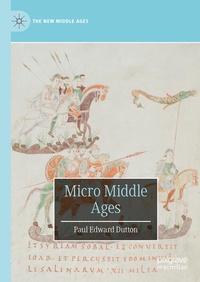
Micro Middle Ages
Description

Micro Middle Ages brings together five microhistorical case studies focusing on small or seemingly inconsequential evidence that leads to broader conclusions about medieval history and the way we do and understand history in general. Paul Dutton provides an overview of microhistorical approaches and theorizes about its use in pre-modern history. As opposed to studying history "from above" or history "from below," Dutton shows the advantages for historians of doing history "from the inside out," starting from some single, overlooked, but potentially knowable thing, delving deep inside, and then reattaching it to its time and place. Such an approach has one abiding advantage: its insistence on being grounded in the particularity of the evidence. The book highlights what the microhistorical is, its conceptual and practical challenges. Dutton argues that the attention to the micro has always been with us and is a constitutive, cognitive part of who we are as human beings.
Reviews / Votes
"Micro Middle Ages is an important and timely book, one that refreshes and enhances the traditional historiography on microhistory. ... The book works well as a whole to prompt its reader to think about how we choose to approach the medieval past. Each of its five core constituent chapters may, moreover, be read on their own merits or collectively." (Steven Bednarski, The Medieval Review, scholarworks.iu.edu, November 6, 2025)
More details
Other editions
Additional editions
Person
Paul Edward Dutton
is Emeritus Professor at Simon Fraser University, Canada. He is a Fellow of the Royal Society of Canada, Fellow of the Medieval Academy of America, a former president of the Canadian Society of Medievalists and councillor of the Medieval Academy of America, and author of eight books, monographs, editions and translations of medieval materials.
Content
1. Preamble.- 2. an Incident : The Strange Case of the Green Children.- 3. a Name : Heloise, Philosophess and Prostitute.- 4. a Scene : Slipping below the Surface of the Bayeux Tapestry.- 5. Meandering through Microhistory.- 6. a Sentence : The Desert War of a Carolingian Monk.- 7. a Joke : The Tiny Revolution of Theodulf's 'Stolen Horse'.- 8. a Color : Alcuin and the Bloody Rain.- 9. Ambles End in Tears.
